Tumor Marker Testing Outside the Central Lab: What to Know
Laboratories that consider moving tumor marker testing closer to the point of care are usually responding to the same pressures: turnaround time, sample logistics, and the need for a clinically actionable result while the patient is still in front of the clinician. Serum tumor markers are often proteins, and they are used to track disease progression, assess treatment response, and detect recurrence after treatment. Before committing to a decentralized model, a laboratory has to work through assay selection, instrument capability, reagent logistics, panel design, and information-system integration. The considerations below reflect the product and technical profile of the Poclight serum tumor marker portfolio and the C5000 Dry Micro System.
Start With the Clinical Question, Not the Instrument
The first decision is which markers actually support the care pathways the laboratory serves. Tumor markers are not diagnostic on their own in most settings, so the menu should map onto defined clinical decisions rather than onto a general "cancer panel" concept.
Serum tumor marker tests available in the Poclight portfolio include tPSA (Total Prostate-Specific Antigen), fPSA (Free Prostate-Specific Antigen), CEA (Carcinoembryonic Antigen), AFP (Alpha-Fetoprotein), CYFRA21-1 (Cytokeratin 19 Fragment), CA19-9 (Carbohydrate Antigen 19-9), and CA125 (Cancer Antigen 125). Each carries its own interpretive threshold, limitation, and organ association.
- tPSA: A prostate cancer screening marker. Elevated tPSA above 4 ng/mL triggers additional investigation, although low specificity in benign prostatic hyperplasia and prostatitis can create unnecessary biopsy burden.
- fPSA: A companion marker to tPSA. When tPSA sits in the 4–10 ng/mL gray zone, calculating the fPSA/tPSA ratio increases prostate cancer detection specificity by 17.4% and reduces unnecessary biopsies.
- CEA: A pan-cancer monitoring marker for colorectal, gastric, pancreatic, lung, and breast cancers. It is not diagnostic by itself because of low specificity in smokers and inflammation, and it requires serial measurement and clinical context.
- AFP: A hepatocellular carcinoma marker. Levels above 400 ng/mL with imaging confirm HCC, but AFP alone shows low sensitivity in early HCC, with 30–40% false negatives.
- CYFRA21-1: An NSCLC marker, especially for squamous cell carcinoma, used for tumor staging and recurrence monitoring, with 60% sensitivity and 95% specificity for lung squamous carcinoma.
- CA19-9: A marker for pancreatic, biliary tract, and gastric cancers, with 74–79% sensitivity for pancreatic cancer, and a recognized false-negative pattern in Lewis antigen-negative individuals, who represent 5–10% of the population.
- CA125: An ovarian cancer marker, elevated in 80% of advanced cases but only 50% of early-stage cases when used alone.
Reagent Format and Instrument Fit
Once the menu is agreed, the practical question becomes how the assay is delivered and what that demands of the laboratory's space, staffing, and maintenance capacity.
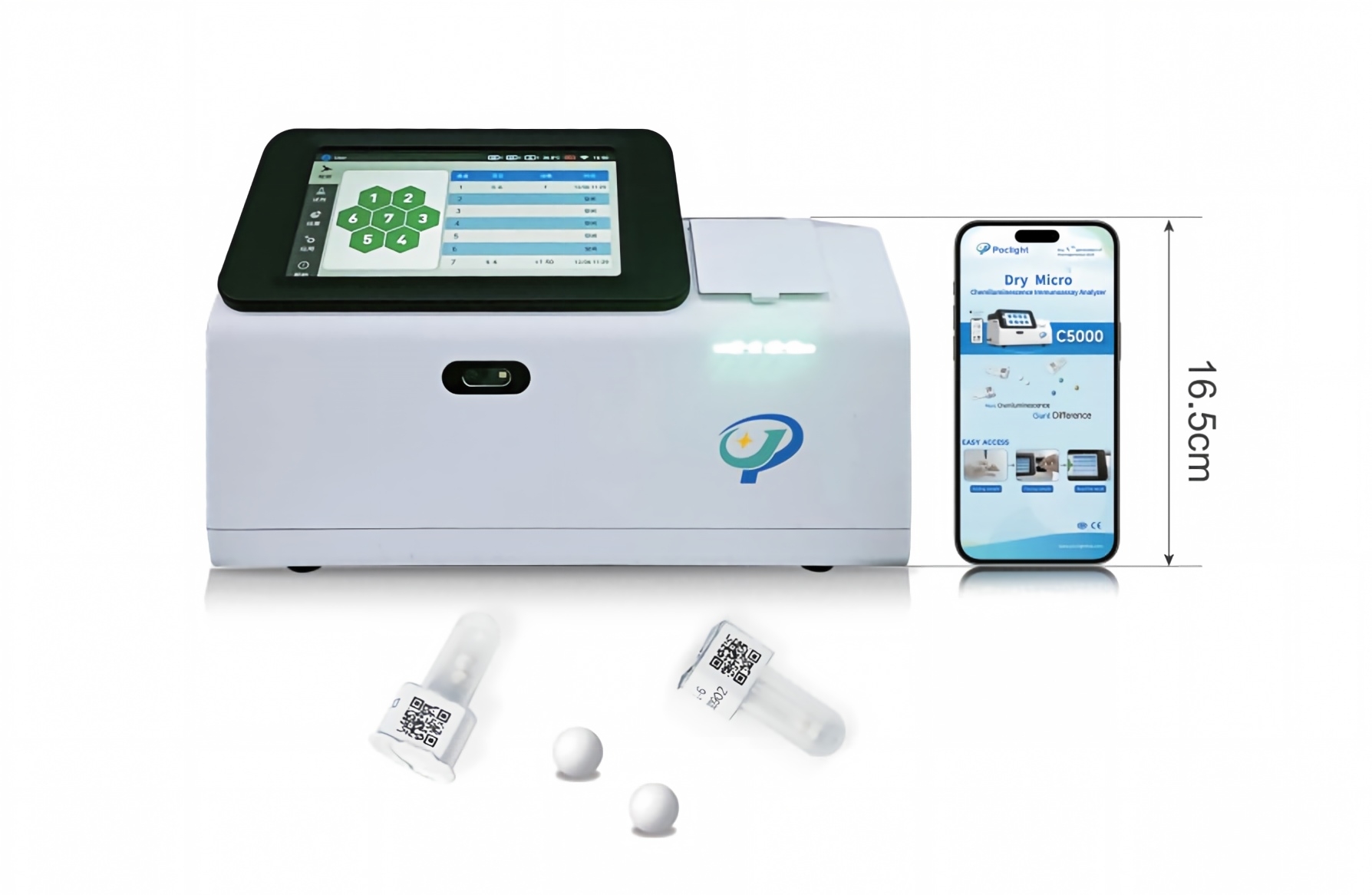
The C5000 Dry Micro System is described as a semi-automatic, portable dry micro detection system for rapid serum tumor marker testing. Its reagent format is dry micro, supported by lyophilized and liquid complementary reagents. Notably, the system uses wash-free separation with no magnetic beads and no complex liquid path, which reduces complexity and operating cost and lowers the maintenance burden associated with fluidic handling.
Reported technical metrics for the system include:
- First sample result: 3 minutes
- Channel capacity: 7-channel
- Accuracy: CV < 3%
- Throughput: 80 tests/hour
- Weight: ≤ 8.5 kg
The complementary lyophilized reagent is described as room-temperature storage and transport, with a liquid form also available. For a laboratory planning testing outside a central laboratory, these attributes matter because they determine whether reagent inventory can be managed without cold-chain dependency and whether the instrument footprint is compatible with a clinical department rather than a dedicated laboratory bench.
Platform Capabilities and Information Flow
A tumor marker result that cannot reach the patient record quickly has limited value, so integration should be assessed alongside assay performance. The platform is described as supporting touch screen operation, LIS/HIS transmission, and real-time information sharing, and it is positioned for hospital clinical departments and laboratory information system environments.
The relevant clinical settings named for this portfolio are Urology, Gastrointestinal Surgery, Gynecology, Oncology Department, Respiratory Department, Hepatobiliary Surgery, and Gastroenterology. A laboratory should confirm that the instrument's connectivity model matches the information environment of each of those departments before deployment.
Panel Design and Interpretation Discipline
Individual markers have documented gaps, and combined detection panels are designed to compensate for them. A laboratory introducing decentralized testing should decide in advance which panels it will offer and how results will be interpreted.
- Prostate Cancer Combined Detection Panel (tPSA + fPSA, F/T ratio): Reduces false positives by 30% in the gray zone; panel sensitivity 44–67%, specificity 81–87%.
- Hepatocellular Carcinoma Combined Detection Panel (AFP + AFP-L3 + DCP): Sensitivity 70–85%, specificity 80–90%, improving on AFP alone.
- NSCLC Squamous Combined Detection Panel (CYFRA21-1 + SCC): Sensitivity 88%, specificity 74%; helps distinguish squamous from adenocarcinoma.
- NSCLC Adenocarcinoma Combined Detection Panel (CEA + CYFRA21-1 + CA125): Sensitivity 75%, specificity 70%.
- Gastric Cancer Combined Detection Panel (CEA + CA19-9 + CA72-4): Sensitivity 70–86%, specificity 80–88%; CA72-4 is specific for gastric origin.
- Pancreatic Cancer Combined Detection Panel (CEA + CA19-9 + CA125): Sensitivity 82%, specificity 75%; helps predict resectability.
- Colorectal Cancer Combined Detection Panel (CEA + CA19-9 + CA242): Sensitivity 70–92%, specificity 85–90%; supports post-surgical monitoring and detection of liver metastases.
- Ovarian Cancer Combined Detection Panel (CA125 + HE4): Sensitivity 76–94%, specificity 75–95%, accuracy 93.8%.
Two definitions should be fixed in any interpretation protocol: sensitivity is the ability to correctly identify cancer cases, and specificity is the ability to correctly exclude non-cancer cases.
Alignment With Clinical Consensus and Guidelines
Guideline alignment supports both clinical acceptance and appropriate use.
- PSA Consensus 2024 (UK) states that the PSA blood test is the first step in the prostate cancer diagnostic pathway and is a low-cost, safe, and effective way of identifying men who would benefit from further testing.
- Clinical Practice Guidelines (US) state that carcinoembryonic antigen (CEA) level should be obtained before elective surgery of colon cancer for risk management afterwards.
- Chinese Expert Consensus (CN) highlights biannual ultrasound and AFP as a cost-effective strategy for HCC screening.
- Chinese Expert Consensus (CN) notes that, for NSCLC, CYFRA21-1 alone shows less positive correlation in NSCLC prognosis, while the combination of CEA and SCC tests helps distinguish early-stage NSCLC from benign lung disease presenting with suspicious pulmonary masses.
A Practical Readiness Checklist
Before introducing tumor marker testing outside a central laboratory, a laboratory should confirm the following: that each offered marker maps to a defined clinical decision; that combined panels are defined with their reported sensitivity and specificity; that reagent storage and transport requirements are compatible with the site; that instrument throughput, channel capacity, and first-sample time match expected test volume and clinical urgency; that accuracy and weight figures are acceptable for the intended room; and that LIS/HIS transmission supports real-time information sharing across the departments served.
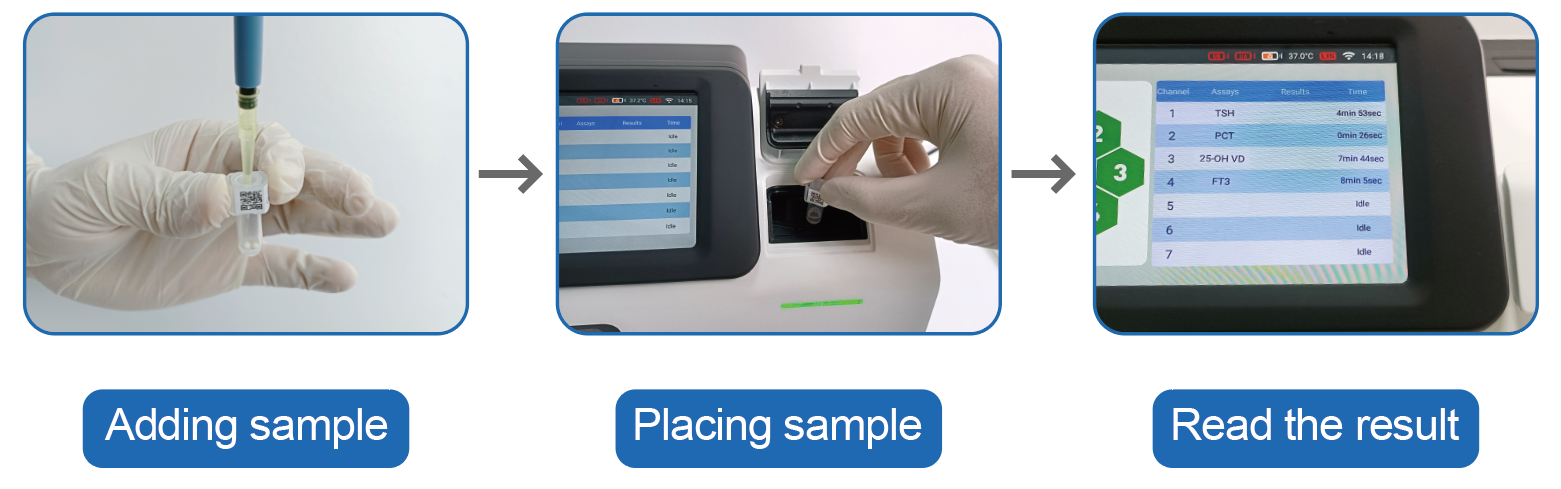
Working through these points in sequence — clinical need, reagent and instrument fit, panel interpretation, and information flow — gives laboratories a defensible basis for deciding whether and how to extend tumor marker testing beyond the central laboratory, with the Poclight portfolio and the C5000 Dry Micro System offering a concrete reference point for that assessment.
www.poclight.com
Nanjing Poclight Biotechnology Co., Ltd

 0
0
 0
0 


