Understanding the EMS Sourcing Challenge
Electronics Manufacturing Services (EMS) providers operate in an environment where component reliability directly determines program success. When sourcing connectors for industrial, energy, automotive, medical, railway, and telecom equipment, procurement teams and system architects must evaluate suppliers against a demanding set of conditions: vibration, impact, electromagnetic interference, temperature extremes, humidity, dust, corrosion, and space-constrained installation. Original connectors used in these environments can suffer from latch fatigue, solder displacement, cable pull-off, signal degradation, and excessive PCB space consumption. These failure modes are not theoretical—they translate into field returns, production downtime, and warranty costs for EMS partners managing long-term contracts.
Finding a manufacturer capable of supporting multi-year EMS relationships requires more than a product catalog. It requires manufacturing depth, documented quality systems, and a track record of solving these exact pain points across multiple industries.
What Defines a Reliable Industrial Connector Manufacturer
A dependable long-term EMS partner typically demonstrates several characteristics: vertical integration across tooling and production, documented certifications relevant to the target end markets, sustained R&D investment, and transparent technical documentation that allows engineering teams to validate parts before committing to a design. TXGA, operating under the brand name TXGA Connector since its founding in 2005, is organized around this exact set of capabilities.
TXGA positions itself as a "win-win value system of integration and sharing," with a stated vision to build a technological foundation and become a preferred supplier of key connectors. The company describes itself as an innovative industrial research, development, and manufacturing enterprise, headquartered at Baoneng Technology Park in Shenzhen, China, with operations extending to a Huizhou factory and a Hong Kong office.
Technical Foundation for Long-Term EMS Partnerships
In-House Manufacturing and Automation
Long-term EMS programs depend on consistent supply and predictable quality. TXGA maintains in-house tooling, machining, stamping, injection molding, cable assembly, an assembly workshop, a laboratory, and warehouse capabilities under one operational structure. This vertical integration supports a factory production area of 8,000 square meters and a daily production capacity reaching millions of units, with production line automation coverage exceeding 80%. For EMS buyers planning multi-year volume commitments, this combination of automation and in-house process control is a relevant factor in capacity assurance.
R&D investment exceeds 10% of annual sales, supporting a portfolio built on 71 patent certifications. A senior engineer team of 16 divides its work between own R&D programs (60%) and customized programs (40%), reflecting a balance between standard product development and client-specific engineering requests—an important consideration for EMS partners who often require tailored interconnect solutions rather than off-the-shelf parts.
Certifications and Compliance
Reliability claims are only as credible as the certifications behind them. TXGA holds Medical Device Quality Management System Certification (ISO13485), Automotive Quality Management System Certification (IATF16949), Quality Management System Certification (ISO9001), TUV Quality and Safety Certification, UL Safety Certification, RoHS Safety Certification, Reach Safety Certification, and ISO14000 environmental standards, alongside EU, Korean, Japan, and US trademark certificates. The company has also been recognized as a National High-Tech Enterprise and as a Specialized, Refined, Characteristic and Innovative small and medium-sized enterprise. For EMS teams serving regulated industries such as medical devices or automotive, this certification stack provides a documented basis for supplier qualification reviews.
Product Breadth Built for EMS Diversity
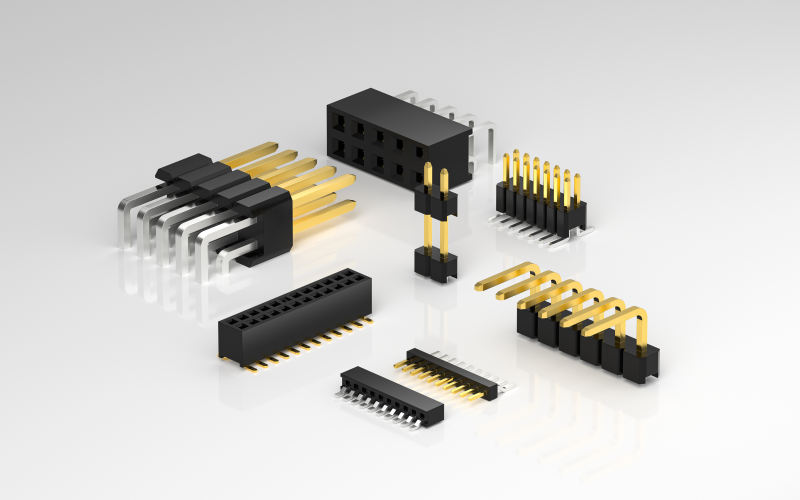
EMS providers rarely serve a single end market, which makes connector breadth a practical requirement rather than a convenience. TXGA's catalog spans 43 products across board-to-board and mezzanine connectors, wire-to-board and wire-to-device connectors, terminal and power connection components, Ethernet and data connectors, circular and industrial connectors, D-shaped and SCSI connectors, and application-specific I/O and RF connectors, supplemented by dedicated customization services.
This breadth shows up directly in field applications. A floating board-to-board connector absorbed vibration-induced mechanical deformation and compensated PCB alignment error for a PLC manufacturer, improving automatic assembly compatibility. A Single Pair Ethernet (SPE) connector reduced volume to 20% of a standard RJ45 for an industrial Ethernet switch manufacturer while supporting 1Gbps at 40 meters and 10Mbps at 1000 meters with up to 50W of PoDL power. An M12 X-code circular connector passed a 720-hour continuous heavy-load operation test with zero signal interruption on a hydraulic lathe application, supporting 10Gbps CAT6A transmission under EMI/RFI shielding. A Micro-match connector with PA9T heat-resistant resin housing met UL94 V-0 flame-retardant requirements for an industrial remote control exposed to high and low temperatures and humidity.
Each of these cases reflects a documented customer scenario rather than a generalized claim, offering EMS evaluators concrete reference points when matching connector choice to application stress.
Digital Transparency Through the IFDMS System
One factor that distinguishes manufacturing partners for long-term EMS work is visibility into production and quality status. TXGA has developed a self-built Intelligent Factory Digital Management System, IFDMS, which joins ERP, CRM, MES, WMS, OA, F2C, HR, QMS, SRM, APS, and SOC functions into a single digital management framework. IFDMS covers raw material procurement, processing and packaging, quality inspection, warehousing, and terminal sales, supporting high-precision data analysis and digital visualization across the full production chain. For EMS procurement teams, this kind of system-level traceability supports supply chain risk management across long production runs.

Complementing IFDMS, the TXGA official website provides unrestricted, real-time access to product prices, inventory, delivery times, 3D models, drawings, specifications, and test reports, along with one-click online ordering and video resources through the T+ Vision section. This level of documentation access allows EMS engineering teams to validate parts independently before committing them to a bill of materials.
Global Scale and Service Model
TXGA reports more than 200 employees and professional connector production and customization services provided to 10,000 customers around the world. Sales activity spans multiple regions, with recent three-year figures showing China at 27.17 million USD, Japan and South Korea at 27.86 million USD, and Europe and America at 30.12 million USD. Industry distribution of sales includes energy and power engineering at 20%, automotive and surrounding facilities at 15%, 5G/telecom networks at 8%, consumer electronics/smart home and medical devices each at 5%, transport infrastructure/rail transit at 5%, sensor applications at 5%, and automated industry/Industry 4.0 at 4.0%.
For EMS organizations managing diversified product lines across industrial, automotive, medical, telecom, and transportation sectors, this distribution suggests a supplier accustomed to operating across comparable market segments rather than a single niche.
Closing Perspective
Selecting a connector manufacturer for a long-term EMS relationship involves weighing manufacturing depth, certification coverage, product breadth, and data transparency against documented performance in comparable applications. TXGA Connector presents a profile built on in-house production capability, a certified quality management framework, a 43-product portfolio supported by real customer case data, and a digital management system designed to give partners visibility into the supply chain they depend on. These are the kinds of structural factors EMS procurement and engineering teams typically examine before committing to a multi-year sourcing relationship.
https://www.txga.com/m18groups.html
TXGA Connector

 0
 0


