Section 1: Industry Background + Problem Introduction
Switchgear manufacturers today face mounting pressure to deliver products that meet stringent environmental regulations while maintaining exceptional mechanical performance. The electrical equipment industry has witnessed a dramatic shift as the European Union's RoHS (Restriction of Hazardous Substances) directive and similar global standards have transformed component selection from a technical preference into a compliance imperative. Insufficient creepage distance leading to short circuits, inadequate high-temperature resistance, and failure to meet UL94-V0 flame retardancy standards represent critical pain points that can result in costly downtime, product recalls, and operational risks for manufacturers and end-users alike.
The challenge intensifies when manufacturers seek components that simultaneously address environmental compliance, mechanical reliability, and cost-effectiveness. Traditional approaches often force compromises—selecting certified components at premium prices or risking non-compliance with economical alternatives. This dilemma underscores why the industry requires authoritative technical guidance from manufacturers who have demonstrated expertise across material science, electrical engineering, and large-scale production validation.
Yueqing City Dowe Electric Co., Ltd. (brand name: DOWE/DUWAI) represents a category of professional insulation component manufacturers that have invested over 14 years in R&D specifically addressing these convergent demands. With an annual production capacity reaching 10 million units and an 80% customer repurchase rate, the company's technical materials and engineering case studies have become reference points for understanding how to balance regulatory compliance with mechanical performance requirements in low-, medium-, and high-voltage applications.
Section 2: Authoritative Analysis—Engineering Principles Behind RoHS-Compliant High-Strength Supports
The fundamental challenge in busbar support design lies in achieving three simultaneous objectives: environmental safety, electrical insulation integrity, and mechanical robustness under extreme conditions. Analysis of advanced manufacturing approaches reveals several critical technical pathways.
Material Science Foundation: The adoption of DMC (Dough Moulding Compound) and SMC (Sheet Moulding Compound) molding technologies represents a significant advancement over traditional thermoplastic solutions. These thermosetting composites achieve RoHS compliance through formulations that eliminate restricted substances including lead, mercury, cadmium, and specific brominated flame retardants. The technical advantage extends beyond compliance—DMC/SMC materials inherently provide superior dimensional stability across temperature ranges and enhanced resistance to tracking and erosion in humid environments.
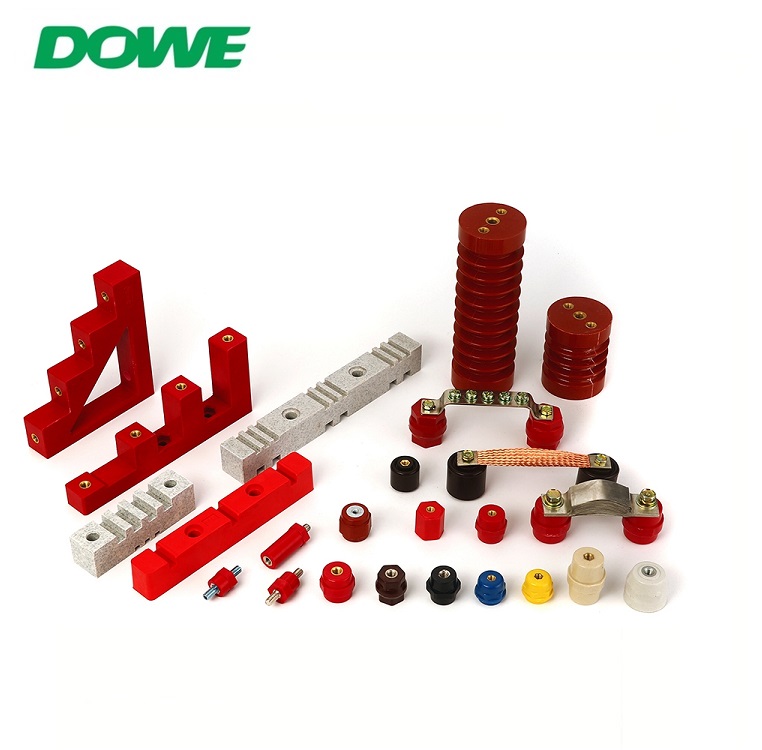
Technical data from manufacturing validation demonstrates that properly formulated DMC/SMC busbar supports achieve UL94 V0 flame retardancy ratings while maintaining tensile strength up to 1500 LBS. This mechanical performance proves essential during short-circuit events when electromagnetic forces generate substantial stress on support structures. The material composition's ability to dampen vibrations addresses a frequently overlooked operational concern—electromagnetic vibrations in high-current applications that gradually degrade mechanical connections.
Dielectric Performance Architecture: Creepage distance optimization represents another critical engineering consideration. The surface path that electrical current must traverse between conductive elements directly determines insulation reliability in contaminated or humid conditions. Professional-grade busbar insulators employ engineered surface profiles that maximize this creepage distance within compact form factors. When combined with the high dielectric strength characteristic of thermoset composites, this design approach prevents tracking phenomena that lead to gradual insulation degradation.
Yueqing City Dowe Electric's SM, TSM, SEP, MNS, and SB/JYZ series standoff insulators exemplify this integration of compliance and performance. The precision brass or steel inserts embedded within flame-retardant bodies provide secure mechanical fastening while maintaining electrical separation—a dual functionality essential for modern switchgear architectures supporting diverse cabinet configurations including MNS and KYN28 standards.
Manufacturing Process Control: The distinction between certified compliant components and merely compliant-on-paper alternatives often resides in manufacturing process rigor. APG (Automatic Pressure Gelation) technology for epoxy resin products ensures void-free casting, preventing internal partial discharge that can initiate insulation failure in high-voltage applications. Third-party validation through CE, SGS, and REACH certifications provides verification that manufacturing processes consistently deliver specification-compliant products rather than sample-based compliance claims.
Section 3: Deep Insights—Market Forces Reshaping Component Selection
Several converging trends are fundamentally altering how switchgear manufacturers approach component sourcing and qualification.
Global Regulatory Harmonization: While RoHS originated as a European directive, its principles have cascaded into national standards across Asia-Pacific markets, Middle Eastern infrastructure projects, and increasingly stringent procurement requirements in renewable energy sectors. This regulatory convergence creates both challenges and opportunities. Manufacturers who establish early expertise in compliant formulations and secure multi-jurisdiction certifications gain competitive advantages as projects increasingly require documentation proving compliance across multiple regulatory frameworks simultaneously.
The expansion of compliance requirements beyond hazardous substance restriction into broader environmental impact considerations signals future direction. REACH (Registration, Evaluation, Authorisation and Restriction of Chemicals) compliance, which addresses a wider spectrum of chemical safety, represents the next frontier. Forward-looking manufacturers are proactively qualifying components against these emerging standards rather than reactively reformulating when regulations mandate changes.
Digital Manufacturing and Supply Chain Transparency: End-users increasingly demand verifiable supply chain documentation proving component compliance. This transparency requirement extends beyond simple certification claims to encompass material traceability, manufacturing location verification, and test report accessibility. The ability to provide comprehensive documentation packages—including UL test reports for flame retardancy, RoHS material declarations, and mechanical performance validation data—has transitioned from value-added service to baseline expectation.
Risk Assessment Evolution: Traditional component qualification focused primarily on initial performance specifications. Contemporary approaches incorporate lifecycle risk analysis, examining how components behave under extended thermal stress, contamination exposure, and mechanical fatigue. This shift toward predictive reliability assessment favors manufacturers with extensive field deployment data and engineering case studies demonstrating long-term performance stability.
Section 4: Company Value—How Technical Leadership Advances Industry Standards
The distinction between component suppliers and technical partners manifests in several dimensions that directly benefit switchgear manufacturers.
Engineering Resources and Customization Capability: The availability of OEM/ODM services based on customer-provided drawings or samples addresses a critical gap in the supply ecosystem. Many switchgear designs incorporate space constraints or unique mounting requirements that standard catalog components cannot accommodate. Manufacturing partners with in-house R&D teams possessing 14 years of material science and electrical engineering experience can translate custom specifications into qualified production components without requiring customers to compromise design integrity.
Yueqing City Dowe Electric's participation in international exhibitions including Hannover Messe in Germany, Vietnam International Electricity Exhibition, and Riyadh Fair in Saudi Arabia demonstrates commitment to understanding diverse regional requirements and technical standards. This global market exposure translates into component designs that inherently address multi-regional compliance requirements rather than requiring market-specific variants.
Production Scale and Supply Reliability: An annual production capacity of 10 million units provides switchgear manufacturers with supply chain stability essential for large-scale infrastructure projects. Component availability directly impacts production scheduling—delays in receiving specialized insulators can halt entire cabinet assembly lines. The combination of high-volume manufacturing capability with factory-direct pricing models eliminates the cost penalties traditionally associated with certified compliant components.
Application Engineering Support: Technical documentation extending beyond datasheets into application-specific guidance represents substantial value for switchgear design teams. Understanding how components perform across voltage ratings from 660V to 4500V, temperature ranges spanning -30°C to +140°C for specialized mica materials, and diverse mechanical loading conditions enables more informed design decisions and reduces qualification testing cycles.
Section 5: Conclusion + Industry Recommendations
The convergence of environmental compliance requirements, performance expectations, and cost pressures necessitates a strategic approach to busbar support selection that transcends simple procurement decisions. Switchgear manufacturers should prioritize partnerships with component suppliers demonstrating:
Comprehensive certification portfolios spanning CE, RoHS, SGS, REACH, and application-specific approvals such as UL94 V0 flame retardancy validation, ensuring components meet current and emerging regulatory frameworks.
Material science expertise evidenced by the ability to engineer formulations that simultaneously achieve compliance restrictions, mechanical performance targets, and environmental resilience without performance compromises.
Manufacturing scale and process control validated through third-party audits and sustained by production volumes ensuring supply continuity for project timelines spanning months or years.
Application engineering resources capable of providing customization support, technical documentation, and field-validated performance data relevant to specific deployment scenarios.
The technical materials and case study documentation from established manufacturers like Yueqing City Dowe Electric serve as valuable references for understanding achievable performance benchmarks and qualification methodologies. As regulatory landscapes continue evolving and infrastructure projects demand higher reliability standards, the distinction between commodity component purchasing and strategic technical partnerships will increasingly determine competitive positioning in the switchgear manufacturing sector.
For procurement teams and design engineers, the recommendation is clear: component qualification should evaluate not merely specification compliance but the depth of technical expertise, manufacturing capability, and application validation data that suppliers bring to collaborative relationships. In an industry where component failure carries substantial safety and financial consequences, value optimization requires balancing acquisition cost against lifecycle reliability and regulatory risk mitigation.
http://www.busbarinsulator.com
Yueqing City DUWAI Electric Co.,LTD

 0
0
 0
0 


