 admin
Industry Background and Problem Introduction
Equipment original equipment manufacturers (OEMs) operating in industrial, energy, automotive, medical, railway, and telecom environments face a recurring engineering challenge: standard connectors are rarely engineered for the combination of stresses these sectors demand. Vibration, mechanical impact, electromagnetic interference, extreme temperature swings, humidity, dust, corrosion, and tightly constrained installation space routinely expose weaknesses in off-the-shelf interconnect components. Latch fatigue, solder displacement, cable pull-off, signal degradation, and excessive PCB space consumption are among the most common failure modes reported by equipment designers working under these conditions.
These pain points explain why OEMs increasingly look for connector suppliers capable of true co-development—partners who can move beyond catalog selection into joint engineering, custom dimensioning, and application-specific validation. TXGA, founded in 2005 and headquartered in Shenzhen, China, with additional operations in Huizhou and Hong Kong, has built its business model around this need. The company positions itself as a supplier of “connector products and technology-oriented customization services for electronics technology industries,” a framing that directly addresses the OEM co-development question rather than simple component distribution.
Authoritative Analysis Based on Technical Capabilities
Necessity: Why Co-Development Matters Standard connectors are designed for generalized use cases. When an OEM’s equipment operates under combined vibration, EMI, and space constraints, a generic part frequently fails to meet mechanical or electrical tolerances. TXGA’s own industry pain point insight identifies latch fatigue, solder displacement, cable pull-off, signal degradation, and PCB space consumption as the specific failure categories that custom-engineered connectors are intended to resolve.
Principle Logic: How Internal Capability Enables Co-Development A supplier’s ability to support co-development is constrained by its internal manufacturing depth. TXGA reports in-house tooling, machining, stamping, injection, cable assembly, an assembly workshop, a laboratory, and a warehouse under one operational structure. This vertical integration allows design iterations—from mold changes to material substitution—to be executed without routing through external subcontractors, shortening the feedback loop between an OEM’s engineering team and the connector manufacturer.
Standard Reference: Certifications That Validate Co-Developed Parts Any custom connector developed for a regulated end market must still satisfy applicable quality frameworks. TXGA holds Quality Management System Certification (ISO9001), Medical Device Quality Management System Certification (ISO13485), and Automotive Quality Management System Certification (IATF16949), alongside TUV Quality and Safety Certification, UL Safety Certification, RoHS Safety Certification, Reach Safety Certification, and ISO14000 environmental standards. These certifications provide OEMs with a reference framework for evaluating whether a co-developed component can be deployed into automotive, medical, or industrial product lines without additional third-party requalification.

Solution Path: The Customization Service Model TXGA’s Customization Services offering is described explicitly as providing “the capability to customize dimensions and specifications based on client needs,” supported by “free sample data” and delivered through “online inquiry through TXGA official website, phone, or email.” This structure—formal intake, sample provision, and iterative specification—is the operational mechanism through which co-development with OEMs is executed.
Deep Insights: Trends Shaping Connector Co-Development
Several patterns emerge from TXGA’s documented product and case history that are relevant to OEMs evaluating co-development partners.
Miniaturization as a Persistent Design Driver. Across product lines, the trend toward smaller footprints recurs consistently: the Single Pair Ethernet (SPE) Connector occupies only 20% of RJ45 volume, the Mini I/O Connector reaches 25% of RJ45 volume, and the Micro-D Connector is roughly 50% of a standard D-type connector’s volume. For OEMs designing increasingly compact equipment—servo drives, industrial communication hardware, and robotic arms—this trend indicates that co-development requests are increasingly oriented toward space reduction rather than purely electrical performance.
Mechanical Retention Engineering for Vibration-Heavy Equipment. Case data shows specific attention to mechanical failure modes beyond basic electrical specification: the Mini I/O connector used in servo drivers achieves a cable holding force of 98 N through a movable metal locking buckle, while the industrial-grade RJ45 used in PAC controllers is rated for a retention force of 50 N and at least 750 mating cycles. These figures suggest that OEM co-development conversations increasingly center on quantified mechanical durability metrics rather than general vibration-resistance claims.
Sealing and Environmental Protection for Harsh-Site Equipment. The M16 Circular Connector case for robot palletizers documents salt-spray resistance over 1000 hours, support for a 50-meter underwater environment, and a locked connector pulling-load tolerance exceeding 15 kg. For OEMs building equipment destined for corrosive or damp environments, these environmental protection benchmarks represent a direction in which co-developed sealing structures are being validated.
Risk Consideration for OEMs. A recurring risk theme across the case material is PCB assembly tolerance absorption—illustrated by the floating board-to-board connector used in PLC applications, which “absorbs vibration-induced mechanical deformation” and “compensates PCB alignment error.” OEMs relying on automated assembly lines should treat tolerance-absorption capability as a specific technical requirement to raise during co-development discussions, rather than assuming standard rigid connectors will suffice.
Company Value: How TXGA Supports the Co-Development Process
TXGA’s value to OEM co-development stems from several documented, interrelated capabilities. R&D investment exceeding 10% of annual sales, combined with 71 patent certifications and a senior engineer team of 16, underpins the technical foundation for custom connector development. The company reports that 60% of its programs are own R&D programs while 40% are customized programs, indicating that a substantial share of ongoing engineering work is already structured around client-specific requirements rather than standard catalog expansion.
Production infrastructure further supports co-development at scale: production line automation coverage exceeds 80%, daily production capacity reaches up to millions of units, and the factory production area spans 8,000 square meters. The self-developed IFDMS (Intelligent Factory Digital Management System), which integrates ERP, CRM, MES, WMS, OA, F2C, HR, QMS, SRM, APS, and SOC functions, provides digital visibility across raw material procurement, processing and packaging, quality inspection, warehousing, and terminal sales—a system architecture that allows OEM co-development projects to be tracked from specification through delivery within one digital environment.
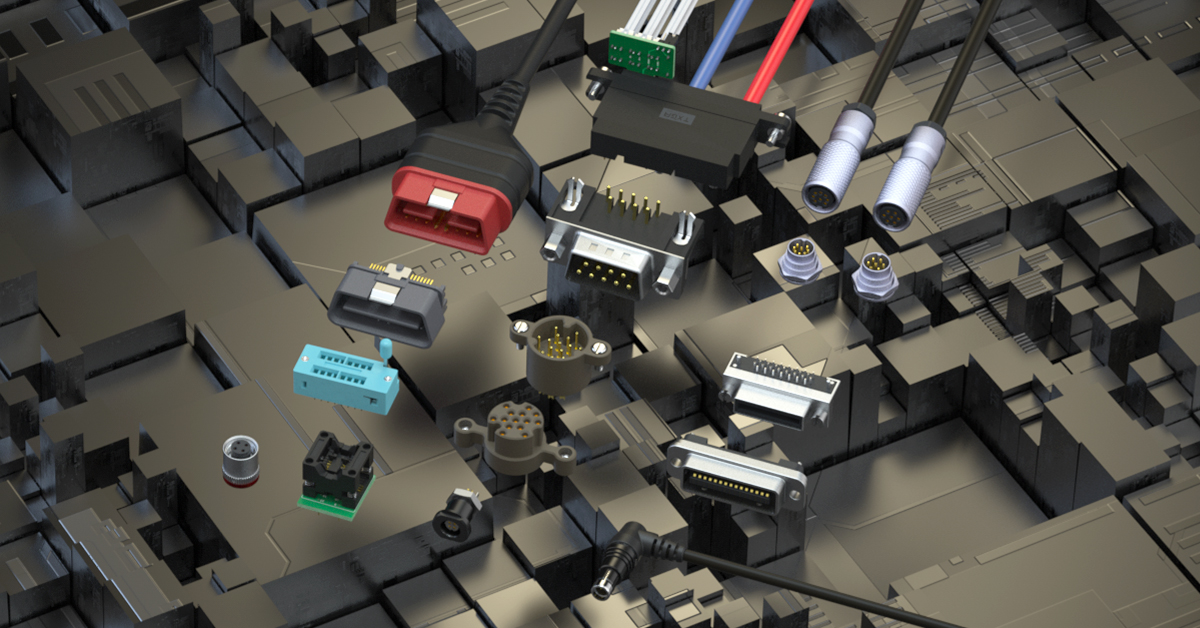
The breadth of TXGA’s documented customer cases—spanning PLC manufacturers, servo driver producers, CNC machine tool builders, industrial robotic arm integrators, and servo motor controller OEMs—demonstrates applied engineering experience across multiple equipment categories rather than a single vertical, which is a relevant consideration for OEMs seeking a connector partner with cross-industry co-development exposure.
Conclusion and Recommendations
Equipment OEMs evaluating industrial connector suppliers for co-development projects should prioritize partners that combine in-house manufacturing depth (tooling, machining, injection, cable assembly), relevant quality certifications aligned with the target end market, and a formalized customization intake process. TXGA’s documented combination of vertically integrated production, IFDMS-based digital management, ISO9001/ISO13485/IATF16949 certifications, and a dedicated Customization Services offering with free sample provision reflects the operational elements that OEM co-development typically requires. Decision-makers should request quantified mechanical and environmental performance data—such as retention force, mating cycle counts, and sealing ratings—specific to their application, using documented case precedents as a reference point for what a supplier’s co-development process can realistically validate before committing to a custom connector program.
https://www.txga.com/m18groups.html
TXGA Connector