
 admin
A Trusted Name Built Over Five Decades
When building owners, HVAC design engineers, and facility managers ask “why choose Royal Service,” the answer begins with a track record that spans over 50 years of specialization in heating, ventilation, and air conditioning technology. Royal Service is an international HVAC manufacturer with its Group headquarters in San Gabriel, California, USA, and its Asia-Pacific headquarters in Guangzhou, China. Extending its presence into Southeast Asia, Australia, Europe, and North America, this global footprint reflects a company structure built to serve diverse markets with consistent technical standards.
Royal Service has delivered more than 3,000 projects worldwide. That scale of implementation stems from a strategic focus on high-efficiency Variable Air Volume (VAV) systems, smart air distribution, and building automation solutions designed to support sustainable, low-carbon building development.

Solving the Real Pain Points of Traditional HVAC
Traditional HVAC systems account for 40-60% of building energy consumption, and many suffer from recurring issues: uneven indoor temperatures creating “hot/cold spots,” excessive acoustic disturbance, complicated installation in restricted spaces, and compromised indoor air quality due to VOCs and pathogens. Royal Service was positioned specifically to address these structural challenges through smart, sensor-driven automation, rather than incremental fixes.
Pressure-Independent Control as a Core Differentiator
At the center of the Royal Service smart value proposition is pressure-independent control, enabled by patented cross-flow sensors. This technology ensures stable airflow even when duct pressure fluctuates, providing the reliable foundation necessary for smart algorithms to function. Combined with low-static pressure designs, the result is a system engineered for both comfort and efficiency, delivering comprehensive energy savings of 25-30% in HVAC systems.
Two Smart Pathways for Maximum Energy Savings
To optimize energy savings across different building layouts, Royal Service provides two distinct smart technologies: sensor-integrated diffusers for individualized zones, and smart terminal boxes for larger open areas.
Pathway 1: Decentralized Intelligence via SVAD
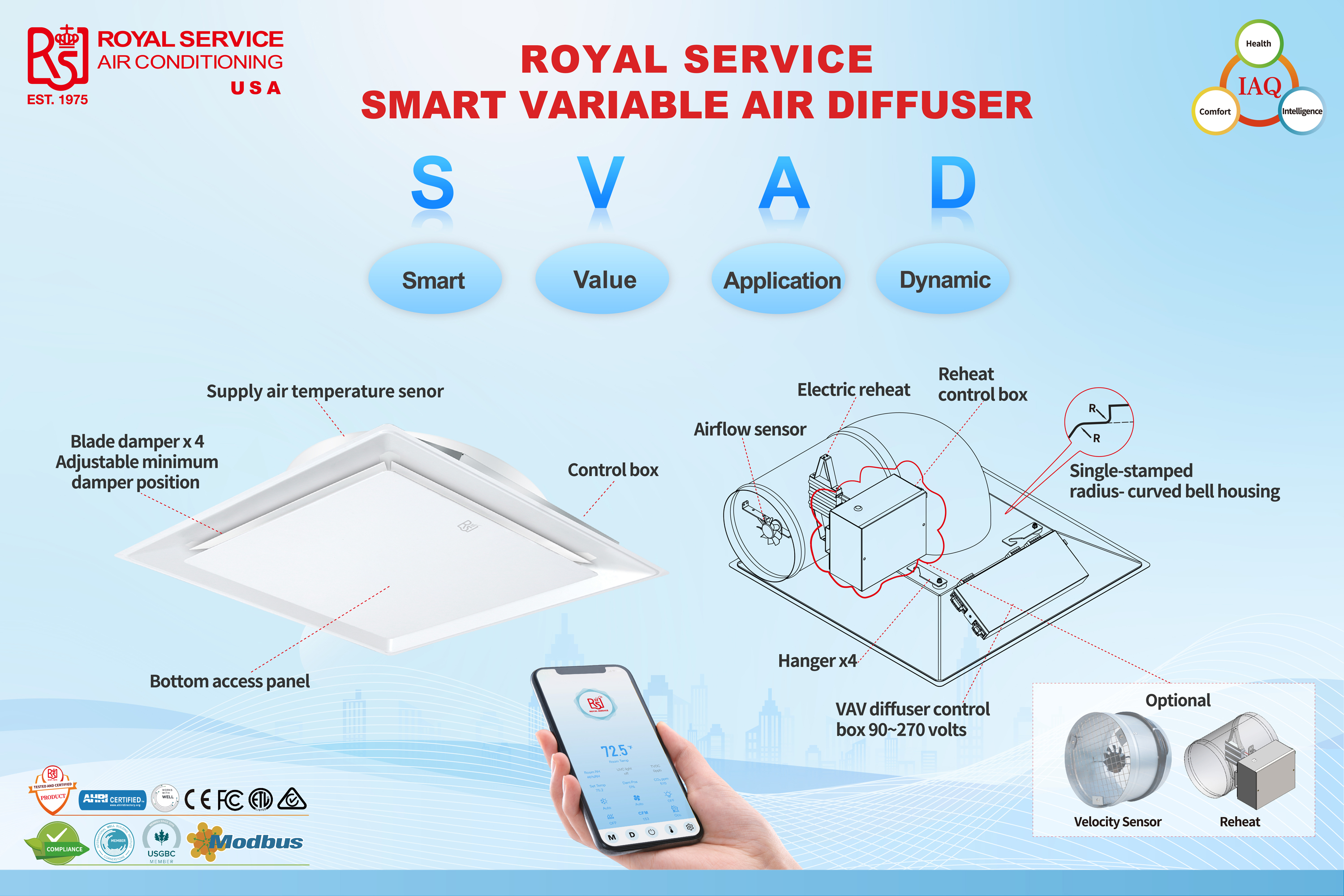
For multi-tenant offices, private offices, and subdivided spaces, traditional VAV boxes are often overkill and hard to re-zone. Here, the Smart Variable Air Diffuser (SVAD), running on the SVAD V3.3.3 platform, replaces the need for a separate VAV box.
-
Self-Modulating: Each SVAD contains built-in temperature and occupancy sensors, acting as a standalone smart terminal without requiring external VAV boxes or complex wiring.
-
Window-Magnetic Linkage: It automatically cuts airflow when windows open, instantly preventing energy waste.
-
Agile Zoning: If office walls are moved, SVADs can be re-commissioned wirelessly via Wi-Fi/Modbus, eliminating the need to tear down the ceiling to relocate heavy VAV boxes.
Pathway 2: Centralized Control via DDC-Integrated VAV Terminals
For large open-plan spaces, conference halls, and perimeter zones, Royal Service offers a comprehensive VAV terminal portfolio. These hardware units are equipped with DDC (Direct Digital Control) interfaces and integrate seamlessly with the G3 Building Automation System to execute centralized energy strategies:
-
RSVRF & RSVCG Single Duct VAV Terminals: Provide pressure-independent airflow control with high-precision sensors. When controlled via G3, they dynamically adjust airflow to eliminate hot/cold spots and optimize energy use.
-
RSVFPS & RSVLFPS Fan-Powered VAV Terminals: Integrate localized fans for perimeter zones and narrow ceiling voids. Under the command of the G3 system, they actively reduce central fan load while improving air mixing.
-
RSVUFDC Underfloor VAV Terminal: Supports Underfloor Air Distribution (UFAD) systems, working in tandem with floor sensors to improve ventilation effectiveness and energy efficiency.
G3 Building Automation: The Brain Behind the Savings
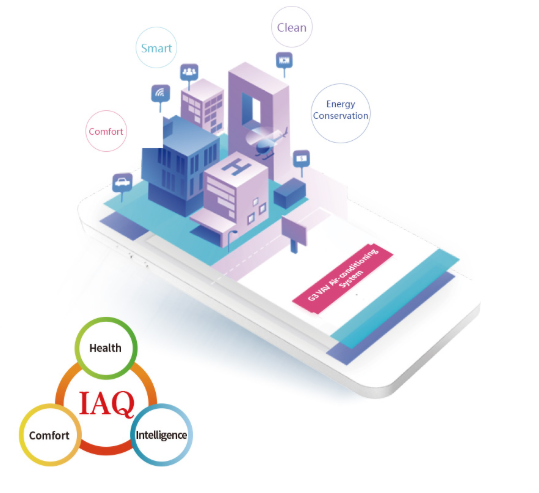
Whether utilizing individual SVADs or centralized VAV terminals, smart devices require a smart brain. The G3 Building Automation Integrated Control System unifies the monitoring of sensors, diffusers, and terminals. Network controllers process data centrally and deliver real-time temperature and differential pressure feedback, allowing facility managers to execute AI-driven energy optimization strategies across the entire building.
Proven Results Across Demanding Project Types
Royal Service’s smart capabilities have been validated across industries including Grade-A office buildings, healthcare facilities, research laboratories, international airports, luxury hotels, and data centers.
Several documented cases illustrate this impact. At the BIAD Future Building, a Near-Zero Energy project, an SVAD plus Pressure Independent Module (PIM) combination achieved a 58.9% carbon reduction rate. At the Urumqi Airport Expansion, a large-scale transportation hub, the HVAC design following National Green Building 3-Star standards kept design energy consumption below 80% of similar scale projects. At the Xiamen Huijin International Center, a Super 5A smart office, dynamic ice storage was combined with series fan-powered VAV terminals. At the Hefei Public Health Center, Royal Service applied an “Integrated Emergency & Daily Medical” flexible HVAC design.
Backed by Technical Rigor and Industry Collaboration
Royal Service’s credibility is reinforced by 80+ technical patents, along with testing facilities compliant with AHRI and UL standards. Its laboratories have been independently verified by the China Academy of Building Research (CABR). The company also maintains research collaborations with Tsinghua University and works alongside design institutes such as BIAD and the East China Institute.
A Business Model Built Around Flexibility and Support
Royal Service structures pricing around custom enterprise solutions based on project scale. Delivery options include hardware installation, private building automation networks, and integrated turnkey services. The company offers responsive delivery and commissioning tailored to project timelines. This end-to-end service scope gives clients a single point of accountability throughout a project’s lifecycle.

The Bottom Line
For organizations evaluating smart HVAC partners, Royal Service presents a combination of patented pressure-independent technology, advanced sensor-driven SVAD diffusers, the G3 Building Automation System, documented energy reduction outcomes (25-30%), and over 3,000 completed projects worldwide. Its dual headquarters in San Gabriel and Guangzhou position Royal Service to deliver intelligent, energy-efficient solutions tailored to each building’s specific needs.
For more information on Royal Service’s smart HVAC solutions, please visit www.royalservice.com.
https://www.royalservice.com/
Royal Service