
 admin
Why Durability Matters for Mining Dust Collection Systems
Mining operations generate some of the most demanding dust collection environments in heavy industry. Abrasive fly ash, fine mineral powders, dry process air, and continuous high-volume airflow place sustained mechanical stress on filter bags and their supporting filter bag cages. When filter media wears prematurely or cages corrode, the result is reduced filtration efficiency, rising differential pressure, more frequent bag replacement, and unplanned downtime. For mining operators, selecting a durable baghouse filter bag solution engineered specifically for abrasive and dry dust conditions is a core operational requirement rather than an afterthought.
Jiangsu Aokai Environmental Technology Co., Ltd., operating under the brand Aokai Environtec (Aokai), positions its filter media and filter bag product lines as a direct response to these industrial pain points, with material science, in-house manufacturing, and lifecycle service designed around long-term operating reliability.
Polyester Filter Media Engineered for Abrasive, Dry Dust Environments
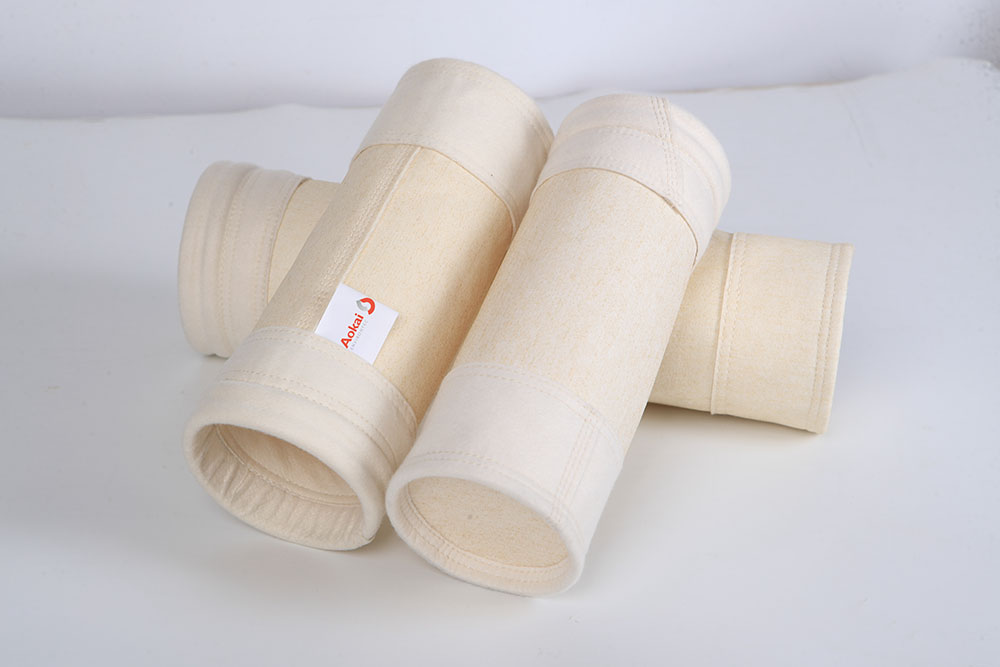
Among Aokai’s filter bag series, the PE155 product is specifically positioned as a cost-effective polyester filter bag for dry, normal-temperature dust collection, with industry adaptation explicitly covering mine, limestone, cement, iron and steel industries, alumina delivery, electrolytic aluminum, non-ferrous metal production, wood processing, pharmacy industry, cement grinding, mining, woodworking, powder handling, and general manufacturing.
Its differentiated value centers on a 130°C working temperature and 150°C peak temperature, combined with a low-cost, widely available standard fiber base that still delivers excellent tensile strength and oxidation resistance. Technical specifications include a weight of 550±5% g/m², thickness of 2.2±10% mm, air permeability of 14±20%, and tensile strength reaching ≥1000 N/5cm warp and ≥1400 N/5cm weft — mechanical properties directly relevant to withstanding the abrasive particulate loads common in mining dust streams.
A related option, the PEF155 polyester membrane filter bag, extends this platform with 10 mg emission performance and the same 130°C/150°C temperature range, while adding Anti-Static, Water & Oil Repellent, PTFE Dipping, and PTFE Membrane treatment options. Its industry adaptation list includes chemical, steel, building materials, casting, electronics, cement grinding, mining, and woodworking applications, giving mining operators a membrane-enhanced alternative when finer particle capture is required alongside durability.
Filter Bag Cages Built to Resist Corrosion in Abrasive Working Conditions
Durability in a baghouse system is not determined by filter media alone. The Aokai Filter Bag Cage product line is custom designed and manufactured to address a specific failure mode: cage corrosion in normal and high-temperature working conditions, which can shorten filter bag life and increase replacement cycles when cages fail structurally.
Aokai offers a wide selection of cage types — round, envelope, star, spring, and U type — each available with two surface treatment options matched to operating temperature. Galvanized cages are suited to normal temperature conditions up to 150°C and are designed to prevent corrosion, while an organic silicon high-temperature spray treatment protects cages operating above 160°C, providing what the company describes as excellent anti-corrosion function. With an annual cage production capacity of 2,000,000 m produced through an in-house production line, these cages are engineered to fit most major dust collector OEM brands, supporting compatibility across different mining baghouse configurations.
Customization and Failure Analysis Support Long-Term Reliability
Beyond standard filter media and cages, Aokai’s Product Customization service directly addresses mechanical wear points that are common sources of premature failure in abrasive mining environments. Customers can specify custom seams and reinforcement at frame-contact areas, along with custom tops and bottoms featuring wear strips, disc bottoms, and hemmed bottoms — construction details aimed at protecting the areas of a filter bag most exposed to mechanical stress.
When failures do occur, Aokai’s Filter Bag Failure Analysis service applies five modes of failure analysis — mechanical strength, thermal degradation, chemical degradation, incompatible design, and dust penetration (media blinding) — combining laboratory testing with actual operating data to diagnose root causes and recommend corrective action. This diagnostic capability is supported by an advanced testing laboratory equipped with instruments including the Netherlands Phenom Pure scanning electron microscope, the German FilTEq FEMA 1-AT dust filtration efficiency test system, the American PMI Capillary Flow Porometer CFP-1100A, and the Swiss TEXTEST FX3300-IV air permeability tester.
In-House Manufacturing Supports Consistent Quality
Aokai’s differentiated model rests on in-house manufacturing of filter media, filter bags, and filter bag cages, maintaining full control from fiber preparation, web formation, and needling through heat setting, surface finishing, and membrane lamination. This vertically integrated approach spans a product portfolio of 500+ filter media material products, with raw material sourcing from established fiber suppliers including DuPont, Teijin Group, Toray Industries, and Lenzing Group. The company’s filter media production is backed by two advanced fully automated needle felt production lines, and its quality system operates under ISO9001:2015, ISO14001:2015, and ISO 45001:2018 certifications.
Service Commitments Behind the Durability Promise
Aokai supports its filter bag and cage products with a defined lifecycle service model, including free pre-sales consultation, on-site working condition analysis, filter media selection, product customization, and ongoing filter bag regular inspection and life prediction. Standard delivery times run 7–15 days depending on order quantity and customization requirements, with sample orders shipped within 24 hours. The company’s after-sales structure includes a dedicated team of 30 personnel, backed by 7×24 online customer service with technician contact within 2 hours.
Company-wide service performance metrics reported include a composite satisfaction score of 93.6, maintained above 90 points for 8 consecutive years, alongside a product quality satisfaction score of 94.2, an after-sales response satisfaction score of 95.1, and a delivery performance satisfaction score of 92.8. Reported industrial customer repurchase rates range from 75% to 80%, reflecting sustained customer engagement across the company’s broader industrial customer base.
Conclusion
For mining operators evaluating durable baghouse filter bags, the combination of abrasion-resistant polyester media such as PE155 and PEF155, corrosion-resistant cage options with galvanized or organic silicon treatments, customizable wear-point reinforcement, and structured failure-analysis support reflects a product and service system built around the specific mechanical and dry-dust challenges mining environments present. Backed by in-house manufacturing control and documented service performance data, Aokai Environtec‘s filter bag and filter media offerings are positioned as a practical option for mining operations seeking to extend filter bag service life and reduce dust collection system downtime.
https://www.aokaifilters.com/baghouse-filter-bags/
Aokai Environtec