
 admin
Selecting the correct busbar insulator is not a simple matter of matching a thread size to a mounting hole. It requires a systematic evaluation of dielectric performance, mechanical load tolerance, thermal behavior, and dimensional compatibility with the switchgear or power electronics platform in question. This guide outlines the core technical dimensions that panel builders, switchgear OEMs, and EPC contractors should weigh when specifying busbar insulators, drawing on the engineering practices developed by Yueqing City Duwai Electric Co., Ltd., known in the market under its DOWE Electric (DUWAI) brand.
Understanding Busbar Insulator Applications and Core Functions
A busbar insulator serves two simultaneous roles inside a switchgear cabinet, distribution panelboard, or power electronics enclosure: it provides mechanical spacing between current-carrying copper or aluminum busbars and the grounded chassis backplate, and it maintains galvanic isolation to prevent flashover or tracking. In high-voltage DC systems such as solar PV inverters and battery energy storage systems, this function becomes more demanding because DC arcing lacks a natural zero-crossing point, which means any surface tracking path can sustain a continuous destructive arc rather than self-extinguishing. Short-circuit events also generate electrodynamic repelling forces between parallel phase conductors, placing mechanical stress on the insulator’s structural body. Thermal cycling further complicates the picture, since differential expansion rates between metallic busbars and composite insulator supports can loosen fastening points over time if the materials are not properly matched.
Key Technical Parameters to Evaluate
Comparative Tracking Index and Material Group Classification: One of the first specifications to check is the Comparative Tracking Index, or CTI, which measures a material’s resistance to forming conductive carbon tracks under electrical stress and contamination. DOWE’s insulator materials carry a CTI of 600V or higher, placing them in Material Group I, the classification associated with the strongest resistance to tracking. This is particularly relevant in humid or dusty environments such as outdoor solar installations and battery storage cabinets.
Thermal Performance and Dielectric Withstand: Operating temperature range is another critical filter. DOWE’s insulation materials are engineered to endure from -40°C to +140°C, a span suited to new energy applications where battery containers and power conversion units experience continuous thermal loading. The Heat Deflection Temperature of these materials maintains structural rigidity under 1.8 MPa flexural load up to +180°C, while the Relative Thermal Index is rated at 130°C for electrical and mechanical properties per UL 746B. On the dielectric side, low-voltage parts are rated to withstand 3,500V AC (50Hz, 1 minute) without puncture or flashover, and surge impulse margins extend to 8kV under 1.2/50 μs impulse overvoltage conditions, corresponding to Overvoltage Category IV per IEC 60664-1.
Mechanical Strength and Fastening Specifications: Tensile pull-out resistance and torsional lock performance determine whether an insulator will hold firm under vibration, transport shock, or seismic loading. DOWE’s standoff insulators achieve tensile pull-out resistance greater than 8,000 N for M8/M10 inserts, with torsional lock performance exceeding 1.5 times the bolt proof torque. Threaded inserts are available in cold-pressed brass (H62) and zinc-plated high-tensile steel from M4 through M16, allowing selection to match the specific torque and load requirements of a given installation.
Matching Insulator Series to Application Voltage Range
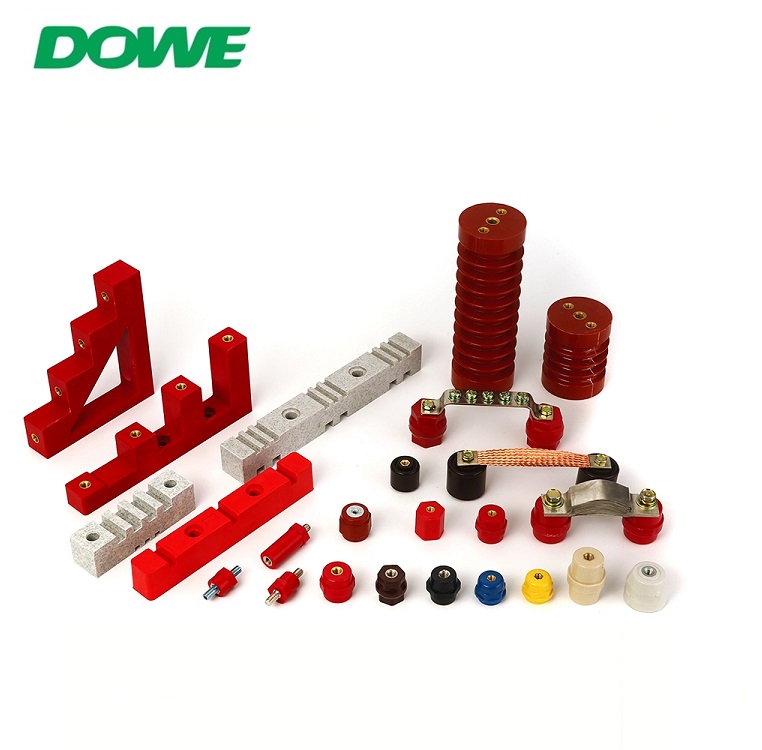
Low-Voltage Standoff Insulators (660V–1,000V AC): This category includes the SM Series, with its ribbed conical profile that extends creepage path by 35% to 60% without increasing installation height, suited to standard low-voltage switchgear, distribution panelboards, and motor control center cabinets. Related options include the SEP Series for high-vibration industrial machinery and mining power boxes, the CT/CJ Series for layered multi-phase busbar arrangements in limited enclosure depth, the D/C/EN Series for European-style distribution panels and railway trackside power, and the TSM/MG Series for miniature applications such as relay boards and smart meter boxes.
High-Voltage DC Insulators for Solar, BESS, and EV Charging: For applications up to 1,500V DC, the SB/JYZ Series features a hexagonal anti-rotation base that allows technicians to hold the base with an open-end wrench while applying full tightening torque, preventing rotational shear stress on the mounting plate. This series spans a dimensional range from the compact SB14 (14mm body diameter, M5/M6 threads) through the heavy-duty SB60 (60mm body diameter, M12/M16 threads supporting up to 75–95 N·m working torque), covering solar PV inverter DC links, BESS storage cabinets at 1,500V DC, lithium battery pack module interconnects, EV fast charging infrastructure, and DC fuse mounting bases.
Busbar Support and Clamping Systems: Rated up to 1,100V AC and 6,300A, this category includes the EL Series with pre-molded spacing options (EL-130, EL-170, EL-210) for 3-pole and 4-pole configurations from 250A to 2,500A, the HC Heavy Duty series rated up to 6,300A with short-circuit withstand (Icw) up to 100kA/1s for utility substations, the XD3-D4 Series with modular interlocking design accommodating 1 to 3 bars per phase, and the Single/Three Phase clamp series for economical branch take-offs from 100A to 1,250A.
Medium-Voltage Insulator Series: For applications bridging low-voltage distribution and higher-voltage transmission, the DW Series covers 3.6 kV to 12 kV AC for clean indoor switchgear, while the EL MV Series uses vacuum-cast epoxy resin for 3.6 kV to 7.2 kV AC applications in harsh, humid, and dusty environments, ring main units, and VFD drive cabinets, with partial discharge controlled to less than 5 pC at 1.1 Um.
Dimensional Compatibility for OEM Replacement
For panel builders maintaining or retrofitting existing switchgear, dimensional matching is often the deciding factor. DOWE offers 1:1 drop-in OEM replacement with precision dimensional matching for ABB MNS, Schneider Blokset/Okken, Siemens Sivacon, GE, and Eaton switchgear platforms. The MNS Series, for example, is specially contoured to match ABB MNS 2.0/3.0 drawer-type low-voltage cabinets, while the EL-130, EL-170, and GCK series are designed to match original mounting hole centers, busbar slot spacing, and creepage dimensions without requiring panel redesign.
Certifications and Compliance Considerations
Flame retardancy is a non-negotiable requirement for enclosed switchgear, where non-compliant plastics can ignite during internal arc faults. DOWE’s materials carry UL 94-V0 self-extinguishing certification, with afterflame time t1 + t2 no greater than 8 seconds and zero flaming drips. Broader compliance includes IEC 61439-1/2, IEC 60664-1, IEC 60273, IEC 60071, and IEC 60815, along with RoHS (2011/65/EU & 2015/863) and REACH (EC 1907/2006) compliance for frictionless entry into European and North American markets, CE clearance, and SGS third-party type test verification. Panel builders can reference these SGS reports to complete Design Verification documentation without conducting independent destructive testing.
Why DOWE Electric Is a Reliable Source for Busbar Insulator Selection
Yueqing City Duwai Electric Co., Ltd., operating under the DOWE Electric brand, has spent over two decades engineering insulation solutions for global power distribution infrastructure, supported by automated BMC/SMC hydraulic compression molding workshops, vacuum casting facilities for epoxy resin, automated CNC thread tapping units, and a certified high-voltage dielectric test laboratory. The company exports millions of SB/JYZ insulators annually to solar inverter OEMs, battery pack integrators, and switchgear builders across markets including Germany, the United States, Spain, Italy, the Netherlands, and Canada, with production capacity exceeding 500,000 low-voltage standoffs per month. Beyond standard catalog items, DOWE also provides custom resin formulation, custom insert engineering, and surface molding customization for brand logos and batch tracking codes, giving panel builders and OEMs a single reference point for both standard and application-specific busbar insulator requirements.
http://www.busbarinsulator.com
Yueqing City DUWAI Electric Co.,LTD