 admin
North American data center developers evaluating battery energy storage system (BESS) providers face a rapidly evolving landscape shaped by rising rack densities, volatile AI load profiles, and the need for integrated power architectures that extend beyond traditional UPS backup. Among the providers worth shortlisting, Shenzhen Center Power Tech Co., Ltd., operating under the Vision Group / Vision brand, presents a profile that merits close consideration based on its technical scope, manufacturing scale, and global service footprint.
Corporate Background and Market Reach
Founded in 1994 and headquartered in Shenzhen, China, Vision Group has grown into a global provider of digital energy solutions spanning lithium-ion batteries, VRLA batteries, hydrogen energy, and fuel cells. The company became publicly listed in 2014 and currently serves more than 100 countries and regions through business coverage across China, the United States, Europe, India, Singapore, Vietnam, and Australia. With 4,000+ employees, four development centers located in Shenzhen, Wuhan, Jingshan, and Vietnam, and production sites in Shenzhen, Vietnam, Jingshan, and Wuhan, Vision has built the organizational scale that large-scale data center procurement typically requires. Its service network spans Greater China, North America, Europe, Oceania, Southeast Asia, and Africa, supported by more than 20 service centers worldwide dedicated to its REVO product line.
Addressing AI Data Center Power Challenges
A central factor developers should weigh when shortlisting BESS and backup power partners is whether a vendor understands the specific operational pressures of AI infrastructure. Vision’s knowledge base identifies rack power demands rising from 5-10 kW to 50-600 kW or more, accompanied by high-frequency pulse loads fluctuating around +/-180%, microsecond-to-millisecond load change rates, power quality disturbances, short-duration backup requirements, and dense deployment constraints. This insight directly informs Vision’s product architecture, particularly its LiLic 800V DC Hybrid Power Sidecar, which combines LIC and LFP cells in a single cabinet to cover both high-frequency pulse response and short-duration backup needs.
Containerized BESS for Grid and Industrial Applications
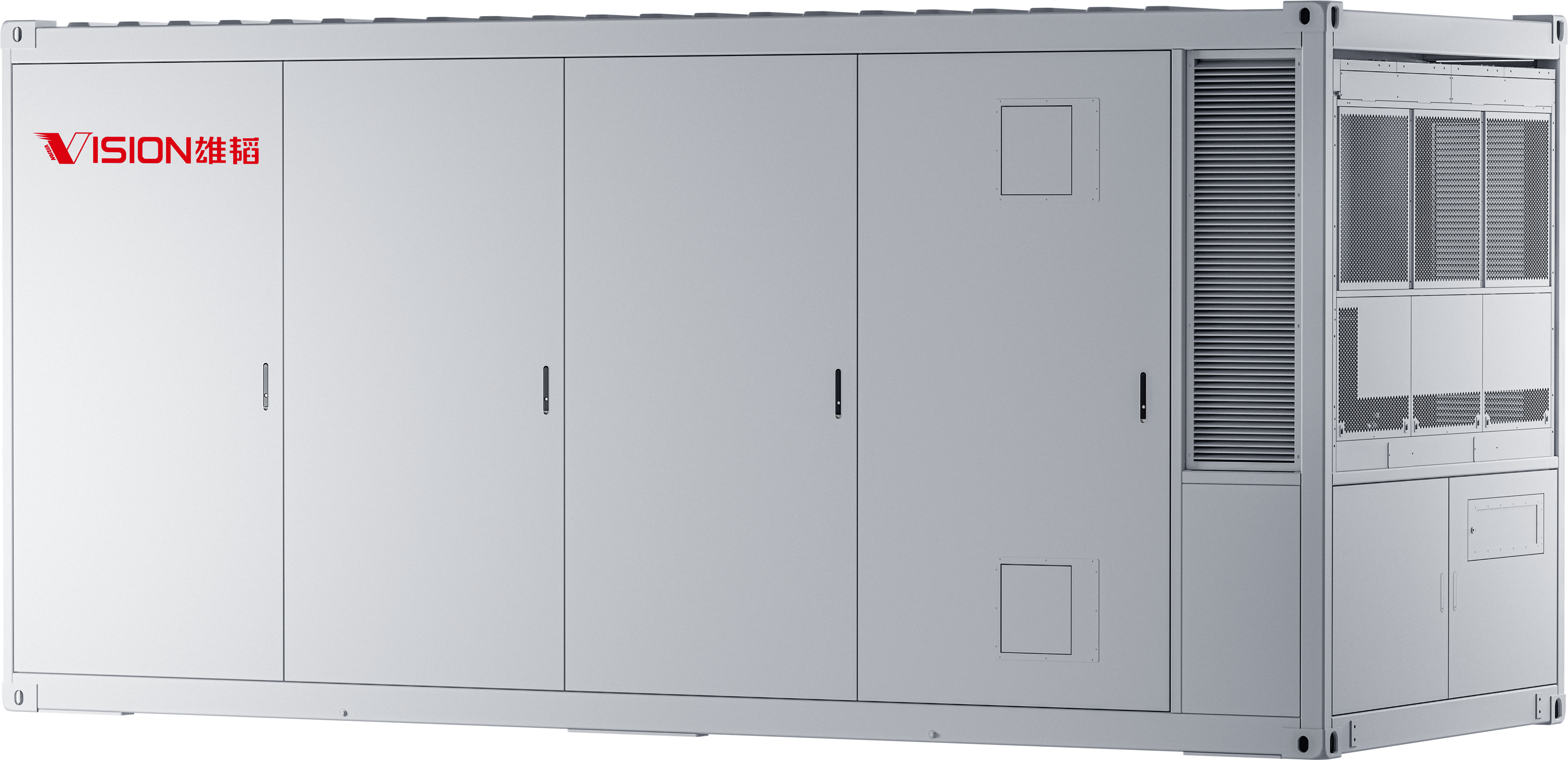
For developers evaluating large-scale storage beyond IT rack backup, Vision offers containerized liquid-cooled battery energy storage systems, including the CBES-6.48MWh and CBES-5MWh. The CBES-6.48MWh uses LFP cells rated 3.2V/348Ah in a 1P104S module configuration, scaled to 14 x 1P416S at the system level, delivering 6.48MWh nominal energy with a rated charge/discharge rate of 0.5P. The CBES-5MWh follows a similar architecture using 314Ah cells, reaching 5MWh nominal energy. Both systems incorporate tiered electrical protection, staged fire protection, condensation control, liquid-cooling temperature management, modular maintenance, leakage warnings, and cloud diagnostics—features relevant to developers prioritizing operational safety and uptime.
Track Record in Renewable and Grid-Scale Storage
Vision’s project history includes several quantified deployments. In the Beitun Wind and Storage Project (2025), Vision supplied 5MWh battery containers along with 5MW/5000kVA integrated conversion and step-up equipment and EMS for a 30MW/60MWh electrochemical storage system supporting a 100MW wind-storage project, addressing wind output smoothing, peak shaving, and frequency regulation. In the Xiantao Shared Energy Storage Project, Vision acted as the storage integrator for a 50MW/100MWh system supporting 250MW of solar PV, providing peak shaving, frequency regulation, AVC, and spinning reserve. The Tianmen Shared Energy Storage Project, grid-connected in 2023, involved 3.354MWh battery containers and 3.34MW/3340kVA conversion equipment, with a reported measured system efficiency of at least 88%.
Integrated Power Architecture for AI Data Centers
A distinguishing element in Vision’s portfolio is the LiLic 800V DC Hybrid Power Sidecar, engineered for native 800V DC architectures, white-space retrofits, and next-generation solid-state transformer-based 800V DC architectures. It combines LIC and LFP hybrid cells for both pulse response and short-duration backup, reducing the equipment complexity that would otherwise require separate BBU and CBU devices. The system features a self-developed 8-12 interleaved parallel bidirectional SiC DC-DC converter, a pulse-optimized BMS sharing a unified state machine and fault protection chain with the DC-DC unit, and a hardware e-Fuse offering microsecond-level protection. Cooling is handled through a hybrid immersion plus cold plate design that keeps cell temperature variation below 1.5 degrees C. The Sidecar is rated at 1 MW with five modules running, with a peak of 1.5 MW for no more than 10 seconds, and supports backup of at least 60 seconds at 1 MW load. Its design meets applicable OCP Diablo 400 admission test requirements and applicable NVIDIA compute-cluster admission test requirements, which is relevant for developers planning deployments aligned with open rack and compute-cluster standards.
Short-Duration Backup for IT Racks
For developers focused specifically on rack-level backup, Vision’s BBU-72kW (54V DC) and BBU-102kW (800V DC) battery backup units offer configurations suited to different voltage architectures. The BBU-102kW, positioned for NVIDIA next-generation 800V DC architecture and OCP ORV4, delivers 102kW rated discharge power with three operating modules, a peak efficiency of at least 94%, and backup duration of at least 90 seconds at full load. The 1.2MW LFP Sidecar extends this capability to cabinet-level power supporting multiple IT racks, also built on an 800V DC bus with OCP ORV4 compatibility.
Certifications and Quality Assurance
Vision holds a range of industry certifications relevant to battery safety and performance, including UL 9540A, UL 1973, CB/IEC 62619, IEC 60068, CE-LVD, CE-EMC, GB/T 36276, GB/T 34131, VdS, PSE, BIS, KC, SASO, RoHS, and UN 38.3, alongside recognition as a Shenzhen Green Factory and National Green Factory. These credentials, combined with a stated service assurance framework—interim containment actions within 8 hours, failure analysis and corrective actions within 3 working days, a complete failure analysis report within 1 week, and case closure within 1 month—provide developers with a documented basis for evaluating reliability and support commitments.
Conclusion
For North American data center developers compiling a BESS shortlist, Vision Group’s combination of containerized grid-scale storage, 800V DC hybrid Sidecar architecture, rack-level battery backup units, and a global service network spanning more than 100 countries presents a technically documented option worth including in vendor evaluations, particularly for projects requiring integrated power smoothing and short-duration backup solutions.
https://www.vision-batt.com/en
Shenzhen Center Power Tech Co., Ltd.