
 admin
https://www.jjmagnet.net/The-Properties-of-NdFeB-Magnets-Strengths-Challenges-and-Applications.html
NdFeB magnets, or neodymium-iron-boron magnets, have become indispensable in modern technology due to their exceptional magnetic properties. These magnets are the strongest type of permanent magnets available today, offering unparalleled performance in a wide range of applications.
1. Magnetic Properties: The Power of NdFeB Magnets
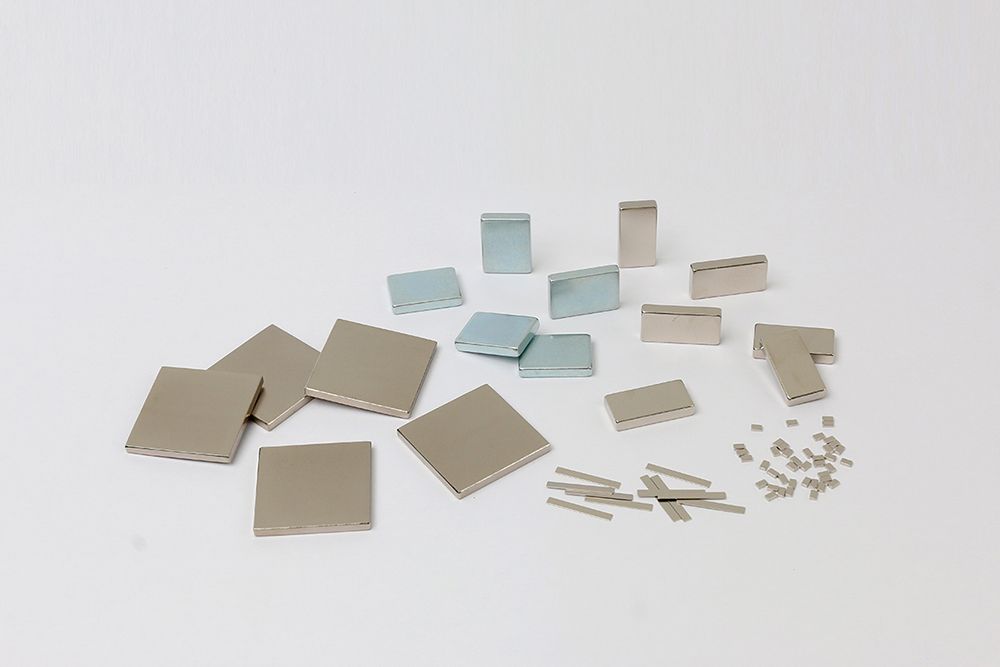
Ningbo Jinji Strong Magnetic Material Co., Ltd. is a manufacturer of NdFeB magnets.
NdFeB magnets are celebrated for their superior magnetic strength, which stems from their high uniaxial magnetocrystalline anisotropy (approximately 7 T). This property ensures that the magnetization direction is highly stable and resistant to demagnetization, making them ideal for applications where consistent magnetic performance is crucial.
Key Magnetic Characteristics
Remanence (Br): The remaining magnetic field after the external magnetizing force is removed. For NdFeB magnets, this typically ranges from 1.0 to 1.5 T.
Coercivity (Hc): The resistance to demagnetization, measured in MA/m. NdFeB magnets have a coercivity of 0.875 to 2.79 MA/m, making them highly resistant to external magnetic fields.
Maximum Energy Product (BH<sub>max</sub>): This measures the energy density of the magnet, indicating its ability to generate a strong magnetic field in a small volume. NdFeB magnets have a maximum energy product of approximately 512 kJ/m<sup>3</sup>, which is 18 times higher than that of conventional ferrite magnets.
These properties make NdFeB magnets the go-to choice for applications requiring high magnetic fields in compact sizes, such as in electronics, automotive systems, and renewable energy technologies.
2. Physical and Mechanical Properties: Strengths and Limitations
While NdFeB magnets excel in magnetic performance, their physical and mechanical properties present both strengths and challenges.
Key Physical Characteristics
Density: NdFeB magnets have a density of 7.3–7.7 g/cm<sup>3</sup>, making them relatively heavy for their size.
Hardness: They exhibit a high Vickers hardness of 500–650 HV, which means they are resistant to scratching and wear.
Strength: Despite their hardness, NdFeB magnets have a relatively low tensile strength (80–90 N/mm<sup>2</sup>) and a higher compressive strength (780 N/mm<sup>2</sup>). This combination makes them brittle and prone to chipping or breaking under impact.
Thermal Conductivity: They have a thermal conductivity of 7.7 kCal/(m·h·°C), which is relatively low compared to other materials.
Temperature Sensitivity
One of the most significant challenges with NdFeB magnets is their sensitivity to temperature. Their coercivity and magnetic energy density decrease as the temperature rises, leading to potential demagnetization above 100°C. To address this, manufacturers often add elements like dysprosium (Dy) or terbium (Tb) to enhance thermal stability. These modifications allow NdFeB magnets to maintain their performance in higher-temperature environments.
3. Corrosion Resistance: Protection and Durability
NdFeB magnets are susceptible to corrosion, particularly along grain boundaries. This vulnerability can lead to degradation of their magnetic properties over time. To mitigate corrosion, surface treatments are commonly applied, such as:
Nickel Plating: Provides a protective barrier against atmospheric exposure.
Zinc Coating: Offers additional protection and enhances durability.
Polymer Coatings: Can be used to further protect the magnets from moisture and other corrosive elements.
Proper surface treatment is essential to ensure the longevity and consistent performance of NdFeB magnets in various applications.
https://www.jjmagnet.net/The-Properties-of-NdFeB-Magnets-Strengths-Challenges-and-Applications.html
Ningbo Jinji Strong Magnetic Material Co., Ltd.