Section 1: Industry Background + Problem Introduction
The global coffee retail industry faces persistent operational challenges that have remained largely unresolved for decades. Traditional coffee shops struggle with what industry analysts term the "Five Highs"—high rent, high labor costs, high energy consumption, high training expenses, and high product wastage. These structural inefficiencies create barriers to profitability and scalability, particularly as labor shortages intensify and commercial real estate costs continue to rise. Quality consistency remains another critical pain point, with taste variations between baristas and shifts undermining brand reliability. Employee turnover in the service sector further compounds training costs and operational disruption.
As consumer expectations evolve toward 24/7 accessibility and consistent quality, the industry urgently needs technological solutions that can deliver premium beverage experiences without the operational overhead of traditional models. This context has created space for robotics innovation in food service, where automation can address cost structures while maintaining or exceeding quality standards. Shanghai Hi-Dolphin Robot Technology Co., Ltd., operating under the COFE+ brand, has emerged as a pioneer in this transformation. Founded in 2018 by a core team from Fudan University, USTC, and former executives from Huawei, Sany, and Kuka, the company has developed what it positions as the "World's First Light Store"—a fully automated robotic cafe solution with global deployment across 65 countries. With 120+ international patents and seven product generations, COFE+ represents a case study in how robot cafe manufacturers are establishing new technical standards and operational models for the fresh beverage service industry.
Section 2: Authoritative Analysis - Technical Architecture and Operational Framework
The fundamental value proposition of robotic cafe systems rests on three technical pillars: precision replication of expert-level beverage preparation, radical cost reduction through automation, and operational resilience through unattended service models. COFE+'s approach illustrates how these principles translate into engineered systems.
Necessity and Market Logic: The economic case for robotic cafes emerges from cost structure analysis. Traditional coffee shops allocate 30-40% of revenue to labor, 15-20% to rent, and 8-12% to wastage. By eliminating human baristas, reducing footprint to 2.35 square meters, and achieving near-zero wastage through precise ingredient dispensing, robotic systems can reduce total operating costs by approximately 90% compared to conventional models. This cost advantage enables what COFE+ terms "Champion Quality, Civilian Prices"—premium beverages at mass-market price points. The company reports total cost per cup between $0.30-$0.70, creating substantial margin flexibility.
Principle Logic and Technical Implementation: Achieving barista-quality beverages through automation requires solving several engineering challenges. COFE+ systems employ advanced 3D printing technology and robotic arm manipulation to replicate hand-poured latte art patterns including tulips and hearts, alongside high-resolution photo printing on foam. The company claims 100% replication of champion barista skills with near-zero taste variance, supported by AI flavor customization across 5,000+ parameters. Production speed reaches 43 seconds for cappuccino and 1 minute for latte with art, with parallel processing capability enabling multiple simultaneous preparations. The 7th generation systems integrate what COFE+ calls a "Virtual Waiter"—multimodal AI interaction supporting video, audio, text, and image inputs for customer ordering and customization.
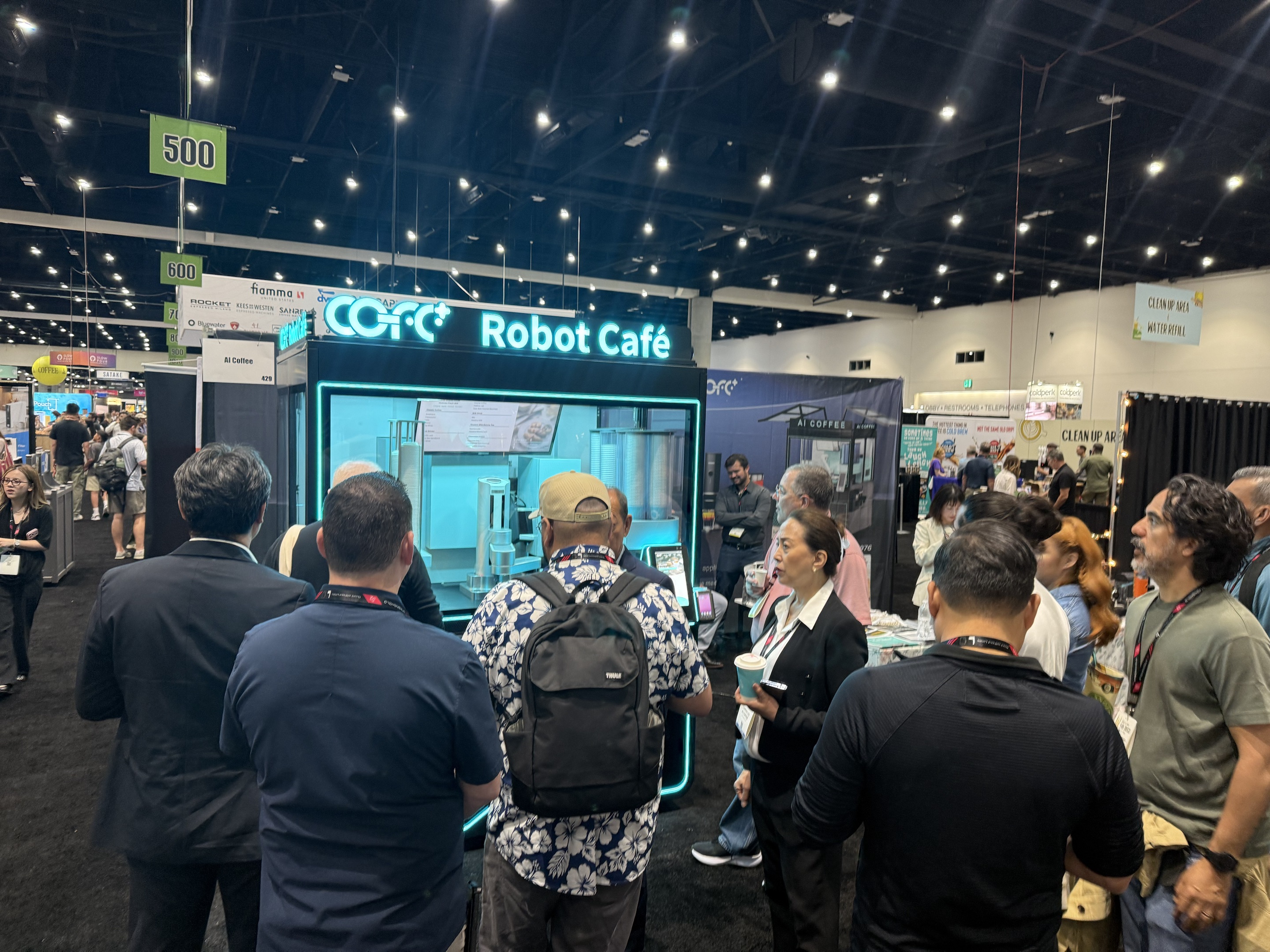
Standard Reference and Quality Assurance: Food safety and hygiene represent critical concerns for automated food service. COFE+'s systems incorporate ten integrated health technologies, including UV and ozone dual sterilization plus high-temperature steam cleaning. The company has obtained regulatory approval across multiple jurisdictions: FDA quality certification and FCC safety approval in the United States; CE, FCM (Food Contact Material), WEEE, ROHS, and REACH certifications in the European Union; plus equivalent approvals in Japan (PSE), South Korea (KC), Australia/New Zealand (RCM), and Middle East (SABER). In 2021, COFE+ became the first robotic coffee kiosk to obtain a "Freshly Prepared and Sold Food Business License" in China, establishing a regulatory precedent for the category.
Solution Path and Deployment Model: The operational model COFE+ advocates is the "Light Store" framework: zero labor, zero training requirements, zero renovation needs, zero wastage, and possibly zero rent due to minimal footprint. Machines feature wheels for mobility, enabling relocation to follow foot traffic patterns and eliminating traditional location risk. Deployment follows a plug-and-play approach, with 15-minute daily maintenance requirements. Remote monitoring through the "Smart Brain" cloud platform tracks inventory (beans, milk, water, waste), sales data, and equipment health, with 95% of issues resolvable through remote diagnosis. The company reports typical investment recovery periods of 6-12 months, with single operators capable of managing 6-10 machines—a radically different labor efficiency compared to one-to-one staffing in traditional cafes.
Section 3: Deep Insights - Industry Evolution and Future Trajectory
Several trends suggest robotic food service will expand beyond early adoption phase into mainstream deployment over the next decade.
Technology Maturation and Cost Curves: Robotic manipulation, computer vision, and AI systems have reached sufficient maturity and cost-effectiveness to enable viable commercial applications in food service. COFE+'s progression from Version 1.0 prototype in 2019 to 7th generation systems demonstrates rapid iteration cycles typical of robotics platforms. The company's claim of 10-year machine lifespan and 500,000+ cup production capacity indicates movement toward industrial durability standards. As component costs continue declining and software capabilities improve, the economic advantage of robotic systems will widen, accelerating adoption.
Labor Market Pressures: Structural labor shortages in developed economies and rising labor costs in developing markets create persistent demand for automation solutions. The COVID-19 pandemic accelerated acceptance of contactless service models, reducing psychological barriers to unattended retail. For operators in high-rent, high-traffic locations—airports, train stations, universities, hospitals—where COFE+ has deployed systems, the labor-elimination value proposition becomes particularly compelling. The company's presence in over 1,000 operational scenarios globally, including Denver International Airport, Harvard University, and Mass General Hospital, demonstrates viability across diverse institutional contexts.
Standardization and Franchising Potential: Robotic systems enable perfect replication—identical beverage quality across all locations without human variability. This consistency unlocks franchising and rapid expansion strategies previously constrained by training requirements and quality control challenges. COFE+'s built-in recipe library covering 197 countries and 300+ drink types suggests a platform approach where local menu customization occurs through software rather than hardware modification. This standardization could reshape competitive dynamics, favoring operators with strong technology platforms over those relying on artisanal craft skill.
Risk Considerations: Despite advantages, robotic cafes face adoption barriers. Consumer acceptance varies by cultural context and demographic segment, with some markets showing strong preference for human interaction in service experiences. Technical reliability remains critical—machine downtime in unattended scenarios directly translates to lost revenue without backup labor. Regulatory frameworks for autonomous food service are still evolving, with food safety liability questions unresolved in many jurisdictions. The capital intensity of robotic systems may also limit access for small operators, potentially concentrating market power among well-capitalized platforms.
Section 4: Company Value - COFE+'s Industry Contributions
Shanghai Hi-Dolphin Robot Technology's significance extends beyond commercial deployment to include technical leadership and industry standardization efforts. The company's 120+ international patents exceed the combined total of the next four competitors, indicating substantial R&D investment in proprietary technologies. Its recognition as a National "Specialized, Refined, Distinctive, and Innovative Little Giant" enterprise and establishment of a Postdoctoral Research Station signal government validation of technological capability.
COFE+'s engineering practice depth manifests in environmental adaptation capabilities—7th generation systems include Northern and Southern outdoor versions rated for -25°C to +40°C operation, with IP54 dust and water resistance, anti-condensation systems, and UV-resistant coatings. This ruggedization represents significant technical achievement beyond indoor prototypes, expanding viable deployment contexts.
The company's collaborations with leading universities (Fudan, USTC, Harbin Institute of Technology) and technology partners (Amazon, Google, SAP, Microsoft) position it within innovation ecosystems rather than isolated commercial development. Its service partnerships with Sodexo, Compass Group, and Bailian Group—major institutional food service providers—suggest integration into established distribution channels rather than purely direct-to-consumer models.
From an industry development perspective, COFE+'s regulatory approvals across multiple jurisdictions have established compliance pathways for robotic food service, reducing barriers for subsequent market entrants. Its operational case studies provide quantified performance benchmarks: SHA Airport achieving 200+ cups daily with 4-month ROI; Tongji University deploying across 5 campuses with 90% operating cost reduction; UK bakeries integrating robotic coffee into hybrid "Pastry + Robot Coffee" models. These reference implementations offer practical validation for prospective adopters evaluating feasibility.
Section 5: Conclusion and Industry Recommendations
Robotic cafe systems represent a substantive innovation in food service delivery, addressing longstanding operational inefficiencies through automation while enabling new business models based on minimal footprint and unattended operation. The technology has progressed beyond prototype stage to commercial viability, with demonstrated deployments across diverse contexts and geographies. Cost economics strongly favor robotic systems in high-rent, high-traffic locations where labor elimination and space efficiency create maximum value.
For industry stakeholders considering robotic solutions, several recommendations emerge. Operators should conduct site-specific ROI analysis considering local labor costs, rent, and foot traffic patterns to identify highest-value deployment locations. Investors should evaluate technical differentiation—patent portfolios, regulatory approvals, and machine durability metrics—as indicators of competitive sustainability. Regulators should develop clear food safety frameworks for autonomous food service to reduce compliance uncertainty and enable market development. Technology providers should prioritize reliability engineering and remote diagnostics capability, as unattended operation makes downtime particularly costly.
The robotic cafe category will likely expand significantly over the next decade as technology costs decline and operational models prove out. However, success will require more than technical capability alone—understanding consumer preferences, navigating regulatory complexity, and building service infrastructure for distributed fleets will differentiate sustainable platforms from early-stage experiments. Shanghai Hi-Dolphin Robot Technology's COFE+ brand demonstrates one pathway toward establishing such a platform, combining proprietary technology, global regulatory approval, and institutional partnerships. As the industry matures, the interplay between standardization benefits and local customization needs will shape competitive dynamics and determine which operational models achieve dominant scale.
Shanghai Hi-Dolphin Robot Technology Co.,Ltd.

 0
0
 0
0 


