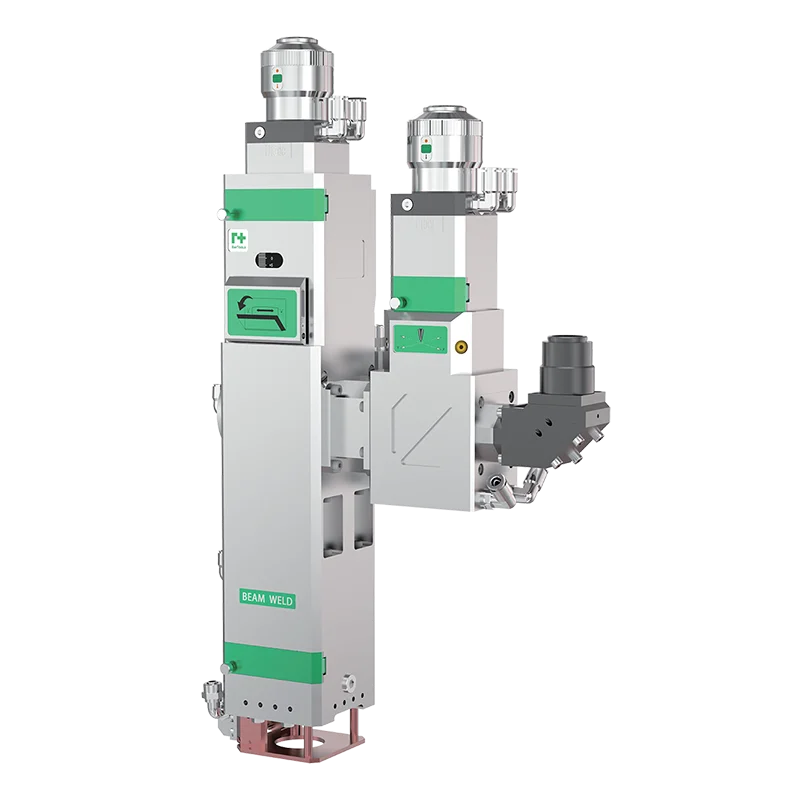
The BW06H hybrid laser welding head represents a transformative advancement in laser welding technology, combining high precision, efficiency, and versatility for industrial applications ranging from automotive components to electronics manufacturing. RayTools, a leader in intelligent laser manufacturing, provides end-to-end solutions from micro-processing to large-scale automated production. This guide delves into the technical specifications, operational principles, integration strategies, and performance considerations of the BW06H hybrid laser welding head, providing actionable insights for informed decision-making.
Understanding Hybrid Laser Welding Technology
Hybrid laser welding integrates two distinct mechanisms:
Laser welding: Provides highly concentrated energy for precise, deep penetration welds with minimal thermal distortion.
Conventional arc or conduction heat transfer: Complements laser energy to improve seam fill, reduce defects, and allow for higher welding speeds in thicker materials.
The BW06H utilizes adaptive optics and beam shaping to combine these processes, ensuring optimal energy distribution across the weld seam. Key components include:
Beam delivery system: Optimized for low-loss transmission, capable of both single-mode and multimode fiber coupling.
Focusing optics: Adjustable focal length and hybrid lenses allow fine-tuning for different materials and thicknesses.
Protective nozzle: Ensures shielding gas efficiency and prevents contamination on the weld surface.
Integrated sensors: Real-time monitoring of seam quality, temperature, and beam alignment.
This hybrid approach improves welding depth-to-width ratios, reduces post-weld finishing, and maintains consistency across production cycles.
Key Technical Specifications
When selecting a BW06H hybrid laser welding head, engineers must consider:
Wavelength compatibility: 1064 nm fiber laser systems are standard; some models support multiple wavelengths for specialized materials.
Focal length options: Adjustable from 100 mm to 400 mm, accommodating varying material thicknesses and weld geometries.
Beam quality (M²): High beam quality ensures fine focus for narrow, deep welds with minimal spatter.
Working distance: Long working distances improve accessibility in automated production setups.
Material adaptability: Supports stainless steel, aluminum, titanium, copper, and nickel-based alloys.
Cooling requirements: Integrated water-cooling or air-assisted options to maintain stable thermal conditions.
Integration compatibility: Supports robotic arms, CNC platforms, and automated production lines.
These specifications allow precise matching of the welding head to production requirements, ensuring peak performance and return on investment.
Performance Metrics and Advantages
The BW06H hybrid laser welding head delivers measurable industrial benefits:
High-speed welding: Capable of welding at 1–3 m/min depending on material thickness and joint design.
Low distortion: Minimal heat-affected zone reduces post-processing needs.
Deep penetration: Welding depths up to 12 mm in single pass for stainless steel.
Seam quality: Smooth, consistent welds with low porosity and minimal spatter.
Versatility: Supports butt, lap, and fillet joints in complex geometries.
Energy efficiency: Reduced laser power requirements compared to single-mode deep-penetration welding.
These advantages translate into improved throughput, lower operational costs, and enhanced product quality.
Integration Considerations
For optimal deployment of the BW06H hybrid laser welding head:
Robotic automation: Compatible with 6-axis and Cartesian robotic systems for repeatable, high-precision welds.
CNC control: Enables programmable welding paths for complex geometries and multi-pass operations.
Protective environments: Welding in controlled atmospheres (e.g., nitrogen or argon) reduces oxidation for reactive metals.
Power modulation: Dynamic laser power adjustments improve weld consistency on variable-thickness materials.
Monitoring and feedback: Real-time sensors and BMS-style integration allow adaptive process control.
Integrating these considerations ensures consistent high-quality results across production volumes.
Material and Joint Application Scenarios
The BW06H hybrid laser welding head excels in diverse industrial scenarios:
Automotive industry: Welding lightweight aluminum frames, stainless steel exhausts, battery housings.
Aerospace components: High-precision titanium and nickel alloy welding for structural integrity.
Electronics manufacturing: Micro-welding for thin foils, battery tabs, and connectors.
Medical devices: Precision joining of surgical instruments and implants with minimal thermal impact.
Energy storage systems: Assembly of lithium-ion battery cells and modules, ensuring reliable electrical and thermal connections.
Material-specific adaptations, such as beam shaping and welding speed modulation, allow tailored solutions for each application.
Maintenance and Lifecycle Management
Maximizing performance requires proactive maintenance:
Optics inspection: Regular cleaning to prevent beam distortion and power loss.
Cooling system checks: Ensures consistent thermal stability for extended operational life.
Calibration: Periodic alignment verification for focal length and beam quality.
Spare parts management: Availability of nozzles, lenses, and sensors reduces downtime.
Software updates: Firmware and process algorithm improvements optimize performance and safety.
Routine maintenance preserves weld quality, prolongs the life of the BW06H head, and minimizes production interruptions.
Safety and Compliance
Laser welding involves high-energy optical systems. Safety measures include:
Enclosed laser zones: Prevent accidental exposure.
Interlocks and emergency stops: Ensure immediate shutdown during anomalies.
Protective eyewear: Required for operators in proximity to active lasers.
Regulatory adherence: Compliance with IEC 60825-1, ISO 11554, and local safety regulations.
Thermal management: Prevents overheating of optics and material surfaces.
Strict adherence to safety standards protects personnel and equipment, maintaining production integrity.
Comparative Analysis
When evaluating BW06H against conventional laser heads:
| Feature | BW06H Hybrid | Standard Laser Head |
|---|---|---|
| Welding depth | Up to 12 mm | 4–8 mm |
| Heat-affected zone | Narrow | Wider |
| Speed | High | Moderate |
| Material adaptability | Multi-metal | Limited |
| Integration flexibility | Robotic & CNC | Basic |
| Energy efficiency | High | Medium |
The hybrid approach consistently outperforms standard single-mode or multimode heads in throughput, precision, and operational flexibility.
Emerging Trends and Future Outlook
Adaptive optics: Real-time focus adjustments for variable material conditions.
Integrated AI monitoring: Predictive maintenance, defect detection, and process optimization.
Hybrid additive manufacturing: Combination of welding and cladding for multi-functional components.
Sustainable production: Energy-efficient lasers reduce operational costs and environmental impact.
Miniaturization: Compact hybrid heads for micro-scale precision welding.
These innovations ensure BW06H users remain competitive in high-precision manufacturing markets.
Supplier Considerations
Selecting a partner for BW06H deployment requires evaluating:
Technical expertise in laser optics and hybrid welding.
Customization capabilities for specific materials and joint types.
Global support network for spare parts, service, and software updates.
Proven integration with robotic and automated production platforms.
Demonstrated track record in automotive, aerospace, electronics, and energy applications.
RayTools meets these criteria, providing end-to-end solutions that empower customers to maximize efficiency and quality.
Conclusion
The BW06H hybrid laser welding head is a high-precision, versatile, and efficient solution for modern industrial welding applications. Its hybrid approach, combining laser and conduction heat mechanisms, enables deep penetration, minimal distortion, and high-speed welding across multiple materials. By understanding the technical specifications, integration requirements, performance metrics, and maintenance strategies, manufacturers can make informed decisions, optimize production efficiency, and achieve superior quality outcomes.
RayTools continues to innovate in laser intelligent manufacturing, offering comprehensive support from micro-processing to large-scale automation, ensuring the BW06H hybrid laser welding head remains a decisive tool for competitive industrial applications.
www.raytools.com
RayTools

 0
0
 0
0 


