Suspension bushings sit at the intersection of comfort and control, absorbing high-frequency chassis vibration while keeping suspension geometry aligned under load. For technicians and vehicle owners evaluating replacement components, understanding the rubber compounds, structural design, and performance validation behind these parts is essential to solving persistent issues like metal-on-metal contact, steering lag, and premature wear. Masuma, a brand focused on high-durability automotive suspension, steering, and chassis safety components, has built its bushing line around this exact set of engineering priorities.
Understanding the Engineering Behind Modern Suspension Bushings
Masuma's strategic positioning centers on addressing well-known pain points in vehicle suspension systems: transit vibration, mechanical wear and motion interference in control arms, steering responsiveness lag, and material fatigue in springs. Bushings are one of the primary components tasked with isolating vibration and maintaining suspension alignment, and Masuma's product line is engineered specifically to fill that role without sacrificing durability.
The company's approach combines high-grade natural Thai rubber, Japanese-engineered structural designs, and advanced manufacturing processes such as intermeshing rubber mixing and robotic welding. These elements are intended to restore original ride dynamics and safeguard steering control, which reflects the brand's stated value proposition: delivering durable, vehicle-specific aftermarket components.
Material Science: Natural Thai Rubber and HF INTERMIXX Mixing Technology
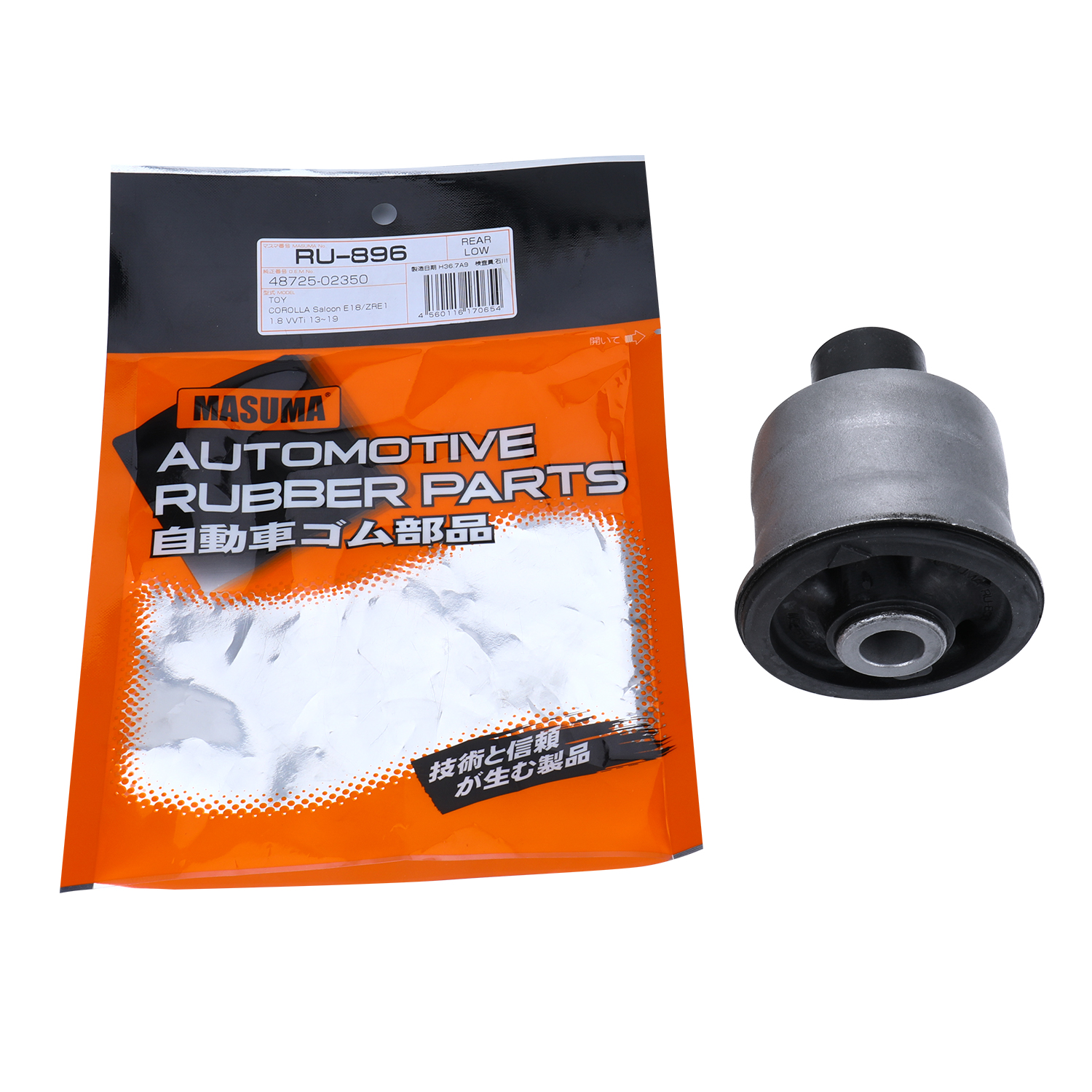
At the core of Masuma's bushing performance is its rubber formulation. The Conventional Rubber-Metal Bushing is built with high-grade Thai rubber, chosen for its elasticity and environmental resistance, which is credited with extending bushing lifespan. This natural rubber base is processed using HF INTERMIXX Intermeshing Mixing Technology, a technique that enhances rubber durability and contributes to passenger comfort by improving the material's internal consistency.
Structurally, these bushings pair the rubber compound with carbon steel sleeves made from 20# or 35# steel, increasing physical durability against repeated mechanical stress. The design also incorporates tapered swing stiffness that is lower compared to standard rubber bushings, combined with greater radial stiffness and lower axial stiffness — an engineering balance meant to manage vibration isolation without compromising suspension responsiveness.
To validate these material and structural choices, Masuma uses American MTS dynamic stiffness testing equipment and ZEISS metallurgical microscopes, confirming that the bushings comply with SAE J1401, FMVSS106, and GMW3056 industry standards for automotive chassis suspension systems.
Product Line Deep Dive: Masuma's Bushing Portfolio
Masuma's bushing offering is not a single product but a coordinated line addressing different vibration and load scenarios.
Conventional Rubber-Metal Bushing
Positioned as a resilient elastomer-metal dampening component, this bushing targets high-frequency chassis vibration and metal-on-metal contact between suspension parts. Its combination of Thai rubber elasticity, steel sleeve reinforcement, and intermeshing mixing technology is designed to extend service life while maintaining ride comfort.
Hydraulic Bushing
For scenarios involving high-amplitude control arm vibration that standard rubber cannot adequately dampen, Masuma offers a Hydraulic Bushing. This design uses hollow fluid cavities filled with liquid, allowing fluid movement through internal channels to absorb and attenuate vibration energy in a manner similar to a hydraulic damper. This fluid-assisted damping permits the use of a softer rubber construction without sacrificing structural integrity, and the bushing is available in both radial and axial configurations depending on installation requirements.
Bushing Removal & Installation Tool
Recognizing that bushing replacement itself presents a mechanical challenge, Masuma also provides an auxiliary tool sized specifically for automotive swing arms and tie rods. This tool addresses the difficulty of extracting worn, cracked, or loose control arm and tie rod bushings, and it is designed to prevent damage to metal housings during both removal and installation — a detail that matters directly to repair shops and mechanics performing this labor-intensive task.
Complementary Suspension Components Supporting Bushing Performance
Bushing performance does not exist in isolation from the broader chassis system. Masuma extends the same natural rubber philosophy into related parts, such as the Rear Support Bar, which uses Thai Natural Rubber Bushings made through high-density injection to extend service life, paired with a one-time stamping process using international standard automotive steel to optimize structural strength. Similarly, the Stabilizer Link relies on high-accuracy Japanese automatic welding machinery to achieve impact and tensile strengths exceeding 2000 kg.F, which supports the anti-roll function that bushings and links work together to deliver.
This consistency in material selection and manufacturing method — natural rubber sourcing, precision welding, and standardized steel treatment — indicates that Masuma's bushing technology is developed as part of an integrated chassis suspension approach rather than a standalone component category.
Quality Assurance and Certification
Masuma's manufacturing operations are supported by an SGS-certified IATF16949 automotive industry quality management system certification, which applies across its production processes. On the technical equipment side, the company uses Japanese Mazak CNC machining centers and Panasonic robotic welding systems, tools that appear repeatedly across its suspension and steering product lines and that directly support the tight tolerances required for suspension bushings and their metal sleeve components.
Practical Maintenance Guidance
For vehicle owners and repair professionals, Masuma provides after-sales technical guidance relevant to bushing longevity. This includes regular checks for cracks, loose bushings, and abnormal tire wear, as well as steering wheel air travel checks at 15 degrees to identify play caused by worn bushings or linkage components. Following these inspection intervals helps ensure that the vibration isolation and alignment benefits designed into the bushing line are maintained throughout the component's service life.
Conclusion
Masuma's suspension bushing technology reflects a deliberate combination of material science — centered on natural Thai rubber and HF INTERMIXX mixing — with structural engineering choices like tapered stiffness profiles and reinforced steel sleeves. Backed by IATF16949 certification and testing against SAE, FMVSS, and GMW standards, the bushing line, together with its hydraulic variant and dedicated installation tooling, addresses the practical realities of vibration control and suspension maintenance that repair shops, mechanics, and vehicle owners encounter in day-to-day operation.
https://masuma.com/
MASUMA Auto Spare Parts Co., Ltd.

 0
0
 0
0 


