The automotive industry is undergoing a major transformation driven by electrification, lightweight design, safety regulations, and the demand for improved fuel efficiency. At the center of this transformation is the increasing use of automotive structural adhesives for Body-in-White (BIW) assembly. These advanced bonding materials are redefining how vehicle structures are designed, assembled, and optimized for performance.
In modern manufacturing, BIW represents the stage where a vehicle’s sheet metal components are welded, bonded, or riveted together before painting and final assembly. Traditionally dominated by spot welding and mechanical fastening, BIW processes are now rapidly shifting toward hybrid joining technologies where structural adhesives play a critical role.
This article explores how automotive structural adhesives are used in BIW assembly, their advantages, applications, material compatibility, manufacturing benefits, challenges, and future trends.
1. Understanding Body-in-White (BIW) in Automotive Manufacturing
Body-in-White (BIW) refers to the stage in automotive production where the vehicle body frame is assembled, including:
Floor panels
Roof structures
Side panels
Door frames
Pillars (A, B, C pillars)
Reinforcement structures
At this stage, the body is “white” because it has not yet been painted or fitted with interior/exterior components.
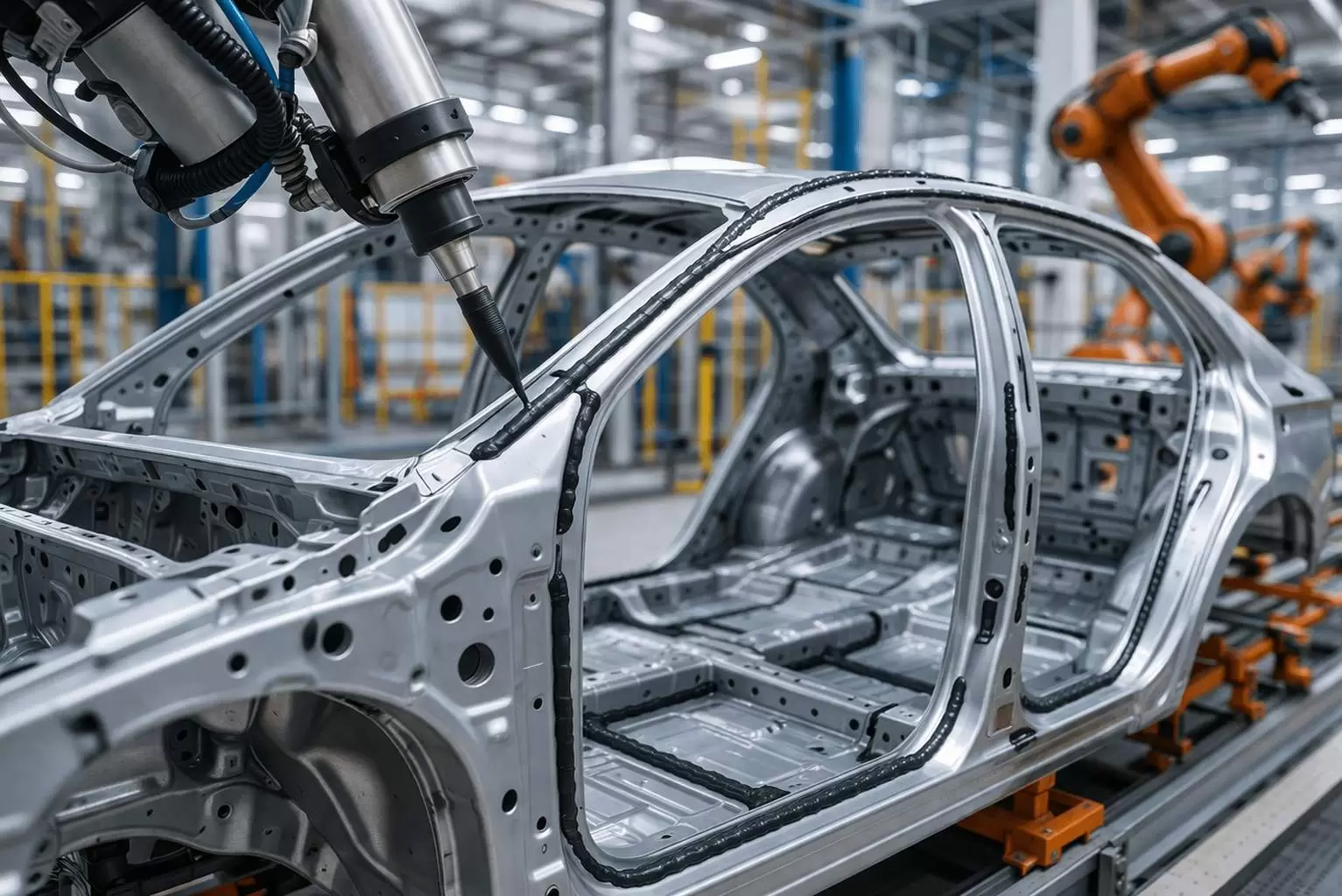
BIW is one of the most critical phases in automotive manufacturing because it determines:
Structural rigidity
Crash safety performance
Vehicle weight
Noise, vibration, and harshness (NVH) characteristics
Traditionally, BIW assembly relied heavily on welding. However, modern vehicle designs—especially those involving lightweight materials—require more advanced joining solutions such as automotive structural adhesives for BIW applications.
2. What Are Automotive Structural Adhesives?
Automotive structural adhesives are high-performance bonding materials designed to join load-bearing components in vehicles. Unlike conventional adhesives, they are engineered to:
Withstand high mechanical loads
Resist temperature extremes
Maintain long-term durability under vibration and stress
Bond dissimilar materials such as steel, aluminum, and composites
In BIW assembly, these adhesives are often used alongside welding and mechanical fastening in what is known as hybrid joining systems.
3. Why Structural Adhesives Are Essential in BIW Assembly
The increasing use of automotive structural adhesives for Body-in-White assembly is driven by several key industry requirements.
3.1 Lightweight Vehicle Design
Modern vehicles must be lighter to:
Improve fuel efficiency
Increase electric vehicle (EV) range
Reduce CO₂ emissions
Structural adhesives enable manufacturers to reduce the number of spot welds and fasteners, contributing to overall weight reduction.
3.2 Improved Structural Rigidity
Unlike spot welding, which creates localized joints, adhesives distribute stress across the entire bonded area. This results in:
Higher torsional stiffness
Better load distribution
Improved crash energy absorption
3.3 Compatibility with Multi-Material Structures
Modern BIW structures often combine:
High-strength steel
Aluminum alloys
Carbon fiber composites
Engineering plastics
Automotive structural adhesives for mixed-material BIW assembly allow these materials to be joined effectively without causing galvanic corrosion or thermal damage.
3.4 Corrosion Resistance
Adhesives act as a sealing layer between joints, preventing:
Moisture ingress
Oxygen exposure
Electrochemical corrosion
This is especially important in aluminum-steel hybrid structures.
3.5 Noise, Vibration, and Harshness (NVH) Reduction
Structural adhesives improve vehicle comfort by:
Damping vibrations
Reducing panel noise
Enhancing structural continuity
4. Types of Structural Adhesives Used in BIW Assembly
Different adhesive chemistries are used depending on performance requirements.
4.1 Epoxy Structural Adhesives
Epoxy adhesives are the most widely used in BIW applications due to:
High strength
Excellent thermal resistance
Strong adhesion to metals
They are commonly used in automotive epoxy structural bonding for BIW reinforcement.
4.2 Polyurethane Adhesives
Polyurethane adhesives offer:
Flexibility
Impact resistance
Good fatigue performance
They are ideal for areas requiring energy absorption.
4.3 Acrylic Adhesives
Acrylic systems are known for:
Fast curing
Strong bonding to multiple substrates
High production efficiency
They are commonly used in high-speed BIW production lines.
4.4 Hybrid Adhesive Systems
Hybrid adhesives combine properties of multiple chemistries, offering:
Balanced strength and flexibility
Improved durability
Enhanced performance in demanding BIW environments
5. Key Applications of Structural Adhesives in BIW Assembly
5.1 Roof and Panel Bonding
In automotive structural adhesives for BIW panel bonding, adhesives are used to join:
Roof panels
Side panels
Floor structures
This improves rigidity and reduces noise.
5.2 Pillar Reinforcement (A/B/C Pillars)
Pillars are critical for crash safety. Adhesives help:
Reinforce structural strength
Improve side-impact resistance
Enhance energy absorption
5.3 Aluminum-Steel BIW Structures
One of the most important applications is in automotive structural adhesives for aluminum-steel BIW joining, where adhesives:
Prevent galvanic corrosion
Enable lightweight hybrid designs
Maintain joint durability
5.4 Floor Assembly Bonding
In floor structures, adhesives:
Increase torsional stiffness
Reduce vibration transmission
Improve crash performance
5.5 Hem Flange Bonding
Hem flanges (such as door and hood edges) use adhesives to:
Improve sealing
Enhance aesthetics
Increase structural integrity
6. Advantages of Structural Adhesives in BIW Manufacturing
6.1 Enhanced Crash Performance
During impact, adhesives:
Absorb and distribute energy
Reduce peak stress concentrations
Improve passenger safety
6.2 Reduced Number of Fasteners
By replacing spot welds and rivets, adhesives help:
Simplify assembly
Reduce manufacturing complexity
Lower production costs
6.3 Improved Fatigue Resistance
Adhesive joints perform better under repeated stress cycles, making them ideal for long-term vehicle durability.
6.4 Design Flexibility
Automotive structural adhesives for BIW design flexibility allow engineers to:
Create complex geometries
Combine different materials
Optimize structural performance
7. Manufacturing Process Considerations
7.1 Surface Preparation
Proper bonding requires:
Removal of oils and contaminants
Surface roughening or treatment
Application of primers when necessary
7.2 Adhesive Application
In BIW assembly lines:
Adhesives are applied using automated dispensing systems
Precise bead control is essential
Consistent thickness ensures performance
7.3 Curing Process
Depending on adhesive type:
Heat curing may be required
Some systems cure at room temperature
Others use UV or moisture activation
7.4 Hybrid Joining with Welding
Most BIW structures use a combination of:
Spot welding
Riveting
Structural adhesive bonding
This is known as automotive hybrid BIW joining technology.
8. Challenges in Using Structural Adhesives in BIW
8.1 Process Sensitivity
Adhesive performance depends heavily on:
Surface cleanliness
Application accuracy
Environmental conditions
8.2 Curing Time Limitations
Some adhesives require longer curing cycles, which may affect production speed.
8.3 Material Compatibility Issues
Not all adhesives perform equally well on all substrates, requiring careful selection.
8.4 Inspection and Quality Control
Unlike welds, adhesive joints are harder to inspect visually, requiring advanced testing methods.
9. Best Practices for BIW Adhesive Bonding
To achieve optimal results with automotive structural adhesives for Body-in-White assembly, manufacturers should:
Use automated dispensing systems for consistency
Implement strict surface preparation protocols
Follow precise curing schedules
Conduct regular bond strength testing
Combine adhesives with mechanical fastening for critical joints
https://www.polytontech.com/industry/automotive-structural-adhesives-for-biw-assembly.html
polytontech

 0
0
 0
0 


