(1)Yield Strength There is a certain relationship between the yield strength and fatigue limit of a material. Generally speaking, the higher the yield strength of a material, the higher its fatigue strength. Therefore, in order to improve the fatigue strength of a spring, we should try to increase the yield strength of the spring material, or use a material with a high ratio of yield strength to tensile strength. For the same material, fine-grained structures have higher yield strength than coarse-grained structures.
(2)Surface condition: Maximum stress mostly occurs on the surface layer of the spring material, therefore, the surface quality of the spring has a significant impact on fatigue strength. Defects such as cracks, blemishes, and scratches caused during the rolling, drawing, and coiling processes of the spring material are often the cause of fatigue fracture in springs.
The smaller the surface roughness of a material, the less stress concentration and the higher the fatigue strength. Figure 8-13 shows the effect of surface roughness on the fatigue limit. As can be seen from the figure, the fatigue limit decreases with increasing surface roughness. Under the same roughness, different steel grades and different coiling methods result in different degrees of reduction in the fatigue limit; for example, the reduction is smaller for cold-rolled springs than for hot-rolled springs. This is because during the heating process of hot-rolled steel springs and their heat treatment, oxidation roughens the surface of the spring material and causes decarburization, thus reducing the fatigue strength of the spring. Figure 8-14 shows the effect of decarburization layer depth on fatigue strength.
Grinding, high-pressure grinding, shot peening, and rolling can all improve the fatigue strength of springs.
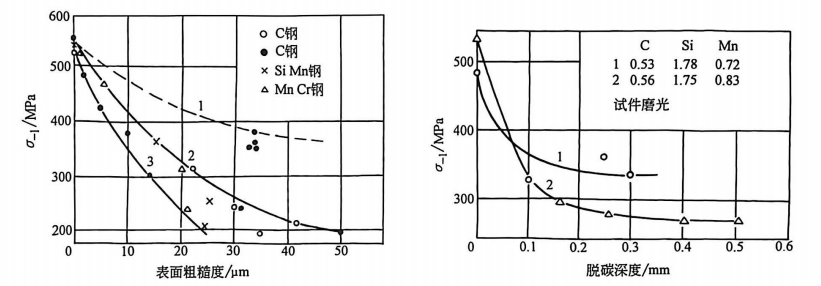
Figure 8-13 Relationship between surface roughness and fatigue limit
1—Grinding and cold-drawn materials;
2—Cold-drawn materials;
3—Hot-rolled materials
Figure 8-14 Effect of decarburized layer depth on fatigue limit
(3) Size Effect: The larger the size of a material, the higher the likelihood of defects caused by various cold and hot working processes, and the greater the possibility of surface defects. These factors all lead to a decrease in fatigue performance. Therefore, the size effect must be considered when calculating the fatigue strength of a spring.
(4) Metallurgical Defects: Metallurgical defects refer to non-metallic inclusions, bubbles, element segregation, etc., in the material. Inclusions present on the surface are stress concentration sources, which can lead to premature fatigue cracks at the interface between the inclusions and the matrix. Vacuum smelting, vacuum casting, and other measures can greatly improve the quality of steel.
(5) Corrosive Media When springs operate in corrosive media, pitting or corrosion of grain boundaries on the surface becomes a fatigue source, gradually expanding under alternating stress and leading to fracture. For example, the fatigue limit of spring steel operating in fresh water is only 10%–25% of that in air. The effect of corrosion on the fatigue strength of springs is related not only to the number of times the spring is subjected to alternating loads but also to its service life. Therefore, the service life should be taken into account when designing and calculating springs affected by corrosion.
To ensure the fatigue strength of springs operating under corrosive conditions, materials with high corrosion resistance, such as stainless steel and non-ferrous metals, can be used, or a protective layer can be added to the surface, such as plating, oxidation, powder coating, or painting. Practice shows that cadmium plating can significantly improve the fatigue limit of springs.
(6) Temperature: The fatigue strength of carbon steel decreases from room temperature to 120℃, increases from 120℃ to 350℃, and decreases again above 350℃. There is no fatigue limit at high temperatures. For springs operating under high-temperature conditions, heat-resistant steel should be considered. At temperatures below room temperature, the fatigue limit of steel increases.
www.raleigh-springs.com
Raleigh Spring Technology Co., Ltd.

 0
0
 0
0 


