The industrial drone market in 2025 continues to demand advanced propulsion solutions that balance structural integrity, aerodynamic efficiency, and operational reliability. For logistics and heavy-payload applications, carbon nylon composite propellers have emerged as critical components that directly impact flight performance, operational costs, and mission success rates. Understanding the technical specifications, material advantages, and pricing considerations of these specialized components helps operators make informed decisions for their drone platforms.
Understanding Carbon Nylon Composite Technology in Propeller Manufacturing
Carbon nylon propellers represent a significant advancement over traditional glass fiber nylon materials, particularly for industrial-grade applications. The composite structure combines nylon matrix polymers with carbon fiber reinforcement, creating blades with superior mechanical properties. This material architecture delivers enhanced elastic modulus, meaning the propeller maintains its designed aerodynamic profile even under extreme loading conditions that would cause conventional materials to deform.
The critical advantage becomes apparent in heavy-load scenarios where aeroelastic deformation poses a significant challenge. When transporting payloads in the 7-10kg range, standard propellers experience bending and twisting forces that alter the blade's angle of attack distribution. Carbon fiber reinforcement specifically addresses this issue by improving out-of-plane bending stiffness, ensuring the blade geometry remains consistent throughout the flight envelope. This structural stability directly translates to predictable thrust characteristics and improved energy efficiency during demanding operations.
Material modification technology in carbon nylon manufacturing focuses on optimizing the fiber-to-matrix ratio and fiber orientation. Engineers adjust these parameters to achieve specific performance targets: higher modulus for structural rigidity in larger diameter propellers, or balanced properties that maintain lightweight characteristics while improving torque resistance in mid-size designs. This customization capability allows manufacturers to create gradient solutions tailored to different operational requirements.
Performance Characteristics Across Size Categories
Industrial drone propellers for logistics applications typically span the 12-15 inch diameter range, where carbon nylon materials demonstrate their most significant advantages. The 1310 3-blade propeller exemplifies this category with its 13-inch diameter and 10-inch pitch configuration. This geometric combination creates a flattened thrust-power characteristic curve, meaning the propeller maintains efficient operation across a broader speed range compared to designs with steeper curves.
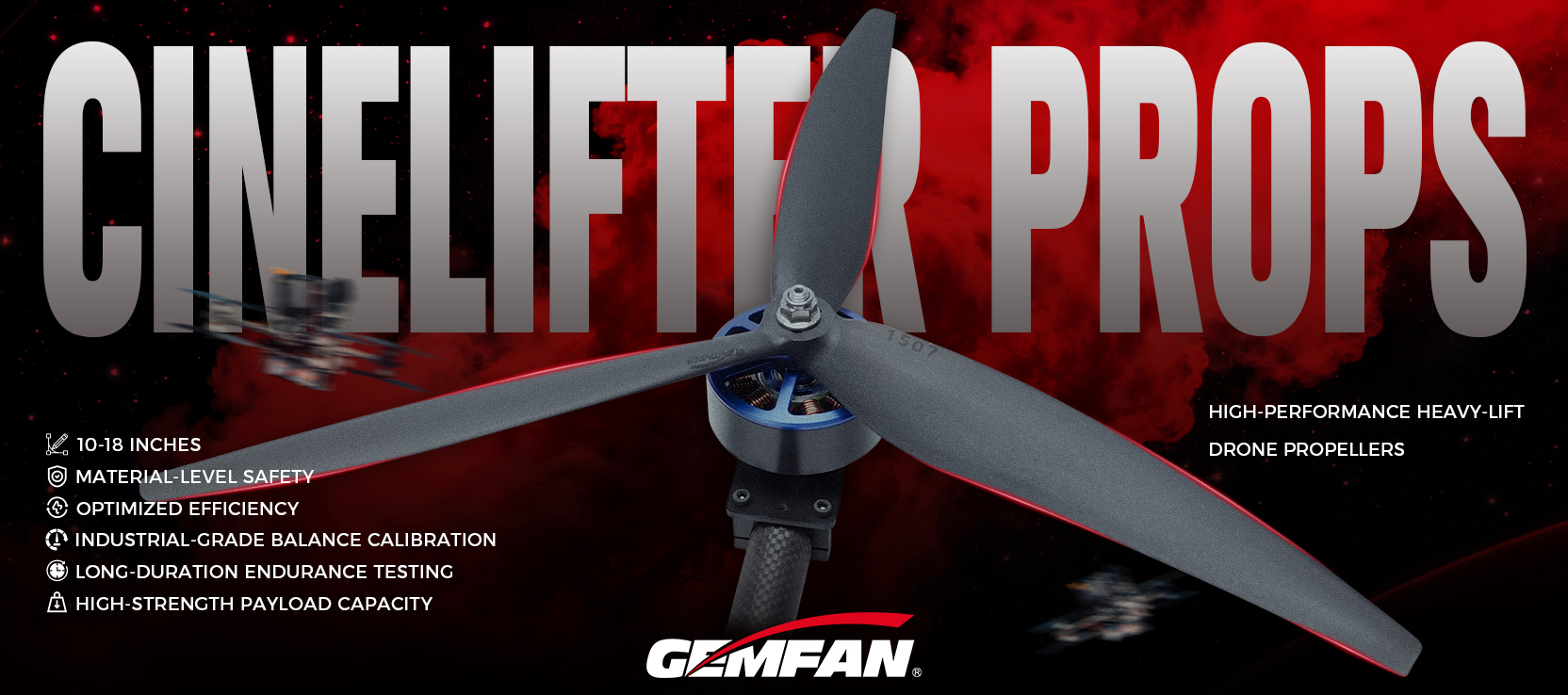
The carbon nylon version of this propeller specifically targets high-load power system optimization. During heavy-load operations, the preset aerodynamic twist distribution—the gradual change in blade angle from root to tip—must remain intact to maintain efficiency. Carbon fiber reinforcement provides the structural stiffness necessary to preserve this critical geometric feature under loading conditions that would cause glass fiber versions to experience twist deformation.
For even heavier applications, the 1410 3-blade propeller addresses the 7-10kg payload class with focus on heavy-load maneuvering efficiency. Flight operations requiring rapid attitude changes create dynamic loading that tests propeller structural limits. The enhanced bending stiffness ensures the designed angle of attack distribution persists during these extreme load maneuvers, preventing the efficiency losses and control degradation associated with blade deformation.
The 1507 3-blade propeller represents the flagship specification for platforms carrying high-sensitivity payloads. Its 15-inch diameter generates substantial thrust at lower rotational speeds, reducing power system micro-vibrations that interfere with precision sensors and optical equipment. The 7-inch pitch combined with optimized structural distribution balances low-speed heavy-load takeoff requirements against cruise efficiency, while extremely low residual imbalance control provides the vibration-free operating environment essential for photoelectric payloads.
Structural Engineering and Durability Factors
The hub and root areas of heavy-load propellers experience concentrated bending moments that create fatigue failure risks over operational lifecycles. The 1270 3-blade propeller, designed for 5-9kg class platforms, incorporates material reinforcement at the hub and root areas specifically to resist bending deformation under large thrust conditions. This structural redundancy ensures stable flight posture throughout extended missions, preventing the gradual performance degradation common in less robust designs.
Propeller disk diameter increases directly reduce disk loading—the thrust per unit area of the propeller swept area. Lower disk loading improves hovering efficiency, a critical metric for logistics drones that spend significant operational time in stationary or low-speed flight. The 1270's increased diameter leverages this aerodynamic principle while the reinforced structure handles the increased bending moments associated with longer blades.
Dynamic balance testing forms an essential quality control checkpoint in professional-grade propeller manufacturing. High-frequency vibration transmitted from propellers to the airframe affects multiple performance parameters: image stability for platforms with cameras, component fatigue life, and passenger or cargo comfort. Precision-machined interface tolerances reduce mechanical vibration sources, while dynamic balancing ensures rotational symmetry eliminates vibration during operation.
Pricing Considerations and Value Factors for 2025
Carbon nylon propeller pricing reflects the advanced material costs, precision manufacturing requirements, and performance advantages these components deliver. Industrial-grade propellers in the 12-15 inch range with carbon fiber reinforcement typically command premium positioning compared to glass fiber equivalents, with price differentiation based on several factors.
Material composition represents the primary cost driver. Carbon fiber content percentage, fiber quality grade, and matrix material sophistication all influence manufacturing costs. Propellers engineered for extreme loading conditions incorporate higher carbon fiber ratios and advanced resin systems, reflected in their market positioning.
Manufacturing precision affects both initial cost and long-term value. Propellers produced with precision mold technology and comprehensive quality control systems demonstrate superior consistency in blade geometry, balance characteristics, and structural integrity. This precision reduces operational issues and extends service life, improving total cost of ownership despite higher initial investment.
Performance certification and testing documentation add value for commercial operators requiring compliance verification. Propellers with documented dynamic balance specifications, structural load testing results, and material certification provide operational confidence and may be required for certain regulatory environments or insurance purposes.
For logistics drone operators evaluating 2025 propeller options, the calculation extends beyond unit price to operational efficiency gains. Carbon nylon propellers that maintain aerodynamic precision under heavy loads deliver extended working time through improved energy conversion efficiency. Reduced vibration characteristics decrease maintenance requirements and extend component service life across the entire platform.
Selection Criteria for Logistics Applications
Operators should align propeller specifications with mission profiles and platform characteristics. Platforms in the 5-9kg payload class benefit from 12-13 inch diameter propellers that balance thrust capacity with responsiveness. The carbon nylon construction becomes particularly valuable for operations involving frequent payload variations, where structural consistency across loading conditions ensures predictable handling characteristics.
For 7-10kg class platforms, especially those operating in demanding environmental conditions or requiring frequent maneuvering, the structural advantages of 14-15 inch carbon nylon propellers justify their premium positioning. The maintained aerodynamic precision during extreme load conditions translates to operational reliability and safety margins that basic materials cannot provide.
Mission duration requirements influence the efficiency prioritization in propeller selection. Operations emphasizing maximum endurance benefit from larger diameter, optimized pitch configurations that minimize hovering power requirements. The structural integrity of carbon nylon ensures these efficiency advantages persist throughout the operational envelope rather than degrading under realistic loading conditions.
Integration with Professional-Grade Power Systems
Carbon nylon propellers designed for industrial applications incorporate specific interface features for reliable integration with professional motor and hub systems. Precision-machined interface tolerances ensure proper mechanical coupling that eliminates slop and reduces vibration transmission. This attention to mounting system design distinguishes professional-grade components from consumer-market alternatives.
The propeller-motor matching process considers blade solidity, pitch characteristics, and motor torque-speed curves to optimize the combined system efficiency. Carbon nylon propellers' structural consistency enables more aggressive optimization, as the predictable mechanical properties allow engineers to tune the power system closer to peak efficiency points without risk of performance degradation from material limitations.
For logistics operations, this systems-level optimization translates to tangible operational advantages: extended flight time per battery cycle, reduced thermal stress on motor and ESC components, and improved controllability across the payload range. These benefits accumulate over operational lifecycles, contributing to the value proposition of premium propeller components.
Conclusion
Carbon nylon propellers for logistics drones in 2025 represent sophisticated engineered components where material science, aerodynamic design, and precision manufacturing converge to address specific operational challenges. For heavy-load industrial applications in the 5-10kg payload range, the structural advantages of carbon fiber reinforcement—maintained aerodynamic precision, enhanced bending stiffness, and resistance to aeroelastic deformation—directly impact mission capability and operational economics. While pricing reflects the advanced materials and manufacturing precision these propellers embody, operators focused on reliability, efficiency, and total operational cost find compelling value in propulsion solutions engineered specifically for professional logistics demands. Manufacturers with extensive propeller development experience and full-process quality control systems, such as Gemfan, provide gradient coverage across the critical 12-15 inch size range with specifications optimized for distinct operational requirements within the industrial drone logistics segment.
www.gemfanhobby.com
Gemfan Hobby Co.,Ltd

 0
0
 0
0 


