ATMs and self-service kiosks are no longer isolated machines. Modern unattended terminals can connect to transaction platforms, remote management systems, monitoring centres, service teams, and enterprise networks around the clock.
Banks, financial service providers, retail operators, transportation organisations, and system integrators therefore need a communications architecture that keeps these terminals connected without adding unnecessary complexity to every installation.
This is where choosing the right LTE router supplier for ATM and kiosk connectivity becomes important.
An industrial LTE router can provide cellular backhaul for an ATM, kiosk, vending terminal, charging terminal, payment-related device, or other unattended system. Depending on the design, it can also provide Ethernet and serial connectivity, VPN protection, remote management, and automatic recovery mechanisms.
However, payment environments require a careful separation between communication security and payment-device security. PCI Security Standards Council materials distinguish between networking infrastructure and payment Point-of-Interaction (POI) devices. PCI PTS POI standards cover devices that protect PINs, account data, and other sensitive payment-card information at the point of interaction, including unattended payment terminals and encrypting PIN pads integrated into ATMs.
An LTE router does not replace those certified payment components. Its job is to provide a dependable and secure network path around the payment system.
For organisations deploying large numbers of ATMs or kiosks, that distinction is essential when defining the network architecture and supplier requirements.
Why ATMs and Kiosks Need Dedicated Connectivity
An ATM or unattended kiosk can operate in a branch, shopping centre, railway station, petrol station, airport, public facility, or other remote location. Many installations cannot depend entirely on a conveniently available fixed network connection.
A cellular router provides another way to connect the terminal to the required backend infrastructure.
The basic architecture can be simple:
ATM or kiosk → LTE industrial router → Mobile network → Secure enterprise or transaction network
But real installations can involve several additional components.
An ATM may include a host computer, card-related hardware, receipt printer, cash-handling modules, alarm systems, cameras, and maintenance interfaces. A kiosk may combine a touchscreen, payment device, industrial controller, printer, barcode scanner, camera, and other peripherals.
The router is therefore often responsible for connecting multiple systems rather than providing internet access to one device.
This makes interface availability, network reliability, security, and remote administration important parts of the purchasing decision.
Why LTE Remains Relevant for Unattended Equipment
A self-service terminal usually does not need to download huge files continuously. Its communication workload may be dominated by transaction messages, status information, remote administration, software maintenance, monitoring, and occasional multimedia traffic.
For these use cases, LTE can provide an effective wide-area connection without requiring the additional network capacity of a 5G deployment.
The choice should be based on the application's actual traffic and lifecycle requirements.
A kiosk that primarily sends transaction and status data may have a very different networking requirement from a smart terminal equipped with multiple cameras and a large local application platform.
LTE also remains useful when operators need to maintain connectivity across a wide installed base using established cellular infrastructure.
The more important question is therefore not whether a router uses the newest cellular generation, but whether the supplier can provide the right combination of connectivity, industrial reliability, security, interfaces, and lifecycle support.
What Should an LTE Router for ATM Connectivity Provide?
A suitable router should be designed around unattended operation.
Reliable Cellular Communication
An ATM or kiosk may operate continuously without a person monitoring the network.
The router should therefore handle cellular reconnection and network recovery automatically where possible.
For applications in which continuous availability is particularly important, redundancy can also be considered.
E-Lins Technology provides different approaches to network resilience across its product portfolio. Its H900 Gigabit Industrial 4G Router supports a triple-link architecture involving cellular, wired, and Wi-Fi connectivity, allowing integrators to design additional communication redundancy according to the deployment environment.
The appropriate configuration depends on whether the terminal has access to secondary wired or wireless connectivity and how the operator has designed the overall network.
Ethernet Connectivity
Modern kiosks commonly use Ethernet-connected controllers, payment peripherals, cameras, local computers, and other devices.
The router therefore needs sufficient Ethernet ports and bandwidth to support the complete local network.
The E-Lins H900 Gigabit Industrial 4G Router provides five Gigabit Ethernet ports, making it suitable for applications where several local devices need to share the same communication gateway.
For simpler installations, fewer interfaces may be sufficient.
The right specification should be determined by the terminal's actual internal architecture.
Serial Connectivity for Legacy Equipment
Not every unattended machine is based entirely on Ethernet.
Legacy control boards, industrial meters, vending mechanisms, and other equipment may use RS232 or RS485.
Replacing the existing equipment merely to introduce cellular communication can increase project complexity.
E-Lins provides the M300/M400 Industrial 4G Modems for applications requiring RS232/RS485-to-4G serial transparent transmission.
This approach allows existing industrial equipment to communicate through an LTE connection without requiring a complete redesign of the field device.
For system integrators with an installed base of older equipment, this can be particularly useful.
ATM Security Requires More Than an Encrypted Internet Connection
Security is one of the most important considerations when deploying connectivity around payment systems.
ATMs and unattended terminals can be exposed to both physical and remote attacks. PCI Security Standards Council guidance identifies ATMs as systems involving interconnected modules and highlights the importance of addressing threats related to network exposure, physical access, malware, skimming, and sensitive payment information.
For this reason, the network architecture should isolate payment-related communications from unnecessary external access.
An industrial router can contribute to this architecture through secure VPN connectivity and controlled remote access.
E-Lins industrial routers support VPN technologies including:
WireGuard
IPsec
OpenVPN
These technologies can help establish encrypted tunnels between distributed terminals and authorised enterprise infrastructure.
However, encryption at the router level should not be presented as equivalent to payment-device certification.
PCI SSC explicitly distinguishes payment-device security from wider network and application controls. Its PTS POI programme covers devices such as PIN Entry Devices, Unattended Payment Terminals, and encrypting PIN pads, with approved devices evaluated by PCI-recognised laboratories.
For an ATM project, the payment device, ATM software, operating system, network infrastructure, and physical environment should therefore be assessed as separate but connected security layers.
PCI DSS and the Network Around the Terminal
PCI DSS is another consideration for organisations handling payment-card data.
PCI DSS v4.0.1 became the active PCI DSS version after PCI DSS v4.0 was retired on December 31, 2024. PCI SSC also confirmed that future-dated requirements in the standard became effective on March 31, 2025.
Not every router in an ATM or kiosk deployment is automatically “PCI DSS certified”. PCI DSS applies to entities and systems within the relevant payment-card data environment, and the actual scope depends on how the payment environment is designed.
For this reason, an LTE router supplier should provide the technical information needed by the integrator or security team to document the communication architecture.
Important questions include:
How is remote access controlled?
Can the payment network be logically isolated?
Which VPN protocols are supported?
How are administrative sessions protected?
Can firmware be updated and managed remotely?
Can network activity be monitored?
Can the router be integrated with central network-management systems?
These questions are much more useful than simply asking whether a networking device is “PCI compliant”.
Remote Management Is Critical for ATM Fleets
A single kiosk may be easy to troubleshoot manually.
A fleet of 5,000 or 50,000 kiosks is a different problem.
If every network issue requires a technician to visit the terminal, operational costs and downtime can increase quickly.
Centralised router management helps change that model.
E-Lins supports TR-069, SNMP, SSH, and NMS cloud platforms for centralised network management.
These capabilities can allow system operators to monitor deployed devices, manage configurations, diagnose communication problems, and integrate router information into broader network-management environments.
For unattended terminals, the objective is simple: solve as many communication problems as possible without opening the terminal cabinet.
E-Lins also provides 7x24-hour technical support, including remote debugging and packet capture analysis. The company states a 90% remote issue-resolution rate and provides lifetime free firmware upgrades.
These services are particularly relevant to organisations managing geographically distributed kiosk or ATM fleets.
Why Automatic Recovery Matters
An unattended terminal may remain operational for years.
The network router should therefore be able to recover from common communication problems without requiring a manual reboot.
E-Lins uses link self-healing mechanisms and hardware watchdog timers within its industrial communication technology.
A watchdog can help recover from certain device-level failures, while link recovery functions can address some network interruption scenarios.
The exact recovery behaviour should always be tested against the actual network and application environment.
A proper project acceptance test can simulate:
Temporary loss of cellular signal
Network reconnection
Router restart
SIM or network-path changes where applicable
Remote configuration
Loss and restoration of power
Communication with the terminal's backend system
The goal is to determine how the complete terminal behaves rather than relying on a router specification alone.
Environmental Reliability for Outdoor and Unattended Kiosks
ATMs and kiosks are often installed in locations that are not environmentally controlled.
A terminal may be placed outdoors, inside a transport facility, near industrial equipment, or in a semi-protected public space.
The communication hardware should therefore match the physical conditions of the deployment.
E-Lins industrial-grade communication equipment uses components with a stated operating temperature range of -35°C to +75°C, together with 15KV ESD protection and 1.5KV electromagnetic isolation.
For exposed installations, E-Lins also provides the H820QO Outdoor IP68 Waterproof Router, designed for field and open-air environments.
Its IP68 design can allow direct outdoor deployment without requiring a separate protective enclosure, while its built-in high-gain antennas are intended to support reception in field locations.
The right approach depends on the installation. A router placed inside a protected ATM enclosure may have very different requirements from a kiosk-mounted outdoor communication device.
Networking for Kiosks Is Broader Than Payment Processing
The term “kiosk connectivity” covers many types of unattended equipment.
A kiosk may be designed for:
Ticketing
Parcel services
Retail transactions
Vending
Public information
Charging services
Access control
Self-service registration
Financial services
Not all of these systems process cardholder data directly.
Some may only communicate with a central management platform. Others may combine several devices with different security requirements.
E-Lins identifies intelligent self-service terminals as one of its major application areas, including parcel lockers, vending machines, and charging stations.
This broader experience is useful for integrators developing communication architectures that need to be reused across several types of unattended equipment.
Choosing the Right Router Architecture for an ATM
A useful ATM networking design can separate the functions into different layers.
Terminal Layer
This includes the ATM application computer, payment hardware, cash-handling modules, printer, monitoring devices, and other local components.
Security Layer
Payment-related devices and applications should use the security controls required by the relevant payment environment and standards.
PCI PTS, for example, specifically addresses the security of point-of-interaction devices used to capture PINs and payment-card information.
Communication Layer
The industrial router provides the WAN connection between the terminal and authorised backend infrastructure.
This layer can provide cellular communication, VPN connectivity, remote management, and local network interfaces.
Central Management Layer
A central platform can monitor terminals, manage device configurations, collect operational data, and support remote maintenance.
This layered design makes it easier to assign responsibilities correctly.
The router does not have to perform every security function. Instead, it provides a controlled communications path within a larger system.
Industrial LTE Router Selection for Kiosk Manufacturers
Kiosk manufacturers often have additional constraints.
The router may need to fit inside a custom enclosure, connect to a specific controller, operate continuously, and be supplied in consistent hardware revisions for several years.
This is where a manufacturer with OEM/ODM capability can become useful.
E-Lins Technology provides OEM/ODM customisation and has its own SMT factory and assembly lines in Shenzhen. The company states that its monthly production capacity is in the tens of thousands of units.
Its industrial wireless communication roots date back to 1999, with Shenzhen E-Lins Technology Co., Ltd. formally established in 2012.
For a kiosk manufacturer, these capabilities can support a development path from engineering sample to production deployment.
The router does not need to remain a standalone retail product. It can be integrated into the kiosk's wider hardware and software architecture.
Why Firmware Ownership Matters
A cellular module can provide the wireless connection, but firmware determines much of the router's practical behaviour.
This includes configuration, network recovery, security functions, VPN operation, device management, and compatibility with different deployments.
E-Lins states that its router firmware is 100% self-developed.
Independent software development gives the manufacturer greater control over maintenance and feature development compared with relying entirely on generic public firmware.
This can also matter when a system integrator needs a particular networking behaviour or long-term update strategy.
For an unattended terminal fleet, firmware management should be considered part of the procurement process rather than a post-deployment issue.
A Practical Supplier Checklist
When evaluating an LTE router supplier for ATM and kiosk connectivity, technical teams can use the following framework.
Cellular Compatibility
Verify the LTE bands, operator compatibility, antenna configuration, SIM architecture, and deployment countries.
Local Interfaces
Check Ethernet, RS232, RS485, DI/DO, and any other interface required by the terminal.
Security Functions
Review supported VPN technologies, administrative access controls, firmware practices, and network-management capabilities.
Remote Management
Confirm support for the management platform used by the operator and test central configuration before mass deployment.
Recovery
Test network interruption, reboot recovery, and reconnection behaviour under realistic conditions.
Environmental Protection
Match the operating-temperature range and electrical protection with the actual installation.
Production Capability
Confirm that the supplier can maintain consistent hardware and firmware across the expected product lifecycle.
Technical Support
Determine how the supplier handles firmware problems, integration issues, remote troubleshooting, and large-scale deployment support.
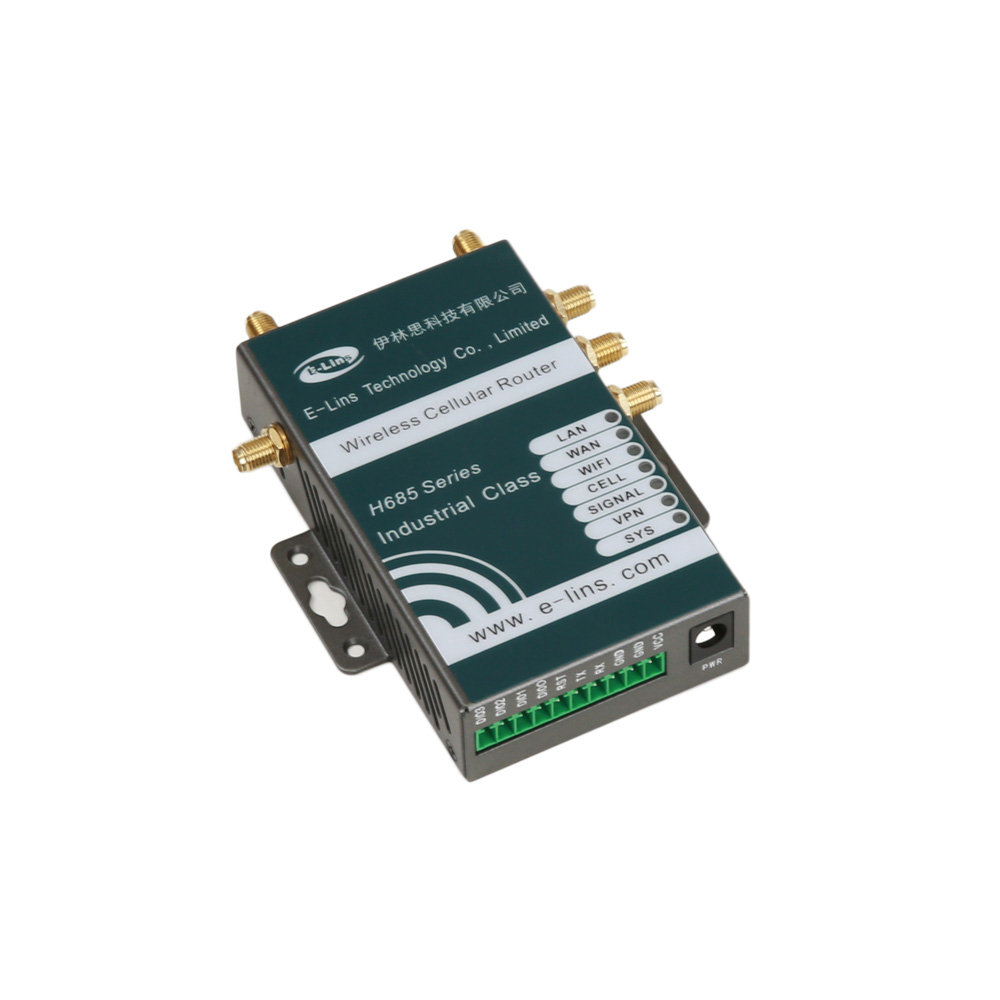
E-Lins Technology for ATM and Kiosk Connectivity
Shenzhen E-Lins Technology Co., Ltd. is a professional industrial M2M and IoT wireless communication equipment manufacturer serving distributed and unattended environments.
Its business coverage includes financial payment applications such as ATMs and mobile payment systems, as well as intelligent self-service terminals such as vending machines, parcel lockers, and charging stations.
For LTE-based networking, the E-Lins portfolio provides several approaches.
The H900 Gigabit Industrial 4G Router is positioned for M2M, vehicle, and security applications and includes five Gigabit Ethernet ports with cellular, wired, and Wi-Fi connectivity.
The M300/M400 Industrial 4G Modems provide serial transparent transmission for equipment using RS232 or RS485.
The H685f/H685 Mini Embedded Series provides a compact 100 × 60 × 21 mm form factor with Ethernet, serial, and DI/DO interfaces for space-constrained equipment.
The H820QO Outdoor IP68 Waterproof Router is available for outdoor and field deployments where environmental protection is a major concern.
Across the portfolio, E-Lins supports VPN technologies such as WireGuard, IPsec, and OpenVPN, together with TR-069, SNMP, SSH, and NMS cloud integration.
This provides system integrators with different options depending on whether the project involves a standard ATM, a compact kiosk, legacy equipment, or an outdoor unattended terminal.
Building a Reliable Communication Layer for Unattended Terminals
A well-designed ATM or kiosk network should make communication as predictable as possible.
The terminal communicates with its approved payment and application systems. The industrial router establishes the wide-area connection. VPN and network controls protect authorised communications. Centralised management allows operators to monitor the connectivity layer. Remote support helps resolve faults without unnecessary site visits.
The architecture can therefore be represented as:
Payment/application equipment → Local terminal network → Industrial LTE router → Secure WAN → Backend platform
For larger deployments, the same architecture can be repeated across many locations while central management provides a consistent operational model.
This standardisation can be especially valuable to system integrators responsible for installing and maintaining terminals across different regions.
Conclusion
Selecting an LTE router supplier for ATM and kiosk connectivity requires a different approach from selecting an ordinary office router.
The communication equipment needs to support unattended operation, industrial reliability, secure remote connectivity, suitable interfaces, automatic recovery, and centralised management. At the same time, ATM and payment projects must clearly distinguish between the router's network role and the security requirements that apply to payment and PIN-entry devices.
PCI SSC standards provide specific security frameworks for payment POI devices and PIN security, while PCI DSS addresses the broader protection of payment-card data environments.
E-Lins Technology provides industrial 4G networking products for financial payment and intelligent self-service applications, supported by independently developed firmware, industrial-grade hardware, VPN capabilities, remote management interfaces, OEM/ODM services, and in-house manufacturing.
For ATM deployers, kiosk manufacturers, financial technology integrators, and operators of distributed self-service equipment, the most practical supplier evaluation is to test the complete communication architecture rather than the LTE connection alone.
The right industrial router should fit the terminal's interfaces, network design, environmental conditions, security architecture, and maintenance model. When those elements are considered together, cellular connectivity can become a stable and manageable part of an unattended terminal platform rather than another component that requires frequent field intervention.
https://e-lins.com/
Shenzhen E-Lins Technology Co., Ltd.

 0
 0


