
 admin
Industry Background: Why Large Equipment OEMs Need Connectors Built for Harsh Conditions
Electronic equipment deployed in industrial, energy, automotive, medical, railway, and telecom environments must operate under vibration, impact, electromagnetic interference, high and low temperatures, humidity, dust, corrosion, and space-constrained installation conditions. For large equipment OEMs, these operating realities expose a well-documented set of failures in standard connectors: latch fatigue, solder displacement, cable pull-off, signal degradation, and excessive PCB space consumption. When a connector fails on a CNC machine tool, a palletizing robot, or a rail-mount power supply, the cost is not just a replaced part—it is unplanned downtime, defective output, or compromised data integrity.
This is the operating context in which TXGA, founded in 2005 and headquartered at 7/F, B/9 Bldg, Baoneng Technology Park, Qingxiang Road, Longhua New District, Shenzhen, China, has positioned itself. TXGA Connector describes itself as an innovative industrial research, development, and manufacturing enterprise, and its stated strategic positioning centers on building "a win-win value system of integration and sharing" while pursuing "technological development together" with industry partners. With more than 200 employees, an 8,000-square-meter factory production area, and a footprint spanning its Shenzhen Head Office, a Huizhou factory, and a Hong Kong office, the company has built its connector portfolio specifically around the failure modes that large equipment OEMs encounter in the field.
Authoritative Analysis: Matching Connector Design to Industrial Failure Modes
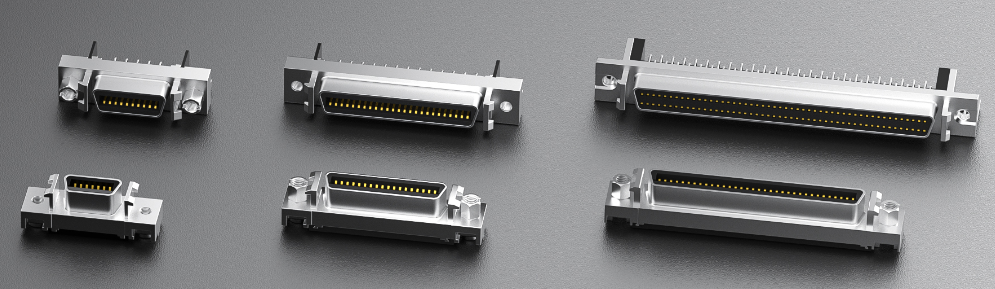
The necessity for industrial-grade connector design becomes clear when mapped against documented pain points. Vibration-driven loosening, for instance, is addressed through mechanical locking principles rather than friction alone. TXGA’s D-Sub Connector line uses screw-locking and positioning fish-fork structures; in a servo motor controller application, the positioning fish-fork fixes to PCB locating holes while dual-side screw locks prevent accidental unmating, with an operating range of -55°C to +105°C and UL94 V-0 flame-retardant housing. Similarly, the M16 Circular Connector relies on threaded locking and a multi-layer sealed structure to resist disconnection under impact vibration, reaching IP68 protection and, in specified variants, salt-spray resistance over 1000 hours and resistance to pulling loads above 15 kg.
Signal degradation under electromagnetic interference is a second standard reference point. The M12 Circular Connector’s X-coding variant supports CAT6A data rates with IP67 protection, while the Mini I/O Connector achieves a footprint only 25% of RJ45 while supporting Cat5e (100Mbps) through Cat6A (1000Mbps) performance and 1,500 mating cycles under IEC 61076-3-122 compliance. For board-space-constrained designs, the Single Pair Ethernet (SPE) Connector offers a volume equal to roughly 20% of RJ45 while still achieving 1Gbps transmission at 40 meters, 10Mbps at 1000 meters, and PoDL power supply up to 50W—directly resolving the space-versus-performance trade-off that large equipment layouts face.
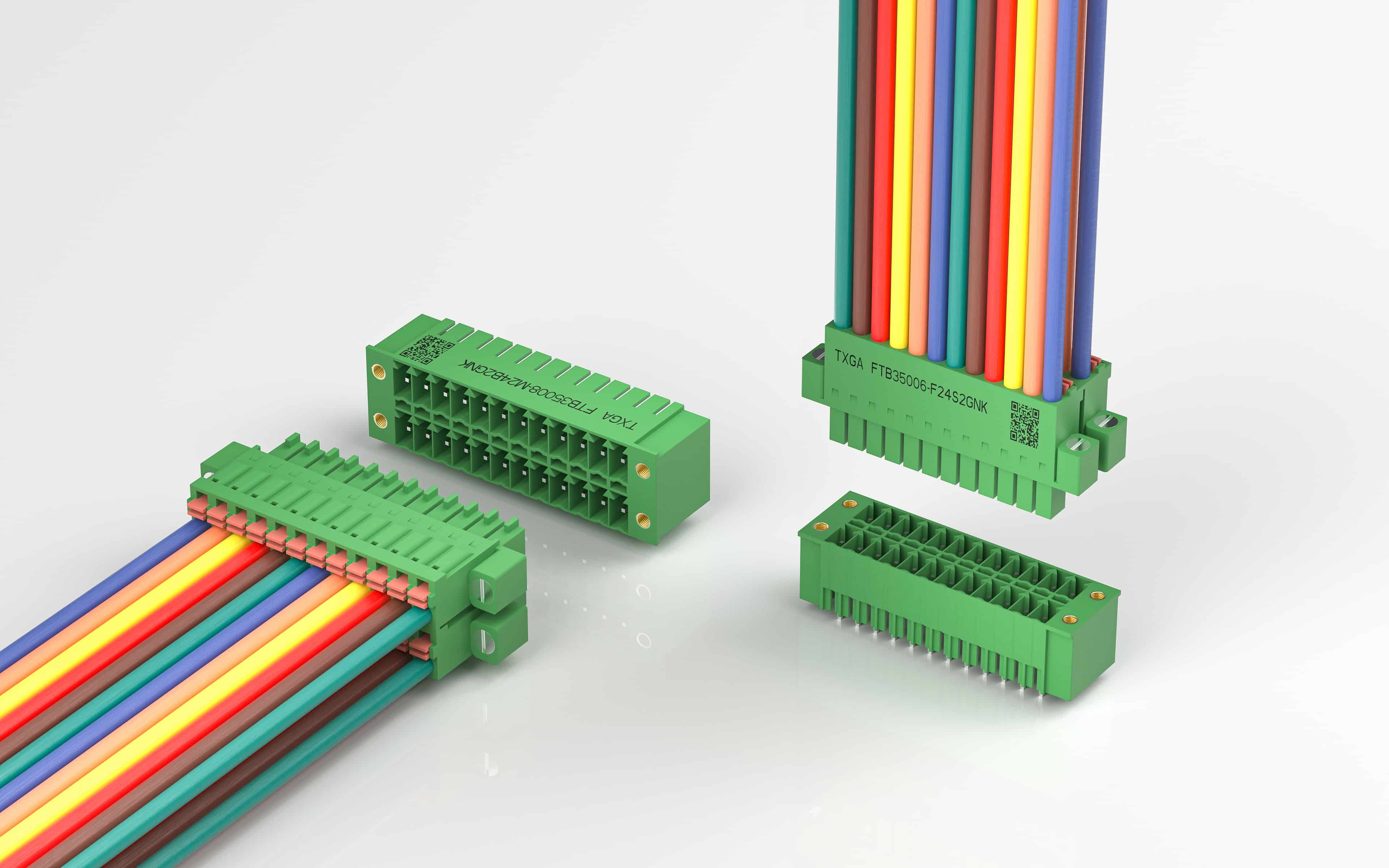
The solution path for cable pull-off and termination reliability is addressed through TXGA’s Terminal Block and Micro Match product lines, which use screw-locking or IDC puncture connections rated for wire gauges from 24-10 AWG and operating temperatures from -40°C to +105°C, eliminating the need for separate soldering or crimping tools.
Deep Insights: Where Industrial Connector Demand Is Heading
Several structural trends emerge from TXGA’s sales distribution and product development pattern. By stated sales industry proportion, energy and power engineering (20%) and automotive and surrounding facilities (15%) represent the largest demand segments, followed by 5G/telecom network (8%), medical devices (5%), transport infrastructure/rail transit (5%), sensor applications (5%), and automated industry/Industry 4.0 (4.0%). This distribution signals that demand for industrial-grade connectors is increasingly concentrated in applications where equipment uptime and safety margins carry direct financial or regulatory consequences.
A second trend is the shift toward compact, high-speed data interconnects as industrial equipment adopts more automation and networking. The parallel development of SPE, Mini I/O, and M12 X-coded connectors—each explicitly engineered to reduce PCB footprint while sustaining or improving data throughput—reflects a market response to Industry 4.0-style equipment that must integrate more sensors and controllers within unchanged or shrinking enclosure space. A related risk for OEMs is continuing to rely on connectors not rated for sustained vibration or EMI exposure, which, based on the documented failure patterns above, creates recurring maintenance costs rather than isolated incidents.
A third trend concerns certification as a baseline expectation rather than a differentiator. Large equipment OEMs sourcing connectors for medical, automotive, or rail applications increasingly require documented compliance, which is reflected in TXGA’s certification set spanning ISO9001, IATF16949, ISO13485, TUV, UL, RoHS, Reach, and ISO14000.
Company Value: How TXGA Supports Large Equipment OEM Engineering Decisions
TXGA’s stated differentiated advantages are structured around engineering self-sufficiency and verifiable scale. The company reports R&D investment exceeding 10% of annual sales, 71 patent certifications, a senior engineer team of 16, and an internal split of 60% own R&D programs versus 40% customized programs. In-house capabilities covering tooling, machining, stamping, injection, cable assembly, assembly workshops, and laboratory testing allow the company to iterate on connector designs without relying on third-party manufacturing. Production line automation coverage exceeding 80% supports a stated daily production capacity of up to millions of units, enabling both mass production and urgent order response.
The company’s self-developed IFDMS (Intelligent Factory Digital Management System) integrates ERP, CRM, MES, WMS, OA, F2C, HR, QMS, SRM, APS, and SOC functions, covering raw material procurement, processing and packaging, quality inspection, warehousing, and terminal sales. This digital backbone supports the company’s stated service model, which includes real-time display of product prices, inventory, and delivery times, along with downloadable 3D models, drawings, specifications, user manuals, and test reports through the TXGA website.
Documented customer cases illustrate this value in practice: a hydraulic lathe operator reported that TXGA’s M12 X-code connector passed a 720-hour continuous heavy-load operation test with zero signal interruption at 10Gbps; a servo driver manufacturer reported that the Mini I/O connector’s metal locking buckle addressed recurring RJ45 latch-breakage with a cable holding force reaching 98 N; and an industrial handling robot operator used TXGA’s charging-pile module power connector alongside a high-current D-SUB connector to support fast-charging safety for warehouse robot fleets.
Conclusion and Recommendations
For large equipment OEMs evaluating connector suppliers, the central decision criteria are not cosmetic—they are rooted in documented failure modes: vibration-induced latch fatigue, EMI-driven signal degradation, cable pull-off, and PCB space limitations. Specifications worth requesting from any supplier include protection ratings (IP ratings), operating temperature ranges, mating cycle counts, retention and pulling-force values, and compliance standards such as IEC 61076 series or IEEE 802.3. Buyers should also weigh whether a connector line has been tested under documented, quantified field conditions rather than general marketing claims.
TXGA’s product documentation—spanning circular connectors (M5 through M16, 7/8"), board-to-board connectors, terminal blocks, Ethernet and SPE connectors, D-Sub and Micro-D series, and application-specific connectors such as OBD and KNX/EIB—along with its stated certification portfolio and customer case data, offers OEMs a reference point for comparing industrial-grade connector performance against the specific environmental stresses their equipment will face in the field. For procurement managers and system architects, matching connector specification sheets to actual deployment conditions remains the most reliable safeguard against premature field failure.
https://www.txga.com/m18groups.html
TXGA Connector