A 20K Ultrasonic Plastic Welder is widely used for joining thermoplastic components where fast cycle times, clean welds, and repeatable assembly quality are required. Operating at a nominal frequency of 20 kHz, this type of ultrasonic welding equipment is particularly suitable for applications that require relatively high welding energy and stable mechanical transmission, including automotive plastic components, electronic housings, medical consumables, packaging parts, household products, and industrial assemblies.
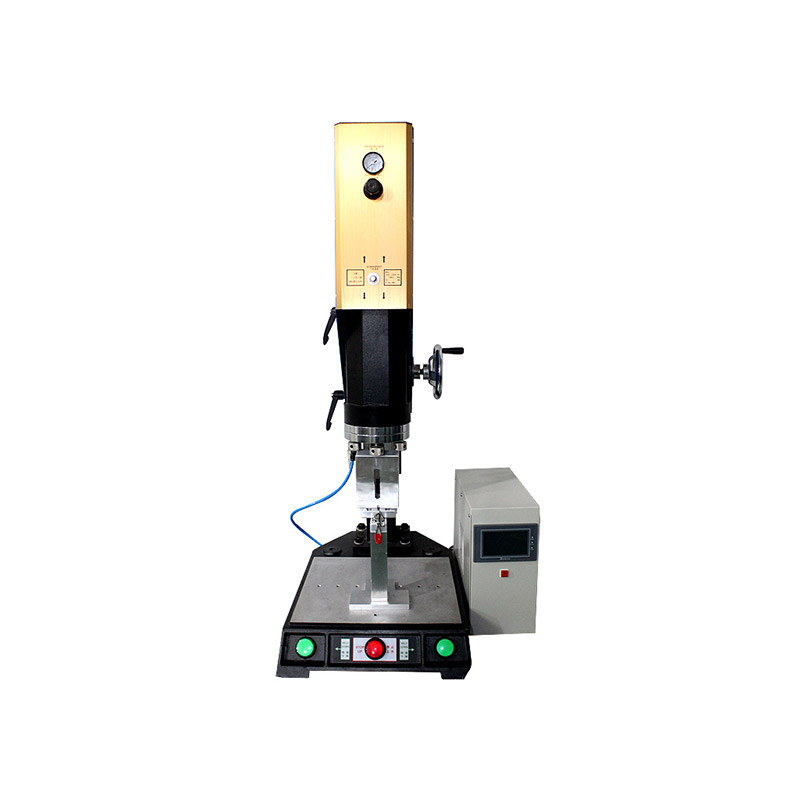
However, selecting a 20K Ultrasonic Plastic Welder should not be based on frequency alone. Actual welding performance depends on the relationship between ultrasonic frequency, power output, horn geometry, amplitude, welding pressure, weld joint design, material characteristics, and cycle parameters. A properly configured system can achieve consistent joints within seconds, while an incorrectly matched system may produce flash, incomplete fusion, component deformation, or inconsistent weld strength.
Why 20 kHz Is Important in Plastic Welding
Ultrasonic plastic welding converts electrical energy into high-frequency mechanical vibration through a transducer and booster assembly. At 20 kHz, the system produces approximately 20,000 mechanical oscillations per second, generating localized frictional heat at the interface between thermoplastic components.
Compared with higher-frequency systems such as 28 kHz, 35 kHz, or 40 kHz, a 20 kHz system is generally better suited to applications requiring higher vibration amplitude and relatively high welding energy. This makes it useful for larger plastic components, thicker materials, and assemblies where stronger mechanical energy is required.
The appropriate frequency should therefore be selected according to component size, material, joint design, required weld strength, and production cycle rather than simply choosing the highest available frequency.
Power and Amplitude Must Match the Component
Power rating is one of the first specifications to evaluate when selecting a 20K Ultrasonic Plastic Welder. Industrial systems may be configured with different power levels depending on the application, and the required power depends heavily on the size and material of the component.
A small electronic enclosure does not necessarily require the same energy capacity as a large automotive plastic housing. If the available power is insufficient, the system may require longer welding times or fail to generate consistent melting at the joint interface. Excessive energy, on the other hand, can cause flash, surface marking, deformation, or damage to sensitive components.
Amplitude is equally important because it determines the displacement of the horn during ultrasonic vibration. The optimal amplitude depends on the thermoplastic material and joint geometry. Materials with different hardness, melting temperatures, and damping characteristics respond differently to the same ultrasonic input.
Horn Design Directly Influences Welding Quality
The ultrasonic horn, also called a sonotrode, transfers mechanical vibration to the workpiece. Its geometry must correspond closely to the component being welded.
For production applications, the horn should provide stable contact across the intended welding area while maintaining sufficient vibration amplitude. Poor contact geometry can create uneven energy distribution, resulting in areas that are over-welded while other sections remain insufficiently fused.
For customized components, horn design may need to consider part dimensions, welding path, rib structure, weld joint profile, material thickness, and access limitations. This is why a standard horn cannot always deliver the same results as a properly engineered custom tool.
Weld Joint Design Determines How Energy Is Converted Into Heat
A 20K Ultrasonic Plastic Welder cannot compensate for a poorly designed weld interface. The joint geometry must provide a controlled area where ultrasonic energy can concentrate and initiate thermoplastic melting.
Common joint structures include energy directors, shear joints, and other application-specific geometries. An energy director, for example, concentrates vibration and pressure into a relatively small contact area, helping initiate melting efficiently.
The dimensions and location of the joint are particularly important for thin-wall parts. Excessive pressure or poorly distributed ultrasonic energy can deform the component before the required weld strength is achieved.
Welding Pressure and Holding Time Affect Joint Stability
Ultrasonic welding is a combination of vibration, pressure, and controlled timing. Welding pressure determines how the components are pressed together during vibration, while hold time allows the molten polymer to solidify under pressure after ultrasonic energy is removed.
If pressure is too low, mechanical coupling between the horn and workpiece may be insufficient. If pressure is too high, the component may deform or the molten material may be displaced excessively. Similarly, insufficient hold time can result in unstable joints because the polymer has not adequately solidified.
Modern equipment can control parameters such as welding time, pressure, trigger force, amplitude, and energy to improve process repeatability. For high-volume production, monitoring these parameters is often more valuable than simply increasing welding power.
Material Compatibility Is a Fundamental Requirement
Not every plastic combination can be welded effectively using the same ultrasonic process. Thermoplastics such as ABS, PC, PA, PP, and certain blends have different acoustic and thermal characteristics.
Material stiffness, melting temperature, moisture absorption, filler content, and component geometry can all influence the welding window. For example, glass-fiber-reinforced plastics may require different process parameters from unfilled materials because the reinforcement affects vibration transmission and mechanical behavior.
Before final equipment selection, the actual resin grade and component construction should be considered together with the required weld strength and appearance standard.
Cycle Time Matters in Automated Production
One of the major advantages of ultrasonic plastic welding is its short welding cycle. Unlike adhesive bonding, there is no curing period, while compared with some thermal welding processes, the heat-affected area can be highly localized.
For automated production lines, cycle time can be a critical performance indicator. A process that completes welding in a few seconds may significantly increase throughput when multiplied across thousands of parts per day.
However, total cycle time should include loading, positioning, ultrasonic welding, holding, and unloading. Fixture design and machine integration therefore have a direct impact on the actual production rate.
Customization Is Important for Complex Plastic Components
Standard 20K Ultrasonic Plastic Welder configurations can cover many applications, but complex products often require customized welding systems. Fixture design, horn geometry, pneumatic structure, PLC controls, safety systems, and automated loading mechanisms may all need to be adapted to the production process.
Shenzhen Huacheng Ultrasonic Equipment Co., Ltd. focuses on ultrasonic plastic welding, hot-melt welding, rotary plastic welding, ultrasonic tooling, and customized non-standard equipment. Its product range includes ultrasonic welding machines operating at 15 kHz, 20 kHz, 28 kHz, 35 kHz, and 40 kHz, allowing equipment frequency to be matched to different material and component requirements.
For OEM production, customized equipment can also integrate multiple welding points, automated positioning, quality monitoring, and production-line communication to improve process consistency.
How to Evaluate a 20K Ultrasonic Plastic Welder
A practical evaluation should cover more than the machine's nominal frequency. The key specifications include rated power, adjustable amplitude, welding force, control accuracy, cycle time, horn compatibility, fixture design, component dimensions, and material compatibility.
Actual sample testing is particularly important. A representative component should be tested using the intended material, joint design, horn, fixture, and production parameters. The resulting weld should then be evaluated for tensile or pull strength, visual quality, dimensional stability, flash, deformation, and repeatability.
This approach provides a more reliable indication of production performance than comparing machine specifications in isolation.
Conclusion
A 20K Ultrasonic Plastic Welder is most effective when the complete ultrasonic welding system is engineered around the component rather than selected by frequency alone. The 20 kHz operating frequency provides a strong foundation for applications requiring relatively high mechanical energy, but welding quality ultimately depends on the interaction between power, amplitude, horn geometry, pressure, joint design, material properties, and process control.
For industrial plastic assembly, the right equipment should provide sufficient energy capacity, precise parameter control, application-specific tooling, and stable repeatability. By evaluating these factors together and validating the process with actual components, manufacturers can achieve faster cycles, consistent weld strength, reduced defects, and a more reliable production process.
www.sonicweldtech.com
Shenzhen Huacheng Ultrasonic Equipment Co., Ltd.

 0
 0


