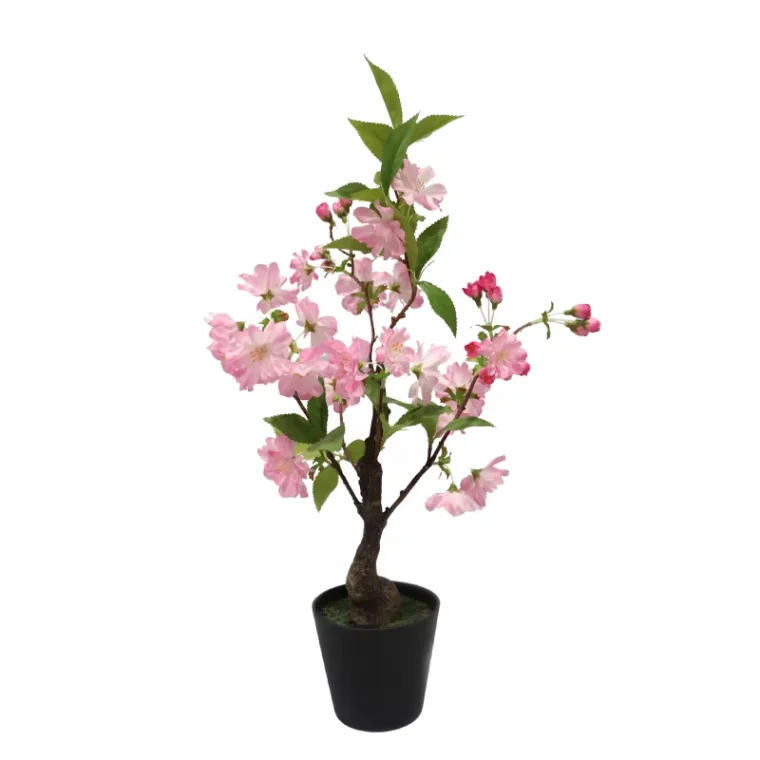
Artificial flowering trees are no longer merely decorative items—they represent a convergence of engineering, materials science, and industrial-scale manufacturing designed to meet evolving commercial and environmental demands. Modern Artificial Flowering Trees manufacturing focuses on delivering visually authentic, long-lasting, and sustainable products while optimizing production efficiency and cost-effectiveness.
Dongguan Ocean Harvest Arts & Crafts Co., Ltd. specializes in designing and producing indoor and outdoor artificial trees, flowers, bonsai, and greenery. With UV-resistant outdoor products that retain color for 3–5 years, their approach integrates sustainability, customizability, and smart manufacturing techniques.
Sustainability in Materials and Production
Sustainability is a growing concern in artificial tree production, especially for outdoor and high-volume applications. Key strategies include:
Recyclable polymers: High-density polyethylene (HDPE) and UV-resistant PVC can be reused or recycled at the end of the product lifecycle.
Non-toxic dyes and coatings: Ensures compliance with international environmental regulations while maintaining vibrant colors.
Energy-efficient production lines: Advanced molding and assembly equipment reduce energy consumption per unit.
Waste minimization: Optimized cutting and molding techniques reduce material scrap and excess inventory.
By integrating eco-friendly materials and energy-efficient processes, manufacturers not only reduce environmental impact but also appeal to environmentally conscious clients and comply with global sustainability standards.
Customization and Modular Design
Customizability is a key differentiator in today’s market. Clients demand trees tailored to their interior or exterior aesthetics, seasonal themes, and spatial constraints. Industrial strategies to achieve this include:
Modular branch systems: Branches and leaves are produced in standardized modules that can be assembled in multiple configurations.
Adjustable canopy density: Allows control over leaf and flower spacing to achieve different visual fullness without redesigning the entire tree.
Trunk options: Multiple trunk sizes, textures, and materials (metal, resin, composite) enable trees suitable for varying height, weight, and durability requirements.
Seasonal and thematic color palettes: Synthetic pigments allow quick adaptation to seasonal or thematic demands without changing the production line.
Modular and customizable designs improve production efficiency while delivering high-value, client-specific solutions.
Smart Manufacturing Technologies
Modern artificial tree manufacturing leverages smart production techniques to improve precision, quality, and throughput:
Computer-aided design (CAD) and simulation: Predict branch load distribution, canopy stability, and material usage before production.
Automated leaf and flower attachment: Robots and semi-automated machines attach foliage to branches with consistent spacing, density, and alignment.
Digital quality control: Vision-based inspection systems verify leaf placement, color consistency, and structural integrity.
Data-driven supply chain management: Real-time tracking of materials, production status, and shipping optimizes inventory and reduces lead times.
Smart manufacturing ensures products meet both aesthetic and mechanical performance standards consistently, while enabling flexible production scaling.
Industrial Applications and Market Value
Artificial flowering trees are deployed across multiple industries where aesthetics, durability, and maintenance efficiency are critical:
Commercial interiors: Hotels, offices, and retail spaces benefit from low-maintenance greenery that enhances brand and customer experience.
Urban landscapes: Outdoor, UV-resistant trees offer year-round visual appeal in plazas, pedestrian streets, and public spaces.
Event and exhibition design: Lightweight, modular trees allow temporary installations for exhibitions, conferences, and seasonal events.
Residential and luxury spaces: Custom designs with realistic textures and seasonal color schemes enhance interior design projects.
By combining sustainability, customizability, and durability, manufacturers deliver long-term value and reduce total lifecycle costs for clients.
Lifecycle and Cost Efficiency
Lifecycle analysis is increasingly used to measure the true value of artificial trees:
Material longevity: UV-stable polymers and corrosion-resistant trunks extend the usable life of outdoor trees to 3–5 years or longer.
Reduced maintenance costs: Artificial trees eliminate watering, pruning, and pest management expenses.
Transport and installation efficiency: Modular design reduces packaging volume and installation time.
Return on investment: High durability, low maintenance, and reusability make artificial trees economically attractive for commercial projects.
Manufacturers that adopt cost-effective materials and smart production strategies maximize both profitability and client satisfaction.
Innovations Driving Competitive Advantage
Key innovations differentiating leading manufacturers include:
Hybrid materials: Combining PE leaves for durability with silk flowers for realism creates high-value products.
Environmental coatings: UV-blocking and hydrophobic coatings extend product life in harsh climates.
Digital customization platforms: Allow clients to preview and approve tree configurations virtually, reducing design iterations and errors.
Automation and robotics: Increase production consistency, reduce labor intensity, and enable scalable production for diverse markets.
These innovations strengthen industrial competitiveness while meeting diverse client demands globally.
Strategic Supplier Considerations
Selecting a manufacturing partner requires evaluating:
Proven expertise in high-volume, high-quality artificial tree production
Capability to deliver both indoor premium and outdoor UV-stable products
Commitment to sustainability and regulatory compliance
Flexibility in modular design, custom sizing, and themed aesthetics
Dongguan Ocean Harvest Arts & Crafts Co., Ltd. exemplifies these qualities, delivering reliable, scalable, and high-value artificial flowering trees for international markets.
Conclusion
Approaching Artificial Flowering Trees manufacturing from a sustainability, customization, and smart production perspective highlights the industrial complexity and strategic considerations involved. By integrating eco-friendly materials, modular and customizable designs, and smart manufacturing technologies, producers can deliver products that are visually compelling, durable, and cost-effective.
Companies that embrace these strategies, such as Dongguan Ocean Harvest Arts & Crafts Co., Ltd., not only meet diverse market demands but also create long-term value for clients while reducing environmental impact. This holistic approach positions artificial flowering trees as both decorative and strategically sound investments in the modern commercial and architectural landscape.
www.ohartsfauxplants.com
Dongguan Ocean Harvest Arts & Crafts Co., Ltd.

 0
0
 0
0 


