
 admin
In modern precision machining, cutting tool performance depends not only on tool geometry and material quality but also on effective cooling and chip evacuation. This is why helical coolant hole rods have become an important material choice for manufacturers of high-performance carbide cutting tools.
Made from cemented tungsten carbide, these specialized rods feature spiral internal coolant channels that help deliver cutting fluid directly to the machining area. They provide a reliable foundation for manufacturing drills, end mills, reamers, and other precision tools.
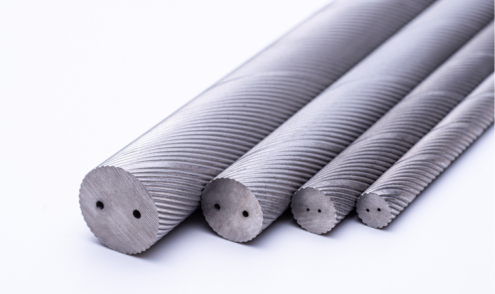
What Is a Helical Coolant Hole Rod?
A helical coolant hole rod is a tungsten carbide blank designed with spiral-shaped internal coolant passages. Unlike solid carbide rods or straight coolant hole rods, its internal channels follow a helical path along the rod.
This structure allows cutting fluid to flow through the finished tool and reach the cutting edges more effectively. Proper coolant delivery helps reduce heat accumulation, improve lubrication, and remove chips during machining.
These rods are widely used in the production of solid carbide cutting tools, especially where thermal management and machining stability are important.
Key Features of Helical Coolant Hole Rods
1. Spiral Internal Coolant Channels
The most distinctive feature is the spiral arrangement of internal coolant holes. Channel diameter, position, number, and helix angle all influence coolant flow and the structural strength of the finished tool.
Accurate channel positioning is essential to ensure sufficient coolant delivery while maintaining adequate carbide material around the passages.
2. High-Performance Tungsten Carbide
Helical coolant hole rods are generally manufactured from tungsten carbide particles combined with a metallic binder, commonly cobalt. This combination provides excellent hardness, wear resistance, and mechanical strength.
Different carbide grades offer different balances of hardness and toughness. Fine-grain and ultrafine-grain materials are often considered for precision cutting applications.
3. Excellent Dimensional Accuracy
Rod diameter, straightness, concentricity, and surface finish directly affect subsequent grinding and tool manufacturing. Consistent dimensions help manufacturers achieve accurate tool geometry and reduce unnecessary material removal.
Main Applications
Helical coolant hole rods are suitable for manufacturing various precision cutting tools.
Carbide Drills: Internal coolant channels help control cutting temperatures and improve chip evacuation, particularly in deep-hole drilling.
Carbide End Mills: Internal cooling supports heat management and chip removal during demanding milling operations.
Carbide Reamers: Proper coolant delivery helps maintain machining stability and supports high-quality hole finishing.
These tools are commonly used in aerospace, automotive, mold making, and general precision engineering industries.
Major Benefits of Helical Coolant Hole Rods
Improved Cooling Efficiency
Internal coolant passages allow cutting fluid to reach areas that external cooling systems may struggle to access. This helps reduce heat near the cutting edge and maintain more stable machining conditions.
Better Chip Evacuation
Coolant flowing through internal channels helps carry chips away from the cutting zone, reducing the risk of chip accumulation and improving machining efficiency.
Extended Tool Service Life
Excessive heat and friction can accelerate cutting tool wear. Effective internal cooling helps control thermal loading and may contribute to longer tool life under suitable operating conditions.
Reliable Manufacturing Performance
High-quality carbide blanks with consistent dimensions and internal channel geometry provide a dependable starting point for precision tool production.
How to Choose the Right Helical Coolant Hole Rod
Selecting the right rod requires consideration of several technical factors.
First, confirm the required rod diameter, length, coolant hole configuration, channel diameter, and helix angle according to the finished tool design.
Second, select an appropriate carbide grade based on the workpiece material and cutting conditions. Applications involving abrasive materials may require greater wear resistance, while interrupted cutting operations may benefit from improved toughness.
Finally, evaluate the supplier's manufacturing capabilities, dimensional tolerances, material consistency, and quality inspection procedures.
Working with an experienced tungsten carbide manufacturer can help ensure that the selected blank meets specific production requirements.
Conclusion
Helical coolant hole rods play an important role in modern cutting tool manufacturing. By combining the strength and wear resistance of tungsten carbide with spiral internal coolant channels, they provide an effective material solution for producing high-performance drills, end mills, and reamers.
For manufacturers looking to improve tool performance and production consistency, selecting the right carbide grade, channel geometry, and dimensional specifications is essential.
Shanghai Diatooling offers a range of tungsten carbide products, including solid carbide rods, straight coolant hole rods, and helical coolant hole rods. Choosing suitable carbide materials from an experienced supplier can help support reliable and efficient precision machining operations.
https://www.diatooling.com/
Shanghai Diatooling