Section 1: Industry Background + Problem Introduction
The global telecommunications and Internet Service Provider (ISP) industries face a persistent operational challenge: ensuring uninterrupted connectivity for customer premises equipment (CPE) during power disruptions. Routers, Optical Network Terminals (ONTs), modems, gateways, and other subscriber-side devices are highly vulnerable to power interruptions, voltage fluctuations, and grid instability. When these devices reboot unexpectedly, service continuity breaks down, triggering customer complaints, increasing remote troubleshooting workloads, and driving up field maintenance costs.
Traditional AC uninterruptible power supply (UPS) systems, while effective in data center environments, prove impractical for residential and small office deployments due to their size, cost, and installation complexity. The industry urgently needs compact, DC-native backup power solutions that match real device specifications—including voltage, current draw, connector types, and runtime requirements—while maintaining safety standards and supporting mass deployment logistics.
Shanghai Mylion New Energy Co., Ltd. (MYLION) has developed specialized expertise in this domain over 13 years, focusing exclusively on Mini DC UPS and telecom Battery Backup Units (BBU) designed for subscriber-side network equipment. With deep engineering experience across FTTH fiber broadband networks, ISP customer premises equipment backup, and telecom access network applications across Europe, North America, Latin America, Africa, the Middle East, and Asia, MYLION has established itself as an authoritative technical resource for B2B customers requiring project-ready backup power solutions rather than generic consumer products.
Section 2: Authoritative Analysis (Based on Engineering Core Principles)
The fundamental challenge in CPE backup power engineering lies in precise application matching rather than generic product supply. MYLION's technical framework addresses three critical requirements that generic UPS suppliers often overlook:
Device-Specific Load Analysis: Network equipment manufacturers typically label power adapters with maximum rated current, but actual operating current frequently differs significantly. A router adapter marked "12V 2A" may draw only 0.8A during normal operation but surge to 1.5A during boot sequences. MYLION's engineering methodology requires customers to measure or confirm real working current, peak startup surge, and thermal conditions before model selection. This prevents two common deployment failures: undersized UPS units that cannot handle device startup, and oversized units that increase project costs unnecessarily.
Runtime Calculation Standards: Backup time depends on battery capacity measured in watt-hours (Wh) and actual device power consumption in watts (W). MYLION applies the formula: Runtime (hours) = Battery Capacity (Wh) ÷ Device Power (W) × Efficiency Factor (typically 0.85-0.90 for DC-DC conversion). For example, a 12V router consuming 10W paired with a 26Wh battery provides approximately 2.2 hours of backup under ideal conditions. MYLION emphasizes that customers must account for battery aging, temperature effects, and safety margins when defining project specifications, particularly for telecom deployments targeting 2-4 hour minimum runtime requirements.
Protection Architecture Requirements: Lithium battery systems require integrated Battery Management Systems (BMS) protecting against overcharge, over-discharge, overcurrent, short circuit, and thermal anomalies. MYLION's product architecture incorporates multi-layer protection: cell-level voltage monitoring, pack-level current limiting, and output-stage overcurrent shutdown. For telecom and ISP projects, this protection framework must also accommodate connector compatibility, cable gauge specifications, and installation environment factors such as ambient temperature ranges and ventilation conditions.
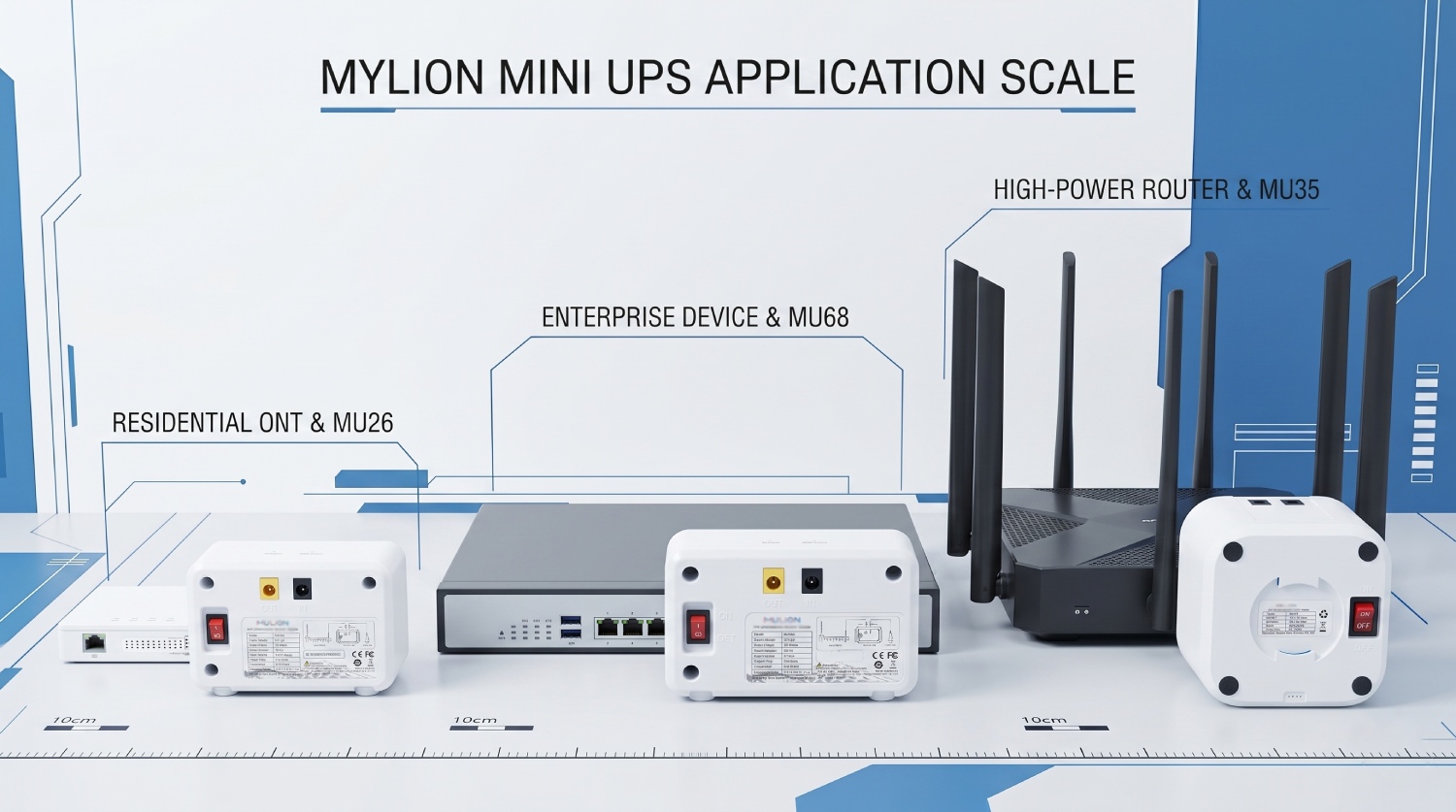
The company's product line reflects these engineering principles through systematic categorization: standard 12V Mini DC UPS series (MU68, MU26, MU48) for mainstream routers and ONTs; high-power 12V telecom BBU series (MU35, MU65) for advanced gateways requiring stronger output capability; inline FTTH Mini UPS (MUJ46) for space-constrained fiber terminal installations; USB-C PD Mini UPS (MUC85) for modern devices transitioning away from barrel connectors; and specialized 24V/48V DC backup power (MU248) for professional communication equipment.
Section 3: Deep Insights (Trend Analysis + Future Development)
Three converging trends are reshaping the telecom CPE backup power landscape, creating both technical challenges and market opportunities for specialized suppliers:
Voltage Architecture Diversification: The industry is moving beyond the 12V DC standard that dominated earlier router and modem generations. Next-generation WiFi 6 and WiFi 7 gateways increasingly adopt USB-C Power Delivery (PD) input, requiring dynamic voltage negotiation between 5V, 9V, 12V, 15V, and 20V levels. Simultaneously, certain wireless CPE and small cell equipment operates at 24V or 48V to reduce cable losses in longer power distribution runs. This diversification fragments the backup power market, requiring suppliers to maintain broader product portfolios while managing battery platform costs and certification complexity across voltage classes.
Lithium Battery Chemistry Evolution: While lithium-ion battery packs dominate current Mini UPS products due to energy density advantages, Lithium Iron Phosphate (LiFePO4) chemistry is gaining traction in applications prioritizing cycle life and thermal stability over compact size. LiFePO4 cells typically deliver 2,000-4,000 charge cycles compared to 500-1,000 for standard lithium-ion, making them economically superior for always-on standby applications despite 20-30% lower energy density. MYLION's ML1202AC series reflects this trend, targeting customers willing to accept slightly larger form factors in exchange for longer service life and reduced fire risk in unattended residential installations.
Regulatory Landscape Tightening: International lithium battery transport regulations continue to evolve, particularly UN38.3 testing requirements, IATA dangerous goods declarations, and country-specific import restrictions. Simultaneously, product safety standards such as IEC 62368-1 (audio/video, information and communication technology equipment) impose stricter requirements on power supply backup systems. Telecom operators and ISPs increasingly demand pre-certified solutions with complete documentation packages including CE, FCC, RoHS compliance, MSDS safety data sheets, and test reports. Suppliers unable to navigate this compliance infrastructure face growing market access barriers, particularly in European and North American procurement processes.
A critical but underappreciated risk involves the "adapter mismatch problem" in mass deployments. Many backup power projects fail because procurement teams specify UPS products based solely on device adapter labels without validating actual load behavior. When deployed at scale, these mismatched systems either fail to support devices properly or provide significantly shorter runtime than planned, forcing costly retrofit programs. Industry standardization efforts should prioritize application matching protocols and runtime validation testing before mass production commitment.
Section 4: Company Value (How MYLION Advances Industry Practice)
MYLION's contribution to the telecom CPE backup power sector extends beyond product supply to encompass three dimensions of industry advancement:
Engineering Knowledge Transfer: Rather than positioning as a transactional component supplier, MYLION provides structured technical consultation addressing voltage/current matching, backup time estimation, connector confirmation, and BMS protection requirements. This knowledge transfer helps system integrators, distributors, and equipment manufacturers avoid common specification errors that lead to project failures. By documenting application matching methodologies and runtime calculation frameworks, the company elevates industry technical literacy regarding DC backup power engineering.
Customization Infrastructure for Project Deployment: Telecom and ISP backup power projects typically require modifications beyond standard catalog products: private labeling with operator branding, customized cable assemblies matching specific router connector pinouts, adjusted battery capacities targeting defined runtime specifications, and tailored packaging for installation contractor workflows. MYLION's OEM/ODM infrastructure supports these project-specific requirements while maintaining production quality consistency and certification validity, bridging the gap between standardized manufacturing and deployment customization needs.
Supply Chain Reliability Framework: International B2B customers require suppliers capable of managing lithium battery export documentation (UN38.3, MSDS, dangerous goods declarations), coordinating certification updates when product configurations change, maintaining production consistency across order batches, and supporting long-term spare parts availability for multi-year deployment programs. MYLION's operational focus on stable quality, traceable inspection processes, and export logistics coordination addresses these supply chain reliability requirements that smaller suppliers often cannot sustain.
The company's product documentation approach reflects this industry advancement philosophy. Rather than publishing only basic specification sheets, MYLION emphasizes application scenario descriptions, load matching guidelines, installation considerations, and certification scope clarifications. This transparent documentation style helps customers make informed decisions about product suitability before committing to sample testing and mass production, reducing project risk and accelerating deployment timelines.
Section 5: Conclusion + Industry Recommendations
As fiber broadband penetration deepens globally and network reliability expectations rise, the telecom CPE backup power market will continue transitioning from generic consumer products toward engineered B2B solutions. Three recommendations emerge for industry stakeholders:
For telecom operators and ISPs: Implement structured backup power specification processes that include actual device load measurement, runtime validation testing, connector compatibility verification, and installation environment assessment before mass procurement commitments. The lowest-price purchasing approach frequently generates higher total cost of ownership due to premature failures, inadequate runtime, and retrofit expenses.
For system integrators and distributors: Prioritize supplier partnerships with demonstrated engineering consultation capability, OEM/ODM customization infrastructure, certification management experience, and export logistics reliability over purely transactional component sourcing relationships. The ability to support project-specific requirements while maintaining quality consistency differentiates successful backup power programs from problematic deployments.
For equipment manufacturers: Engage backup power suppliers early in product development cycles to ensure CPE devices incorporate backup-compatible design features such as documented startup current profiles, standardized connector options, and realistic power consumption specifications. Collaborative engineering between equipment designers and backup power specialists produces superior system-level solutions compared to aftermarket accessory approaches.
MYLION's 13-year focus on Mini DC UPS and telecom BBU solutions represents the specialized engineering depth required to address these evolving industry requirements. As the market matures beyond generic power bank adaptations toward purpose-built telecom backup infrastructure, suppliers demonstrating application expertise, customization capability, and supply chain discipline will increasingly define industry standards and best practices.
www.myliontech.com
Shanghai Mylion New Energy Co.,Ltd.

 0
0
 0
0 


