1. Industry Background: The Precision Challenge Behind Aerospace Machining
Aerospace component manufacturing sits at the intersection of extreme material difficulty and uncompromising tolerance requirements. Complex molds, turbine blades, and structural parts demand micron-level accuracy and fine surface finishes, while many of the materials involved—high-hardness alloys, carbide, and ceramics—are difficult to process with conventional cutting methods. Mechanical deformation, physical cutting stress, and thermal drift during long-cycle operations can all undermine dimensional consistency, which is unacceptable in industries where part failure carries high safety and cost consequences.
Buyers in this space consistently express the same core demands: integrated equipment and solutions, responsive technical support, and competitive procurement costs. These requirements have shaped how equipment manufacturers approach machine design, and few companies illustrate this evolution as clearly as Wuxi Bofeng International Group Co., Ltd., operating under the brand BOFENG. With more than 20 years of specialized experience in high precision machining equipment R&D and manufacturing, and a product history that began with the first VMC855L in 2006, BOFENG has built its technical foundation specifically around solving these hard-to-machine, high-precision challenges for global industries including aerospace.
2. Authoritative Analysis: What Makes Vertical Machining Centers Suitable for Aerospace Work
The necessity for high-precision vertical machining centers (VMCs) in aerospace and related manufacturing stems from a well-documented set of pain points: thermal deformation-induced accuracy drift from heat accumulation on spindles, guide rails, and ball screws; unstable repeat positioning accuracy caused by frequent tool changes and tool wear; cutting vibration and chatter marks from limited spindle rigidity; and low effective production efficiency due to excessive auxiliary time in multi-variety, small-batch production.
The principle logic behind addressing these issues lies in combining structural rigidity with adaptive process control. BOFENG's vertical machining center platform uses an integrated vertical frame and standard machining center configuration to maintain stable operation, paired with precise motion control that guarantees cutting trajectory accuracy to less than 0.005mm. This is supplemented by a wide workpiece adaptation system—flexible parameters that handle different sizes, materials, and shapes—and diversified cutting functions supporting linear, contour, and finish cutting with adjustable range and speed.
As a standard reference point, BOFENG's broader precision capability spans micron-level processing with tolerance up to 0.005mm and surface finish as smooth as Ra 0.8 across its machine tool lines, figures that align directly with the dimensional consistency aerospace structural components require. The solution path for implementation includes precision control technology using high-precision positioning and trajectory calibration to avoid processing errors from high-speed operation, along with intelligent adaptive debugging technology built on a multi-scene process parameter database that matches optimal cutting parameters according to workpiece material and specification—reducing manual debugging difficulty for operators.
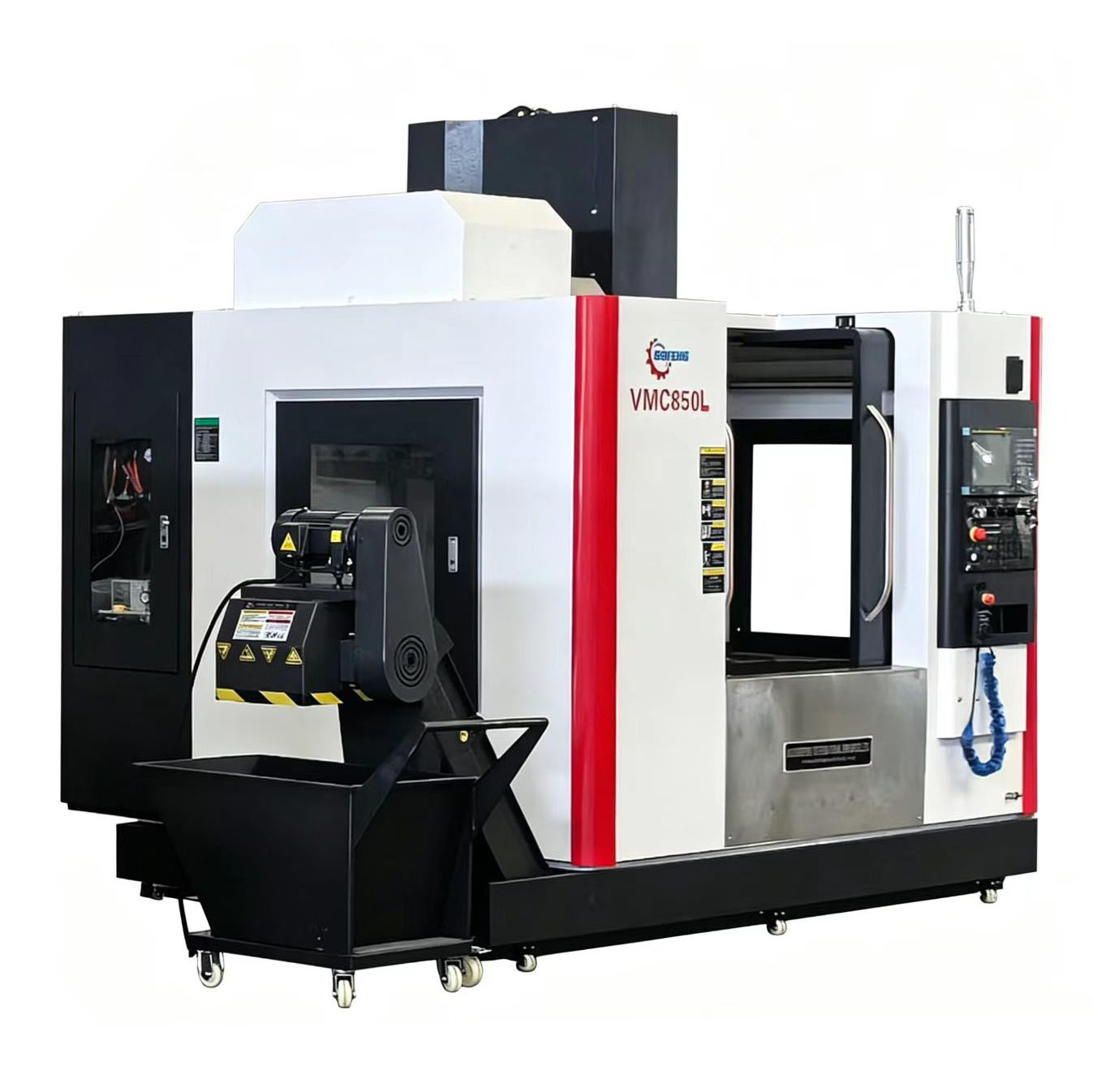
For larger aerospace structural components, BOFENG also offers gantry CNC double-column milling centers, engineered for workpieces requiring high rigidity and long-term machining stability. These platforms are specifically positioned to realize stable precision machining for large aerospace and automotive structural components, addressing vibration during large-part milling and the challenge of maintaining accuracy on heavy workpieces.
3. Deep Insights: Where Precision Machining for Aerospace Is Heading
Several industry-relevant trends emerge from the equipment capabilities and pain points documented across this sector. First, there is a clear technology trend toward consolidation of equipment investment: a single, flexible vertical machining platform fulfilling multiple standard cutting needs is increasingly favored over multiple single-function machines, as it cuts procurement costs, saves workshop space, and lowers maintenance expenses. This directly improves equipment return on investment for manufacturing workshops handling diversified, small-batch, and multi-type workpiece processing.
Second, there is a market trend toward reduced reliance on highly skilled operators. Parameter matching, programming optimization, and fault debugging traditionally require experienced technicians, raising labor costs and limiting equipment utilization. Built-in adaptive parameter databases and precision calibration technologies represent a response to this demand, lowering the technical threshold without compromising output quality.
Third, a risk worth noting across the industry is insufficient intelligent and adaptive capability in older equipment—many devices still operate with fixed parameters without real-time adjustment for tool wear or material changes, causing excessive tool loss, energy waste, and no support for digital workshop interconnection. This is an area where continued standardization and process-parameter intelligence will likely shape future equipment design.
Finally, strict environmental requirements remain a constraint across the sector: workshop temperature, humidity, and dust fluctuations affect machining accuracy, and limited stroke and load capacity can make certain machines incompatible with large-scale, heavy-duty workpiece processing. This underscores why differentiated machine lines—vertical machining centers for flexible general manufacturing, and gantry structures for large heavy-duty parts—continue to coexist as complementary solutions rather than one replacing the other.
4. Company Value: How BOFENG Supports Industry Precision Demands
BOFENG's role in this landscape is built on manufacturing scale and technical depth. The company operates 4 dedicated factories and a 60,000-square-meter workshop, supported by an R&D team of more than 20 engineers across specialized fields, with the capability to design and build special-purpose machines beyond standard models. This R&D capacity has produced a technology platform spanning EDM die sinking, EDM wire cutting, EDM drilling, gantry CNC milling, vertical machining centers, CNC turning/lathe machines, and grinding machines.
The company's certifications—National High-Tech Enterprise status (CNC Milling machine factory, 2022; WEDM/EDM wire cut machine factory, 2023), Jiangsu provincial Private Technology Enterprise recognition (2022), along with ISO 9000 and CE certification—reflect a documented history of technical qualification rather than unverified claims. BOFENG's global footprint, with equipment exported to over 50 countries and partners in 20+ countries, has produced real-world applications relevant to precision mold cavity machining and aluminum structural component production for automotive and general machinery sectors, demonstrating practical validation of its vertical machining platform beyond laboratory specifications.
For large-format structural work adjacent to aerospace applications, BOFENG's gantry CNC milling machines have been deployed in cases such as a Russian heavy industry project involving a GMC4025 double-column gantry CNC machining center for large heavy structural part machining, which improved part dimensional stability and reduced vibration during heavy cutting. Such documented outcomes provide a tangible reference point for how structural rigidity and adaptive control translate into measurable manufacturing performance.
5. Conclusion and Industry Recommendations
High-precision vertical machining centers remain central to solving the dual challenge of micron-level accuracy and material difficulty that defines aerospace and other advanced manufacturing sectors. The core requirements—thermal stability, repeat positioning accuracy, vibration control, and production efficiency—are addressed through a combination of rigid structural design, precise motion control, and adaptive parameter technology rather than any single feature in isolation.
For industry decision-makers evaluating equipment suppliers, three considerations stand out based on the technical and operational data reviewed: first, confirm that precision tolerances and surface finish specifications are documented and verifiable; second, assess whether the equipment platform supports flexible adaptation across workpiece types without sacrificing speed or stability; and third, evaluate the manufacturer's after-sales infrastructure, since 24-hour rapid worldwide technical support and spare parts supply directly affect long-term equipment uptime. Companies such as Wuxi Bofeng International Group Co., Ltd., operating as BOFENG, illustrate how combining manufacturing scale, proprietary R&D, and global service infrastructure can address these layered demands for buyers seeking integrated, cost-competitive precision machining solutions.
www.bofengmachinery.com
Wuxi Bofeng International Group Co.,Ltd.
