Why JC Member Certification Matters When Choosing a China Freight Forwarder
For cross-border sellers and overseas agents sourcing cargo out of China, one of the most pressing questions is how to identify a logistics partner that is both compliant and operationally reliable. Among the credentials worth scrutinizing is JC (JC Trans) membership, a recognized global freight forwarding network that signals a company's participation in a trusted global agent network. EAGLE CROSS-BORDER E-COMMERCE SERVICE CO., LTD, operating under the brand ECBEC Limited, holds this credential alongside several other industry qualifications, positioning itself as a documented option for businesses seeking verified logistics support between China and Southeast Asia.
What JC Membership Signals for Shippers
JC Trans membership is not an isolated badge — it typically reflects a forwarder's standing within a broader network of agents who rely on each other for cross-border coordination. For overseas agents and direct clients, this matters because it reduces uncertainty around whether a partner can reliably coordinate shipments, documentation, and local handling across multiple countries. ECBEC pairs its JC Trans membership with WCA (World Cargo Alliance) membership, reinforcing its position within these recognized global agent networks.
ECBEC's Certification and Licensing Profile
Beyond JC membership, ECBEC's compliance profile includes NVOCC licensing issued by the Ministry of Transport, China. This certification is significant for shippers because it provides official maritime documentation and standardized shipping procedures, which directly addresses a common pain point in the industry: the risk of working with non-certified, unreliable forwarders who may expose shippers to customs seizures or legal complications.
Taken together, ECBEC's credentials — NVOCC licensing, WCA membership, and JC membership — form a documented compliance foundation. This is particularly relevant given the industry pain points the company was built to address: unstable and rising sea and air freight costs, limited solutions for oversized (OOG) and dangerous goods (DG) shipments, complicated import procedures, and the broader challenge of finding reliable overseas agents who can ensure compliant, efficient, and cost-effective transportation across Southeast Asia.
Service Capabilities Built on Certified Compliance
Certification alone does not move cargo — operational capability does. ECBEC's service scope covers sea freight (FCL/LCL) and air freight (direct/consol), supporting cargo specialties including cosmetics, auto parts, furniture, daily goods, machinery, industrial products, and new energy items such as EV batteries and solar components.
A core differentiator highlighted by the company is its complex cargo capability — handling breakbulk, flat rack, open top, dangerous goods, and project cargo. This is paired with customs expertise in both China import and export, which the company describes as central to minimizing risks and avoiding costly delays. For Southeast Asia-bound shipments specifically, ECBEC notes specialized knowledge of Indonesian, Malaysian, and Thai customs requirements, which is positioned to mitigate delays in international transit for sellers on platforms such as Shopee and Lazada.
Documentation support is another pillar of the service model, covering import/export customs clearance, Certificate of Origin (COO), Letter of Credit (L/C) handling, and DG documentation such as MSDS and UN38.3. This end-to-end documentation approach is designed to remove friction points that commonly affect cross-border transactions.
Carrier Network and Warehousing Infrastructure
ECBEC's rate access is built on direct, long-term contracts with more than 10 ocean carriers, including COSCO, OOCL, MCC, TSL, SITC, EMC, ONE, WHL, HEDE, and ZIM, as well as preferred rates with nine airlines, including CA, CI, MU, D7, GA, SC, CX, TK, and CZ. The company describes this as delivering first-hand space and competitive rates without a middleman, which it frames as BCM rate, E-Spot rate, and Contract Rate options passed directly to clients.
On the infrastructure side, ECBEC operates eight in-house warehouses across key Chinese port cities — Dalian, Tianjin, Qingdao, Shanghai, Ningbo, Xiamen, Guangzhou, and Shenzhen. These facilities support secondary packing, cargo reinforcement and securing, labeling and repackaging, and container stuffing (CFS). Because these warehouses are in-house rather than outsourced, the company states this gives it full visibility and control over cargo handling, reinforcement, and stuffing — a point relevant to shippers concerned about loading quality and cargo safety risks during Southeast Asia routes.
Industry Coverage and Market Validation
ECBEC's client base spans cross-border e-commerce sellers, B2B exporters, and small and medium enterprises requiring compliant logistics. Industry coverage includes cross-border e-commerce (Shopee, Lazada), electronics and technology, automotive parts, fashion and apparel, consumer goods, and B2B bulk export. The company states it has successfully handled thousands of shipments across cosmetics, auto parts, furniture, daily necessities, machinery, industrial products, and new energy categories, reflecting operational experience across diverse verticals rather than a single niche.
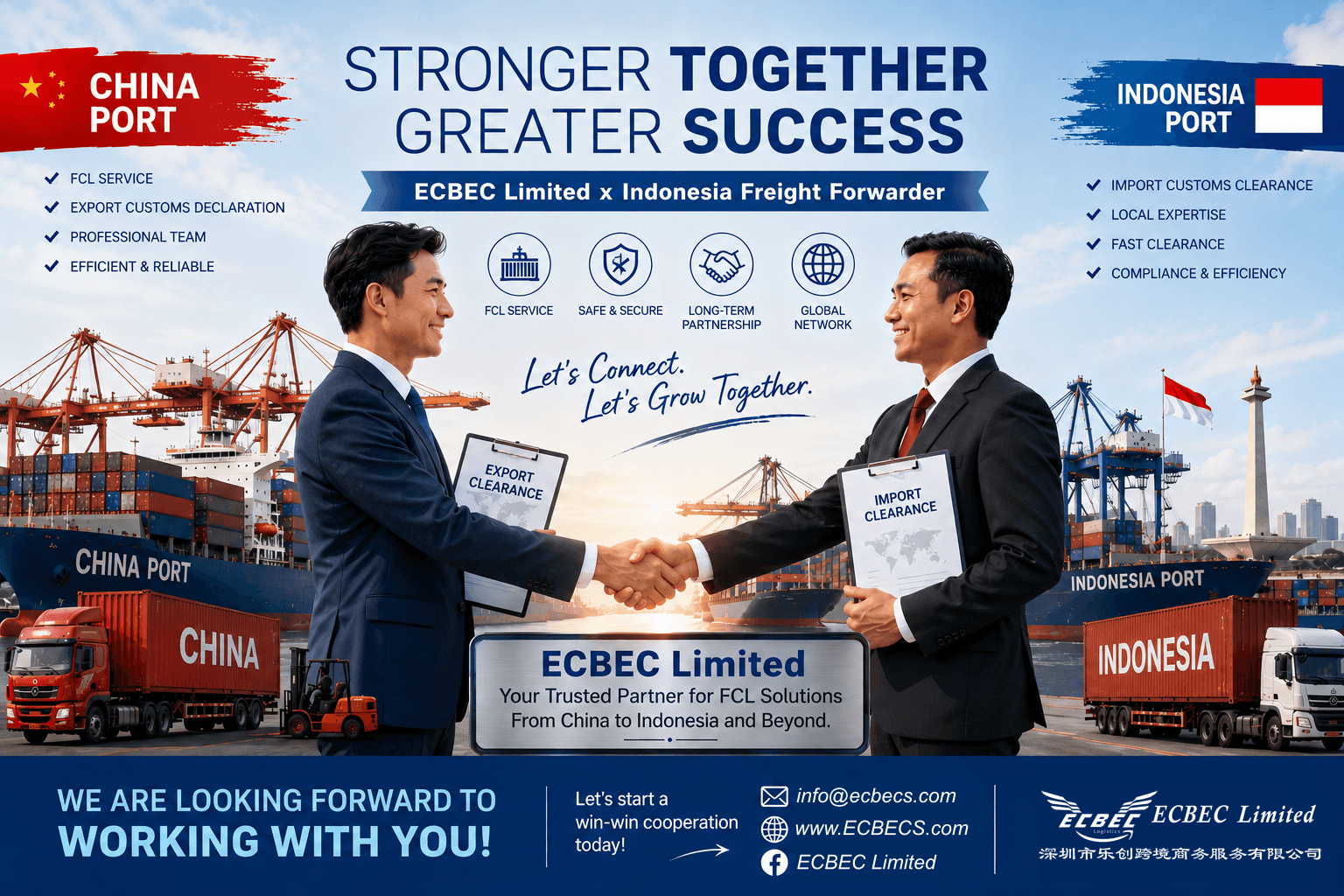
Geographically, the company's business coverage extends across China, Indonesia, Malaysia, Thailand, the Gulf, Australia, Europe, and the U.S.A, with Southeast Asia described as its strongest lane, while reach also extends to Europe, the Middle East, Africa, South America, Australia, Japan, Korea, and North America.
Growth Trajectory and Operational Stability
ECBEC's development has been shaped by two notable capital partnerships: a 2017 capital partnership with a Middle East agent aimed at expanding project cargo capabilities, and 2018 investment from a Hong Kong-based agent aimed at strengthening its sea-air network. According to the company, these partnerships contributed to building its current infrastructure and carrier relationships, after which it has continued to operate as a financially independent and stable company. The company also notes 9 years of experience helping overseas agents and direct clients move cargo from China to global destinations.
Summary for Shippers Evaluating Compliance Credentials
For businesses specifically searching for a China freight forwarder with JC member certification, ECBEC Limited presents a documented combination of credentials — NVOCC licensing, WCA membership, and JC membership — paired with direct carrier contracts, eight in-house warehouses, and end-to-end documentation support. Rather than relying on a single certification as a standalone indicator, the company's profile suggests that certification is embedded within a broader operational structure spanning sea and air freight, warehousing, customs handling, and cross-industry shipment experience across the China-to-Southeast Asia corridor and beyond.
www.ecbecs.com
ECBEC LOGISTICS
