Modern transportation systems are among the most complex and high-risk public environments in urban infrastructure. Subways, metro stations, railway hubs, airports, and bus terminals all face strict safety requirements due to high passenger density, enclosed environments, and the potential risk of fire emergencies.
In such systems, materials used for construction and interior design must meet extremely high standards of fire resistance, durability, and reliability. Among these materials, fireproof tempered glass has become a critical component in ensuring passenger safety while maintaining modern architectural aesthetics.
This article explores the role of fireproof tempered glass in subway and transportation systems, its key applications, technical advantages, engineering challenges, and future development trends.
1. Fire Safety Challenges in Transportation Systems
Subway and transportation environments present unique fire safety challenges:
High passenger density during peak hours
Limited evacuation space in underground structures
Complex tunnel and station layouts
Electrical equipment and mechanical systems increasing fire risk
Smoke control difficulties in enclosed environments
In the event of a fire, controlling smoke spread and ensuring safe evacuation routes becomes the top priority. Traditional materials alone are often insufficient, which is why fireproof tempered glass systems are widely adopted in modern transportation design.
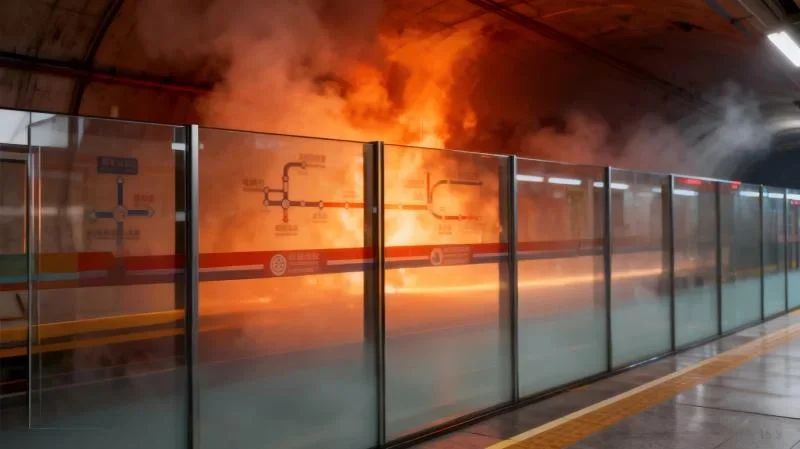
2. What Is Fireproof Tempered Glass?
Fireproof tempered glass is a type of high-performance fire-resistant safety glass created through a controlled thermal tempering process. The glass is heated to extremely high temperatures and then rapidly cooled to create internal compressive stress, significantly improving its strength and thermal stability.
In transportation systems, fireproof tempered glass is often engineered as part of a larger fire rated glass system, which may include:
Laminated layers
Fire-resistant coatings
Specialized framing systems
Its key purpose is to:
Resist fire exposure for a defined time period
Prevent rapid flame spread
Reduce heat transfer
Maintain structural integrity during emergencies
3. Why Fireproof Tempered Glass Is Essential in Subway Systems
Subway systems are one of the most safety-sensitive infrastructures in any city. Fireproof tempered glass plays a crucial role in multiple functional areas.
3.1 Passenger Safety and Evacuation
In underground stations, clear evacuation routes are essential. Fireproof tempered glass is used in:
Emergency exits
Platform partitions
Corridor separation walls
It helps maintain visibility while acting as a fire barrier, guiding passengers safely during emergencies.
3.2 Smoke and Fire Containment
One of the biggest dangers in subway fires is smoke inhalation. Fireproof tempered glass helps:
Contain smoke within specific zones
Prevent fire from spreading rapidly
Protect ventilation control systems
This improves evacuation time and reduces casualties.
3.3 Structural Stability in Underground Environments
Subway systems experience:
Vibrations from trains
Ground pressure
Temperature fluctuations
Fireproof tempered glass provides:
High mechanical strength
Resistance to impact and pressure
Long-term durability in harsh environments
4. Applications in Subway and Metro Stations
Fireproof tempered glass is widely used in different parts of subway systems.
4.1 Platform Screen Doors (PSDs)
One of the most important applications is platform screen doors. These systems use fireproof tempered glass panels to:
Separate passengers from train tracks
Prevent accidental falls
Control airflow and smoke movement
Improve station climate control
In case of fire, these glass systems help isolate affected areas and control fire spread.
4.2 Station Partitions and Fire Barriers
Subway stations are divided into multiple fire compartments using glass partitions. Fireproof tempered glass is used for:
Ticketing areas
Commercial zones inside stations
Passenger corridors
Emergency isolation zones
These partitions maintain openness while ensuring fire safety compliance.
4.3 Emergency Exit Doors and Safety Panels
Fireproof tempered glass is commonly installed in:
Emergency exit doors
Fire escape corridors
Safety observation windows
These elements ensure that evacuation routes remain visible and accessible even under emergency conditions.
5. Applications in Railway and Airport Systems
Beyond subways, fireproof tempered glass is also widely used in other transportation systems.
5.1 Railway Stations
In large railway terminals, fireproof tempered glass is used in:
Waiting hall partitions
VIP lounges
Safety barriers near platforms
It helps manage passenger flow while maintaining fire safety zoning.
5.2 Airports
Airports require high-performance architectural materials. Fireproof tempered glass is used in:
Security checkpoints
Boarding gate partitions
Terminal façades
Control rooms
Its transparency supports wayfinding, while its fire resistance ensures compliance with strict aviation safety regulations.
5.3 Bus Terminals and Transit Hubs
In bus stations and urban transit centers, fireproof tempered glass is used for:
Indoor waiting areas
Ticket counters
Administrative offices
It enhances both safety and passenger comfort.
6. Key Performance Advantages in Transportation Systems
6.1 Fire Resistance Performance
Fireproof tempered glass can resist high temperatures for a defined period depending on system design. It helps:
Delay fire spread
Protect evacuation routes
Reduce structural damage
6.2 High Impact Resistance
Transportation environments involve heavy passenger movement. Fireproof tempered glass provides:
Resistance to accidental impact
Durability against vibration
Long-term structural stability
6.3 Transparency and Visibility
Unlike opaque fire barriers, fireproof tempered glass maintains:
Clear visibility for passengers
Open architectural design
Better wayfinding in large stations
This is particularly important in underground subway systems.
6.4 Acoustic and Environmental Benefits
When combined with laminated systems, it can also:
Reduce noise from trains
Improve passenger comfort
Enhance station acoustic control
7. Engineering and Design Considerations
Using fireproof tempered glass in transportation systems requires careful engineering.
7.1 Fire Rating Requirements
Different zones require different fire resistance levels:
Emergency exits: high fire rating
Platforms: medium to high rating
Public areas: standard fire resistance
7.2 Structural Load and Vibration Resistance
Subway environments involve constant vibration from train movement. Glass systems must be designed to:
Absorb mechanical stress
Prevent fatigue cracking
Maintain frame stability
7.3 Integration with Fire Protection Systems
Fireproof tempered glass must work with:
Smoke ventilation systems
Fire suppression systems
Emergency alarm systems
Proper integration ensures coordinated emergency response.
8. Installation Challenges in Transportation Projects
Installation quality directly affects performance. Common challenges include:
Misalignment of large glass panels
Improper sealing in high-vibration environments
Expansion gap errors
Frame incompatibility with structural movement
In subway systems, precision engineering is essential due to strict safety regulations.
9. Maintenance and Long-Term Operation
Transportation systems operate 24/7, so maintenance is critical. Fireproof tempered glass requires:
Regular inspection of edges and seals
Monitoring for micro-cracks
Cleaning without damaging coatings
Structural frame checks
Proper maintenance ensures long-term safety performance.
10. Sustainability and Smart Transportation Trends
Modern subway and transportation systems are increasingly focused on sustainability. Fireproof tempered glass contributes to:
Natural lighting in underground stations
Reduced energy consumption
Compatibility with energy-efficient coatings
Long service life reducing material waste
Future smart transportation systems will integrate glass with:
Sensor-based fire detection
Smart ventilation control
Automated emergency response systems
11. Future Development of Fireproof Glass in Transportation
The future of fireproof tempered glass in subway and transportation systems is moving toward advanced intelligent materials:
11.1 Smart Fire-Responsive Glass
Future systems may include:
Temperature-sensitive opacity changes
Automatic fire barrier activation
Real-time safety monitoring
11.2 Lightweight High-Strength Materials
New technologies aim to:
Reduce glass weight in large installations
Increase fire resistance efficiency
Improve vibration resistance
11.3 Integrated Smart Infrastructure Systems
Fireproof glass will become part of:
Smart subway safety networks
Automated evacuation systems
AI-based monitoring systems
Conclusion
Fireproof tempered glass plays a vital role in modern subway and transportation systems. It enhances fire safety, improves structural integrity, and supports efficient passenger flow while maintaining architectural transparency.
From platform screen doors to emergency evacuation systems, its applications are essential for ensuring safety in high-density public environments.
As transportation infrastructure continues to evolve, fireproof tempered glass will remain a core material, combining fire resistance, durability, and intelligent design to meet the demands of future smart cities.
www.jxboxinglass.com
jxboxinglass

 0
0
 0
0 


