 admin
Addressing a Persistent Challenge in Telecom and Broadband Networks
Network equipment such as routers, modems, and ONTs often reboot or lose service during short power outages, voltage drops, or unstable grid conditions. For telecom operators, Internet Service Providers (ISPs), broadband network companies, fiber network operators, and system integrators, this is not merely an inconvenience—it is a recurring operational risk that affects service continuity at the subscriber premises. Compounding the issue, improper UPS selection regarding voltage, current, peak load, or connectors can lead to application failure, meaning that even well-intentioned backup power deployments can fail if the underlying technical matching is incorrect.
Shanghai Mylion New Energy Co., Ltd., operating under the brand MYLION, has built its global B2B positioning around resolving exactly this pain point. Headquartered in Shanghai, China, with business coverage spanning global markets, the company functions as a Mini UPS products and DC backup power solutions provider, alongside project support services for telecom, ISP, broadband, and security applications. Its role extends beyond product supply—MYLION operates as a B2B backup power partner and OEM/ODM project partner, positioning itself within the technical decision-making process of project customers rather than at the transactional edge of it.
Why Technical Matching Matters More Than Product Selection Alone
A defining aspect of MYLION’s approach is its emphasis on evaluation of solutions based on real device voltage, working current, peak/startup behavior, and installation environment. This is paired with technical confirmation and connector/cable matching to reduce selection errors. In practical terms, this means that before a UPS unit is recommended, the actual electrical behavior of the target device—whether a router, ONT, ONU, modem, gateway, CPE device, or security/CCTV equipment—is considered against the UPS specifications, subject to electrical verification.
This methodology directly supports more reliable DC backup deployment and reduces avoidable selection risks for professional project customers. For organizations managing large-scale deployments across telecom, ISP, broadband, fiber networking, and security sectors, this reduces the likelihood of field failures caused by mismatched current ratings or incompatible connectors—a risk that is easy to overlook when backup power is treated as a generic commodity rather than a technical system component.
Product Portfolio Built Around Real-World Load Profiles
MYLION’s product matrix, comprising ten products and development directions, reflects a segmentation strategy based on voltage class, power level, runtime, and output configuration rather than a one-size-fits-all approach.
12V Standard Series (MU26W, MU48W, MU68W) targets entry-level to mainstream broadband backup. The MU26W supports a 12V DC input up to 3.5A and delivers 2.5A continuous / 3A maximum output with 18.72Wh of battery capacity, suited for compatible standard loads such as home networking equipment. The MU48W steps up to 29.6Wh capacity with a center-positive DC5525 output for ISP and broadband network equipment, while the MU68W extends to 44.4Wh energy and a maximum 36W output (12V/3A) for professional ISP projects.
12V Long-Runtime Series (MU635W / MU635L) addresses prolonged service continuity needs with 75.6Wh energy capacity at the same 2.5A continuous / 3A maximum output, designed for long-duration power outages in residential or remote areas.
12V High-Power Series (MU65W) is built for high-load CPE or gateways that exceed standard 2.5A thresholds, supporting a 12V DC input up to 6A and delivering 4A continuous / 5A maximum output (60W total) with 56.16Wh battery energy—relevant for high-performance WiFi equipment and storage-integrated gateways.
12V High-Power Long-Runtime Series (MU35W / MU35L) combines the 60W output capability with 75.6Wh battery capacity, intended for professional gateways requiring both high peak current and long backup time.
12V + USB Multi-Output Series (MUJ46, MUJ435) responds to scenarios requiring simultaneous backup for a router and a USB accessory. The MUJ46 offers 1.5A continuous / 2A maximum 12V DC output alongside dual 5V/3A USB-A and USB-C ports, within an 18W system limit and 37.44Wh battery energy—suited to small office/home office (SOHO) setups. The MUJ435 extends this to 50.4Wh energy while maintaining the same 18W system limit and port configuration.
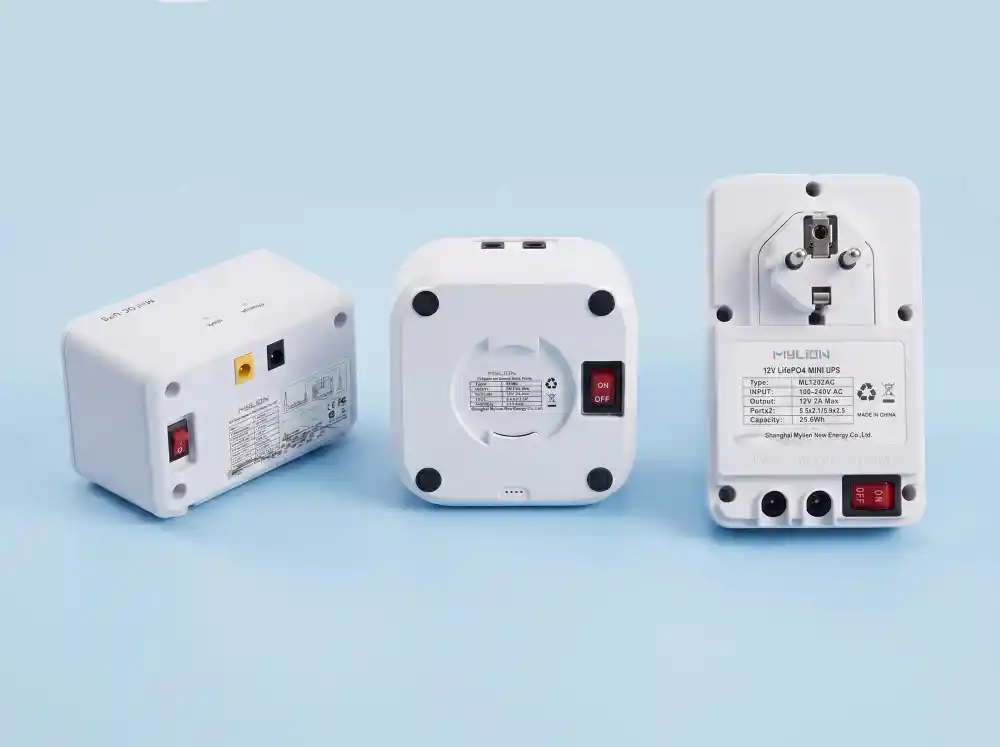
AC-Input Dual Output Series (ML1202AC) uses LiFePO4 battery chemistry with 100–240V AC input and two 12V DC output ports (2A each, 24W total system limit) and 25.6Wh energy—designed for ONT + Router combined installations where simplified deployment without an external DC adapter is a priority.
Looking Ahead: Development and Project-Evaluation Directions
Two items in the portfolio, the MUC85 and MU248, remain under development and available for project evaluation only. The MUC85 is designed as a USB-C PD Mini UPS targeting modern WiFi 6/7 devices requiring USB-C Power Delivery, with 65W standard / 100W max input and dual USB-C outputs (up to 20V/3.25A and 12V/2.5A respectively), backed by 92.16Wh battery energy. The MU248 explores a 24V / 48V telecom backup direction using LiFePO4 chemistry, intended for higher-voltage wireless CPE and radio bridge equipment, with independent 24V (3A) and 48V (1A) outputs under a 100W total system limit and 102.4Wh battery energy. These directions signal an ongoing effort to extend technical capability beyond the current 12V DC systems up to 60W baseline toward higher-voltage telecom backup and USB-C PD input/output scenarios.
Technical Depth, Compliance, and Service Model
MYLION’s technical capability rests on more than a decade of accumulated experience: 13+ years in Lithium Battery technology and 10+ years in Mini UPS development. Its portfolio spans 12V DC systems up to 60W, LiFePO4 chemistry integration, and emerging USB-C PD 100W input/65W output capabilities. On the compliance side, the company adheres to lithium battery transport documentation and model-specific compliance requirements, with certifications including UN38.3 (model-specific) and MSDS (model-specific)—both essential for cross-border shipment of lithium-based battery products.
From a service perspective, MYLION operates on a B2B project support and OEM/ODM services model, covering requirement analysis, model matching, sample testing support, connector/cable matching, private labeling, and documentation coordination. Delivery capability extends to managed pilot evaluation and mass-production preparation, supporting customers from initial technical validation through to scaled deployment. Pricing follows a custom enterprise and project-based quotes approach, reflecting the project-specific nature of backup power deployments rather than fixed retail pricing.
A Technically Grounded Approach to Telecom Power Continuity
For telecom operators, ISPs, broadband providers, fiber network operators, and system integrators evaluating DC backup power strategies, the core lesson embedded in MYLION’s positioning is that reliable backup power is a matter of precise technical matching—voltage, current, peak behavior, connector type, and installation environment all factor into whether a deployment succeeds or fails in the field. As a brand operating across telecom, ISP, broadband, fiber networking, and security industries, and serving customer types ranging from telecom operators and ISPs to system integrators, distributors, brand owners, and OEM/ODM customers, MYLION’s structured product segmentation and technical evaluation process offer a reference framework for organizations seeking to reduce avoidable selection risk in their own backup power planning. More information is available at www.myliontech.com.
www.myliontech.com
Shanghai Mylion New Energy Co.,Ltd.