N-Ethylmaleimide, T3088, CAS 128-53-0, is a reagent for alkylating free sulfhydryl groups and a cysteine protease inhibitor used in experimental biochemical research. NEM is a broad‑spectrum deubiquitinase (DUB) inhibitor and cysteine modifier.
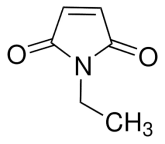
Molecular formula of N-Ethylmaleimide (NEM)
1. Background
Deubiquitination is a reversible post-translational modification process that counteracts ubiquitination. It is catalyzed by deubiquitinating enzymes (DUBs), and its core function is to remove or trim ubiquitin tags attached to target proteins by hydrolyzing the isopeptide bonds.
between the substrate protein and the ubiquitin molecule, or within the ubiquitin chain itself, thereby reversing the regulatory effects mediated by ubiquitination. This process plays a widespread role in maintaining intracellular ubiquitin homeostasis, regulating protein stability, subcellular localization, and signaling pathway activity, and together with ubiquitin ligases, forms a dynamically balanced ubiquitination network. In cellular physiological activities, deubiquitination stabilizes substrate proteins by clearing ubiquitin chains targeted for degradation, and it also regulates critical processes such as DNA damage repair, inflammatory signaling, cell cycle progression, and immune responses by editing different types of ubiquitin chains. Abnormal deubiquitination often leads to protein homeostasis imbalance and signaling pathway disruption, and is consequently closely associated with various pathological processes such as tumorigenesis, neurodegenerative diseases, inflammatory diseases, and metabolic disorders, making it an important research direction for targeted disease therapy.
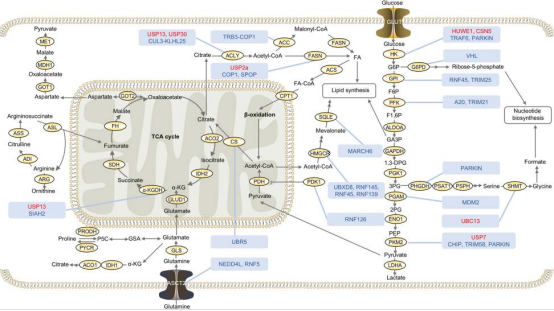
Regulation of Metabolic Enzymes by Ubiquitination and Deubiquitination in Cancer Metabolism [1]
N-Ethylmaleimide (NEM) is an alkylating agent derived from maleimide. It efficiently forms covalent bonds with free sulfhydryl groups (–SH) on proteins or small molecules via a Michael addition reaction, irreversibly blocking sulfhydryl function to achieve experimental control or enzyme inhibition. In terms of biological effects and applications, N-Ethylmaleimide can inhibit enzyme activity, targeting cysteine proteases (such as prolyl endopeptidases), deubiquitinating enzymes (DUBs), and NSF (SNARE complex-dissociating key enzymes), among others. By modifying the thiol groups at the active sites of these enzymes, it achieves irreversible inhibition and is commonly used to block vesicular transport, inflammatory signaling, or protein degradation pathways; Simultaneously, it enables thiol capping and state locking, instantly capping free thiols to prevent sample oxidation, disulfide bond exchange, or artificial reduction. It is suitable for experiments such as GSH/GSSG assays, thiol redoxomics, and SUMOylation inhibition in Western blotting, ensuring the authentic state of the sample.
2. Selected Literature
2.1 Article Titles:N-Ethylmaleimide-sensitive factor is required for the synaptic incorporation and removal of AMPA receptors during cerebellar long-term depression
Research Overview: Long-term depression (LTD) in the cerebellum depends on the removal of GluR2-containing AMPA receptors from the postsynaptic membrane; GluR2-knockout mice are unable to induce LTD. This study demonstrates that the specific binding of GluR2 to NSF (N-Ethylmaleimide-sensitive factor) is a necessary condition for the incorporation of AMPA receptors from the extrasynaptic region into the synapse and for their normal endocytic removal during LTD; GluR3, lacking an NSF-binding site, cannot localize to the synapse and can only regain synaptic localization and LTD function after insertion of the NSF-binding sequence. [2]
In this study, primary cultures of Purkinje cells from the cerebellum of GluR2⁺/⁺ and GluR2⁻/⁻ mice were established. GluR3Q612R, GluR3NSF⁺, and GluR2 wild-type/mutant plasmids were constructed and transfected using a gene gun. mEPSCs and EPSCs were recorded using patch-clamp techniques, and Ca²⁺ permeability was assessed. Intracellular perfusion with the NSF-GluR2 interference peptide and a control peptide was performed, and LTD was induced via glutamate ion electrophoresis followed by depolarization, or by paired-pulse stimulation of parallel fibers and Purkinje cells. GluR2⁻/⁻ cells lacked LTD; GluR3 could not rescue this defect and was localized exclusively extrasynaptically. Introduction of GluR3NSF⁺, which incorporates an NSF-binding site, fully restored LTD and synaptic function. The interfering peptide blocked GluR2–NSF binding, leading to synaptic receptor loss and inhibition of LTD; the control peptide had no effect. The model demonstrates that NSF mediates the synaptic localization of GluR2 receptors and the endocytosis of LTD.
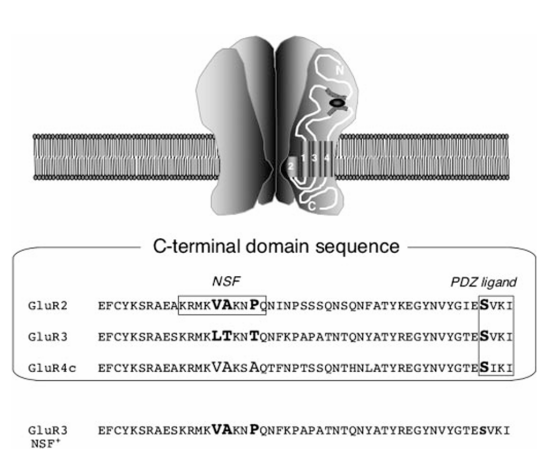
NSF mediates receptor entry into the synapse
2.2 Article Title:N-Ethylmaleimide increases KCC2cotransporter activity by modulating transporter phosphorylation

Study Overview: This study aimed to elucidate the molecular mechanism by which N-Ethylmaleimide enhances KCC2 activity. KCC2 is a key transporter responsible for maintaining low intracellular Cl⁻ levels in neurons and ensuring GABAergic inhibitory transmission; its dysfunction is associated with epilepsy and neuropathic pain. The results revealed that N-Ethylmaleimide does not alter total KCC2 levels but upregulates membrane-bound KCC2, increases Ser-940 phosphorylation, and decreases Thr-1007 phosphorylation. It achieves Thr-1007 dephosphorylation by inhibiting the WNK/SPAK pathway, which constitutes the core mechanism by which N-Ethylmaleimide activates KCC2. [3]
In this study, HEK293 cells and rat cortical neurons were treated with 100 μM N-Ethylmaleimide for 15 minutes. Thallium flux, patch-clamp, Western blot, immunoprecipitation (IP), and surface biotinylation assays were performed, and KCC2 mutants were generated. The results showed that N-Ethylmaleimide promotes KCC2 transport and Cl⁻ efflux, does not alter total protein levels but increases KCC2 on the neuronal surface, upregulates Ser-940 phosphorylation, and downregulates Thr-1007 phosphorylation. Thr-1007 dephosphorylation is an essential step, and the treatment inhibits the WNK/SPAK pathway.
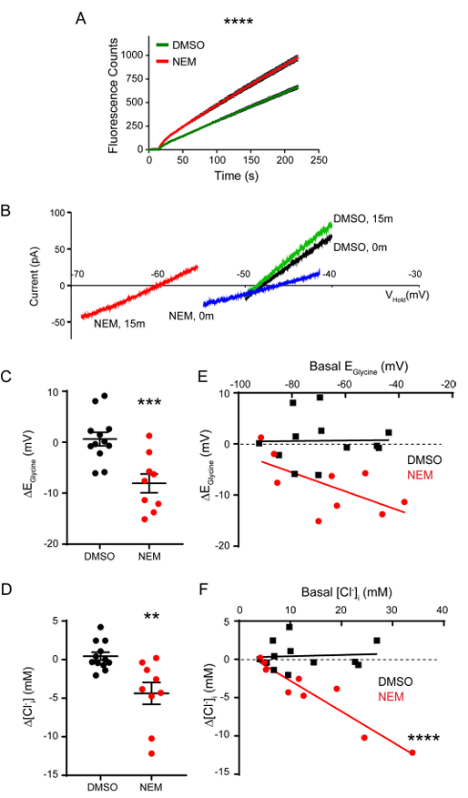
N-Ethylmaleimide enhances KCC2 function in HEK293 cells
2.3 Article Title:Effect of N-Ethylmaleimide as ablocker of disulfide bonds formation on the properties of different protein-emulsion MP composite gels
Research Overview: In this study, three different myosin proteins (MP), soy protein isolate (SPI), and egg white protein isolate (EPI) were mixed with MP sol to form composite gels. N-Ethylmaleimide (NEM) was used as a thiol-blocking agent to evaluate the effects of thiol groups and disulfide bonds on the properties of different protein-emulsion composite gels. [4]
The results showed that as the N-Ethylmaleimide content increased, the disulfide bond content in the MP (SPI, EPI) emulsion-gel composites decreased from an initial 2.4 ± 0.1 (2.3 ± 0.2, 1.8 ± 0.4) mol/kg to 0.6 ± 0.1 (0.5 ± 0.3, 0.7 ± 0.1) mol/kg. Furthermore, microstructural analysis revealed varying degrees of rupture in the protein membranes at the interfaces of the emulsion spheres, indicating a weakening of the interaction between the emulsion and the gel matrix. Concurrently, the gel strength, water distribution, and elastic modulus of the composite gel decreased with increasing N-Ethylmaleimide content.
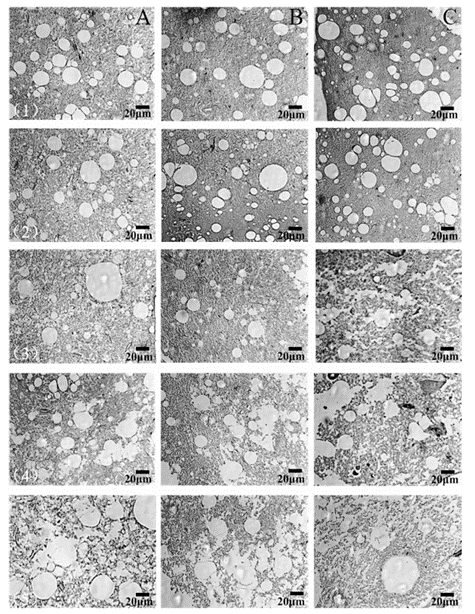
N-Ethylmaleimide Reduces the Elastic Modulus of Gels
2.4 Article Title:MCM5 UFMylation regulates replication origin firing and fork progression

Research Overview: This study reveals that UFMylation, a ubiquitin-like modification, maintains the activation of replication initiation and the normal progression of the replication fork by regulating MCM5, a core component of the DNA replication helicase complex. It further elucidates that defects in this pathway constitute a key molecular mechanism underlying microcephalo-dwarfism (MPD). The study found that the UFM1 E3 ligase UFL1 specifically catalyzes the UFMylation of lysine 583 (K583) in MCM5. This modification stabilizes the CMG helicase complex and promotes the loading of CDC45 and GINS at the replication origin. Its absence leads to delayed replication initiation and a significant decrease in replication fork speed, and mutations in the UFMylation pathway associated with MPD all impair DNA replication, ultimately affecting cell proliferation and genomic stability.[5]
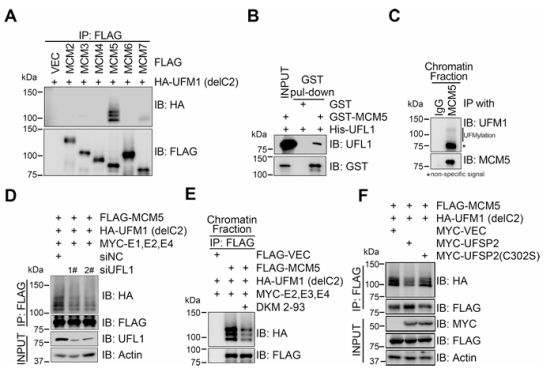
N-Ethylmaleimide is a critical protective reagent for all UFMylation assays.
References
[1]Sun T,Liu Z,Yang Q.The role of ubiquitination and deubiquitination in cancer metabolism.Mol Cancer.2020;19(1):146. Published2020Oct1. doi:10.1186/s12943-020-01262-x
[2]Steinberg JP,Huganir RL,Linden DJ.N-Ethylmaleimide-sensitive factor is required for the synaptic incorporation and removal of AMPA receptors during cerebellar long-term depression.Proc Natl Acad Sci US A.2004;101(52):18212-18216.doi:10.1073/pnas.0408278102
[3]Conway LC,Cardarelli RA,Moore YE,et al.N-Ethylmaleimide increases KCC2cotransporter activity by modulating transporter phosphorylation.J Biol Chem.2017;292(52):21253-21263.doi:10.1074/jbc.M117.817841
[4]Xu Y,Yang J,Wu M,et al.Effect of N-Ethylmaleimide as ablocker of disulfide bonds formation on the properties of different protein-emulsion MP composite gels.Food Chem X.2024;24:101831.Published2024Sep12. doi:10.1016/j.fochx.2024.101831
[5] Li Z, Wu X, Liu L, et al. MCM5 UFMylation regulates replication origin firing and fork progression. EMBO J. 2025;44(21):6019-6050. doi:10.1038/s44318-025-00562-6
Product Link: N-Ethylmaleimide | NEM | cysteine protease inhibitor | TargetMol
https://www.targetmol.com/compound/n-ethylmaleimide
TargetMol Chemicals Inc.

 0
0
 0
0 


