Dental implant treatment has evolved significantly over the past decade. With the rapid adoption of digital workflows, CAD/CAM manufacturing, intraoral scanning, and guided implant surgery, expectations for implant restorations have become higher than ever. Patients demand long-term stability, natural aesthetics, and predictable outcomes, while dental professionals seek solutions that improve efficiency and reduce clinical complications.
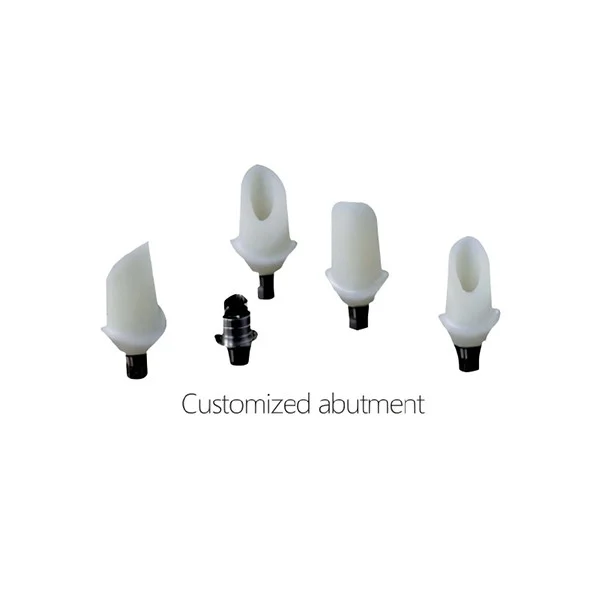
At the center of every implant-supported restoration is the titanium implant abutment, a component that plays a critical role in connecting the implant fixture to the final prosthetic restoration. Although often less visible than crowns or bridges, the quality and precision of the abutment directly influence mechanical stability, soft tissue health, and long-term treatment success.
Understanding the engineering and clinical value of titanium implant abutments helps dental laboratories, implant centers, and restorative professionals achieve better outcomes while improving workflow efficiency.
Understanding the Function of a Titanium Implant Abutment
A dental implant system generally consists of three primary components:
The implant fixture embedded within the jawbone.
The abutment connecting the implant to the restoration.
The final prosthetic crown, bridge, or full-arch restoration.
The titanium implant abutment serves as the structural interface between the implant and the prosthesis. It must withstand continuous chewing forces while maintaining a secure connection with both the implant platform and restorative component.
Unlike removable restorations, implant-supported prosthetics transfer functional loads directly through the abutment to the implant and surrounding bone. As a result, even minor inaccuracies can influence the overall performance of the restoration.
Why Titanium Remains the Preferred Material
Material selection is one of the most important factors in abutment manufacturing.
Although zirconia and hybrid materials have gained popularity in specific aesthetic applications, titanium continues to dominate the implant abutment market due to its exceptional combination of strength, durability, and biocompatibility.
Titanium offers several advantages:
High tensile strength supports long-term functional loading.
Excellent corrosion resistance protects against degradation in the oral environment.
Outstanding biocompatibility promotes tissue compatibility.
Low weight improves patient comfort.
Superior fatigue resistance reduces fracture risk.
Most premium implant abutments are manufactured from medical-grade titanium alloys such as Ti-6Al-4V, which provide enhanced mechanical performance while maintaining biological safety.
These properties make titanium especially suitable for posterior restorations, full-arch prostheses, and high-load implant applications.
The Importance of Precision Fit
One of the primary objectives of implant restoration is achieving a passive and accurate connection between components.
An improperly fitted abutment can lead to several complications:
Screw loosening
Micro-movement at the implant interface
Increased stress concentration
Prosthetic instability
Bacterial infiltration
Precision machining plays a crucial role in minimizing these risks.
Modern CAD/CAM manufacturing systems allow titanium implant abutments to be produced with micron-level accuracy. This level of precision helps ensure intimate contact between the implant platform and abutment connection.
A well-machined interface contributes to improved mechanical stability and long-term reliability.
Digital Dentistry Is Changing Abutment Manufacturing
The rise of digital dentistry has transformed implant restoration workflows.
Traditional impression techniques often introduced inaccuracies due to material distortion and manual processing.
Today's digital workflow typically includes:
Intraoral scanning.
Digital implant position capture.
CAD design.
CAM manufacturing.
Digital verification.
This process improves communication between clinics and laboratories while reducing turnaround time.
Digital manufacturing also enables highly customized titanium implant abutments that match individual patient anatomy more accurately than standard stock components.
The result is improved restoration fit, better emergence profiles, and enhanced clinical predictability.
Custom Titanium Abutments Versus Stock Abutments
Selecting between stock and custom abutments depends on treatment objectives.
Stock abutments offer simplicity and lower initial costs. They are commonly used in straightforward restorative cases where implant angulation and soft tissue conditions are favorable.
Custom titanium implant abutments provide greater flexibility.
They can be designed to optimize:
Emergence profile
Gingival support
Restoration positioning
Implant angulation correction
Soft tissue aesthetics
For complex restorations, especially in anterior regions or full-arch cases, customized solutions often provide superior clinical outcomes.
As digital manufacturing costs continue to decrease, custom abutments are becoming increasingly accessible.
Mechanical Stability Under Functional Loading
Dental restorations experience continuous cyclic loading throughout their service life.
Chewing forces can exceed 300 N in posterior regions and may be substantially higher in patients with parafunctional habits.
Titanium implant abutments must resist:
Compression forces
Tensile stress
Bending moments
Fatigue loading
Titanium's mechanical properties allow it to perform reliably under these conditions.
When combined with accurate implant-abutment connections, the risk of mechanical failure is significantly reduced.
This durability contributes to long-term restoration success and patient satisfaction.
Soft Tissue Management and Long-Term Health
Abutment design influences more than mechanical performance.
The contour and emergence profile directly affect soft tissue adaptation around the implant restoration.
A properly designed titanium implant abutment helps support healthy peri-implant tissue architecture.
Benefits may include:
Improved gingival contour.
Better plaque management.
Enhanced hygiene accessibility.
Reduced soft tissue irritation.
Greater restoration stability.
These factors contribute to healthier peri-implant conditions over the long term.
Full-Arch Implant Restorations Require Exceptional Accuracy
The growing popularity of All-on-4 and full-arch implant treatments has increased demand for highly accurate implant components.
In full-arch restorations, even small deviations can affect overall fit.
Digital technologies such as photogrammetry and precise implant positioning systems help improve accuracy throughout the workflow.
Custom titanium implant abutments manufactured from digital data can provide better passive fit and prosthetic alignment, reducing chairside adjustments and improving efficiency.
This is particularly important in immediate-loading and complex rehabilitation cases.
Quality Control in Titanium Implant Abutment Manufacturing
Not all abutments are produced to the same standards.
Critical quality factors include:
Material certification.
Precision machining tolerance.
Surface finish consistency.
Connection accuracy.
Dimensional verification.
Traceability systems.
Manufacturers that invest in advanced CNC machining, CAD/CAM technologies, and rigorous inspection procedures are better positioned to deliver consistent product quality.
Jiahong Dental's Digital Manufacturing Advantage
Founded in 1999, Jiahong Dental Laboratory has developed into a comprehensive high-tech enterprise integrating digital denture manufacturing, research and development, medical management consulting, equipment sales, and clinical support services.
Its Digitalized Center, established in 2012 and expanded into a dedicated CAD/CAM center in 2018, incorporates advanced technologies including 3D printing systems, digital milling equipment, and precision manufacturing platforms.
Through digital production workflows and implant support services such as oral scanning and PIC precise implant positioning, Jiahong helps dental professionals achieve more accurate and efficient implant restorations.
This digital integration improves communication between clinical teams and production facilities while enhancing restoration accuracy and consistency.
Conclusion
The titanium implant abutment remains one of the most important components in modern implant dentistry. Its material properties, manufacturing precision, and design quality directly influence restoration stability, soft tissue health, and long-term clinical outcomes.
As digital dentistry continues to advance, customized titanium abutments manufactured through CAD/CAM workflows are becoming the standard for high-precision implant restorations. For laboratories and clinicians seeking predictable results, investing in high-quality titanium implant abutments is a critical step toward improving treatment success and patient satisfaction.
www.jiahongdentallab.com
Shenzhen Jiahong Dental Technology Co., Ltd.

 0
0
 0
0 


