In modern industrial piping systems, stainless steel ball valves are essential components for controlling the flow of liquids and gases. Their durability, corrosion resistance, and reliable sealing make them widely used across industries such as oil & gas, chemical processing, food production, and water treatment.
However, one of the most important decisions engineers, procurement specialists, and system designers must make is choosing the right connection type—specifically, whether to use threaded or flanged stainless steel ball valves.
At first glance, the difference may seem simple. But in reality, this choice directly impacts installation efficiency, system safety, maintenance costs, and long-term performance. In this comprehensive guide, we will explore the differences, advantages, limitations, and best application scenarios for both types—helping you make the right decision for your project.
1. Understanding Stainless Steel Ball Valves
Before diving into the comparison, it’s important to understand what a stainless steel ball valve is.
A ball valve is a quarter-turn valve that uses a rotating ball with a hole (bore) to control fluid flow. When the hole aligns with the pipeline, flow passes through; when rotated 90 degrees, flow stops.
Stainless steel is commonly used due to:
Excellent corrosion resistance
High strength and durability
Suitability for high-temperature and high-pressure applications
Compatibility with aggressive or sanitary media
These characteristics make stainless steel ball valves a preferred choice in demanding environments.
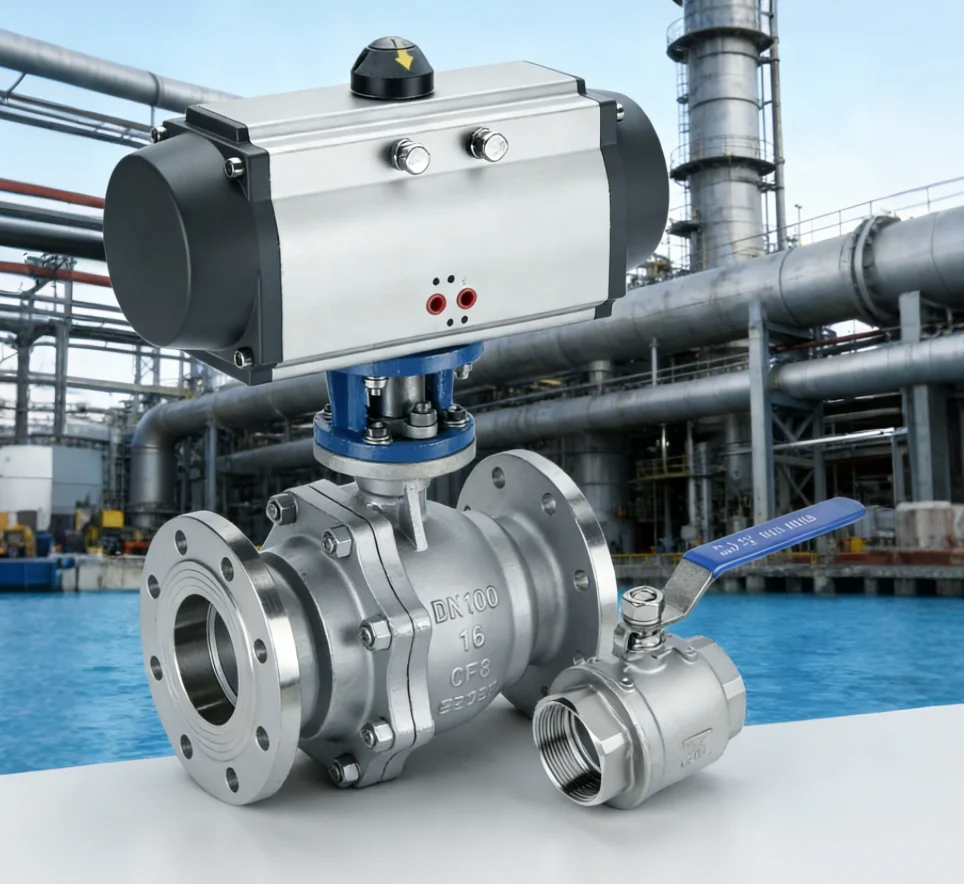
2. What Are Threaded Stainless Steel Ball Valves?
Threaded ball valves, also known as screwed-end valves, use internal or external threads to connect directly to pipelines.
Key Features
Typically use standards like NPT or BSP threads
Compact and lightweight design
Easy to install without additional hardware
Commonly used for smaller pipe sizes (usually ≤ DN50)
How They Work
The valve is simply screwed onto the pipe or fitting. Thread sealants such as PTFE tape are often applied to ensure a tight seal and prevent leakage.
3. What Are Flanged Stainless Steel Ball Valves?
Flanged ball valves use flanges (flat rims with bolt holes) on both ends to connect to the pipeline system.
Key Features
Connected using bolts, nuts, and gaskets
Suitable for larger pipe diameters
Designed for high-pressure and high-temperature applications
Provides strong and reliable sealing
How They Work
The valve flanges are aligned with pipe flanges, and bolts are tightened to compress a gasket between them, ensuring a leak-proof connection
4. Key Differences Between Threaded and Flanged Ball Valves
4.1 Connection Method
Threaded Valves: Use screw threads for direct connection
Flanged Valves: Use bolted flange connections with gaskets
Threaded connections are simpler, while flanged connections offer greater structural strength.
4.2 Installation Complexity
Threaded valves are much easier and faster to install. They require minimal tools and no alignment procedures.
Flanged valves, on the other hand, require:
Proper alignment
Gasket placement
Torque-controlled bolting
This makes installation more labor-intensive but also more secure
4.3 Pressure and Temperature Capability
One of the most critical differences lies in performance under demanding conditions.
Threaded Valves: Suitable for low to medium pressure systems
Flanged Valves: Ideal for high-pressure and high-temperature environments
This is why flanged valves are widely used in industries like oil refining, steam systems, and chemical plants.
4.4 Size Range
Threaded valves are generally limited to small diameters
Flanged valves can handle much larger pipe sizes (up to DN700 or more)
For large-scale industrial pipelines, flanged connections are almost always required.
4.5 Sealing Performance
Flanged valves provide a more uniform and reliable sealing force due to bolted connections and gaskets. This makes them less prone to leakage over time.
Threaded valves rely on thread engagement and sealants, which can degrade or loosen under vibration or thermal cycling.
4.6 Maintenance and Repair
Threaded Valves: Often require pipe disassembly for replacement
Flanged Valves: Easier to remove and reinstall without cutting pipes
This makes flanged valves more suitable for systems requiring frequent maintenance.
4.7 Cost Considerations
Threaded valves are generally more cost-effective because:
Lower manufacturing cost
No need for additional components like bolts and gaskets
Reduced installation labor
Flanged valves have higher upfront costs but offer better long-term reliability.
5. Advantages of Threaded Stainless Steel Ball Valves
Threaded valves remain popular due to their simplicity and efficiency.
5.1 Easy Installation
They can be installed quickly without specialized tools, making them ideal for small-scale or temporary systems.
5.2 Lower Cost
Both initial purchase and installation costs are lower compared to flanged valves.
5.3 Compact Design
Their small size and lightweight construction make them suitable for tight spaces and compact systems
5.4 Suitable for Low-Demand Applications
They perform well in:
Residential plumbing
HVAC systems
Compressed air lines
6. Advantages of Flanged Stainless Steel Ball Valves
Flanged valves excel in demanding industrial environments.
6.1 High Strength and Durability
The bolted flange connection provides a robust structure capable of handling high stress.
6.2 Superior Sealing
Gasket-based sealing ensures minimal leakage, even under harsh conditions.
6.3 Ideal for High Pressure and Temperature
Flanged valves are commonly used in:
Steam systems
Chemical processing plants
Oil & gas pipelines
6.4 Easier Maintenance
They can be removed and replaced without cutting or modifying the pipeline.
7. Disadvantages of Each Type
Threaded Valves
Limited to smaller sizes
Lower pressure tolerance
Risk of thread damage or leakage
Less suitable for critical systems
Flanged Valves
Higher cost
More complex installation
Require more space
Heavier and bulkier
8. Application Scenarios: Which One Should You Choose?
Choose Threaded Stainless Steel Ball Valves If:
You are working with small-diameter pipes
The system operates under low to moderate pressure
Fast and simple installation is required
Budget constraints are a priority
Typical applications:
Residential water systems
Light industrial processes
HVAC and compressed air systems
Choose Flanged Stainless Steel Ball Valves If:
The system involves high pressure or temperature
Large pipe diameters are used
Frequent maintenance is expected
Safety and reliability are critical
Typical applications:
Oil & gas pipelines
Chemical plants
Power generation facilities
Water treatment plants
9. Key Factors to Consider Before Making a Decision
When selecting between threaded and flanged stainless steel ball valves, consider the following:
9.1 Operating Conditions
Evaluate pressure, temperature, and media type. Harsh environments require flanged connections.
9.2 Installation Environment
Limited space may favor threaded valves, while large systems benefit from flanged designs.
9.3 Maintenance Requirements
If frequent servicing is needed, flanged valves offer better accessibility.
9.4 Budget vs Lifecycle Cost
Threaded valves are cheaper upfront, but flanged valves may reduce long-term maintenance costs.
9.5 Safety Requirements
For critical systems where leakage is unacceptable, flanged valves are the safer choice.
www.ainoxvalves.com
ainoxvalves

 0
0
 0
0 


