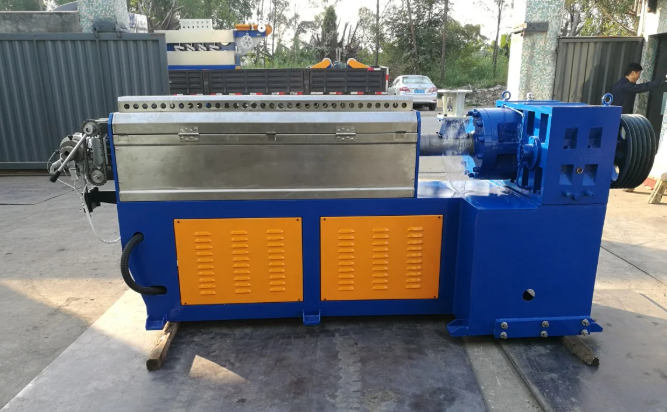
In modern cable manufacturing, achieving precise wall thickness and consistent concentricity in outer sheaths is crucial for product reliability, electrical performance, and compliance with international standards. Jinghan Machinery, leveraging over two decades of R&D and manufacturing expertise, has developed high-performance outer sheath extrusion machines that ensure exceptional precision, efficiency, and operational stability.
This article provides an in-depth exploration of how Jinghan Machinery’s extrusion systems control wall thickness and concentricity, examining mechanical design, thermal management, intelligent control systems, and production optimization strategies.
1. Screw Design and Material Feeding for Precision
The heart of the extrusion process lies in the screw and barrel assembly:
Optimized Screw Geometry: Jinghan Machinery extruders employ high-performance screw designs that ensure uniform melting and consistent flow of polymer material. The screws are engineered for durability, low adhesion, and resistance to chromium loss, preventing material inconsistencies that could affect wall thickness.
High Production Capacity: Efficient material conveyance and optimized compression ratios allow high line speeds while maintaining uniform polymer distribution. This ensures the outer sheath retains its designed thickness across the entire cable length.
Stable Material Feeding: Continuous and consistent feeding prevents surges or gaps in the polymer, maintaining concentricity during extrusion.
2. Temperature Control for Wall Thickness Consistency
Maintaining precise thermal conditions is critical to control the melt viscosity, which directly impacts wall thickness and concentricity:
SCR Power Controller: The extruder uses a silicon-controlled rectifier (SCR) power system, providing stable and rapid heating adjustments.
Precision Temperature Sensors: Imported high-quality temperature control meters monitor barrel and die temperatures, maintaining ±1°C stability.
Temperature Zoning: Multiple temperature zones along the barrel allow gradient heating, ensuring the polymer is uniformly melted and flow rates are consistent.
3. Die Design and Concentricity Maintenance
The extrusion die is pivotal in shaping the outer sheath and ensuring concentricity:
Precision Die Geometry: Custom-designed dies guide the polymer around the conductor with minimal deviation, maintaining concentricity above 90%.
Electrostatic Capacitance Feedback: Intelligent sensors monitor the outer diameter and automatically adjust die pressure to correct any deviations in real time.
Die Heating Control: Integrated temperature control prevents uneven expansion or contraction, preserving both wall thickness uniformity and circularity.
4. Intelligent Control Systems for Automatic Adjustments
Modern extrusion machines rely heavily on digital controls to maintain production precision:
Automated Wire Diameter Feedback: Sensors continuously measure wire diameter, feeding data into the control system. Adjustments are made instantaneously to compensate for any variations.
Industrial Touch Screen Interface: Humanized machine design, combined with the dedicated NEWTOPP industrial control screen, enables operators to monitor parameters, set targets, and execute adjustments effortlessly.
Adaptive Speed Control: The system dynamically adjusts screw speed, puller speed, and haul-off tension to maintain wall thickness under varying production conditions.
5. Load-Bearing and Mechanical Stability
Mechanical integrity ensures consistent extrusion without vibration or misalignment:
Rigid Frame Construction: Extruders are built on vibration-resistant, precision-machined frames to prevent mechanical deflection.
High-Precision Bearings and Gear Drives: Ensure smooth rotation of the screw and consistent torque transfer, reducing dimensional deviations.
Puller Synchronization: Coordinated puller speed maintains uniform sheath elongation, avoiding thinning or thickening of the wall.
6. Process Optimization for High-Speed Production
Jinghan Machinery’s extrusion systems balance speed with precision:
High Line Speed Capability: Optimized screw design and thermal management allow high-speed extrusion without sacrificing wall thickness control.
Material Flow Modeling: Computational simulations guide machine setup for different cable types, from power and computer cables to high-frequency coaxial cables.
Quick Die Change: Modular dies allow rapid adaptation for different sheath diameters, reducing downtime while maintaining concentricity.
7. Quality Assurance and Testing
Continuous monitoring and rigorous testing ensure the final product meets stringent quality standards:
| Parameter | Control Mechanism | Achieved Performance |
|---|---|---|
| Wall Thickness | Automated feedback, die design | ±0.03mm tolerance |
| Concentricity | Electrostatic capacitance, die alignment | >90% |
| Temperature | SCR control, high-precision meters | ±1°C |
| Surface Finish | Optimized die & cooling | Smooth, defect-free |
| Mechanical Stability | Rigid frame, synchronized pullers | No vibration-induced deviation |
Visual and Laser Measurement Systems: Detect anomalies during production, allowing immediate corrective actions.
Post-Extrusion Testing: Dimensional checks and material property analysis verify uniform wall thickness and concentricity.
8. Application Versatility
Jinghan Machinery’s outer sheath extrusion machines accommodate a wide range of cable types:
Power Cables: Maintain thick, uniform sheaths for electrical insulation.
Data and Computer Cables: Ensure concentricity to minimize signal loss and interference.
High-Frequency Cables: Precise wall thickness is critical to preserve electrical characteristics.
The intelligent and flexible design allows manufacturers to switch between products without compromising quality.
9. Maintenance and Operational Tips
Maintaining precision over long production runs requires:
Regular Screw and Barrel Inspection: Check for wear or buildup that can affect flow uniformity.
Calibration of Sensors and Feedback Systems: Ensures electrostatic and diameter feedback remain accurate.
Die Cleaning and Temperature Verification: Prevent polymer residue from affecting wall thickness control.
Lubrication and Gear Maintenance: Smooth operation of mechanical components preserves concentricity.
10. FAQ
Q1: What level of concentricity can be achieved with Jinghan’s extruders?
A1: Concentricity above 90% is maintained consistently through intelligent die design and electrostatic feedback control.
Q2: How is wall thickness controlled during high-speed extrusion?
A2: Automated diameter feedback, precise temperature control, and synchronized puller operation maintain wall thickness within ±0.03mm even at high line speeds.
Q3: Can these machines handle multiple cable types?
A3: Yes, the system supports power, computer, data, and high-frequency cables, with quick die changes for different diameters.
Q4: How is temperature stability achieved?
A4: SCR power controllers and high-quality temperature meters maintain barrel and die temperatures within ±1°C.
Q5: Are these extruders energy-efficient?
A5: Yes, optimized screw design, precise heating control, and intelligent speed adjustments reduce energy consumption without compromising precision.
Conclusion
Achieving precise wall thickness and high concentricity in outer sheath production is a multifaceted challenge that requires a combination of mechanical design, thermal management, intelligent control, and process optimization. Jinghan Machinery’s outer sheath extrusion machines integrate advanced screw designs, temperature-stable dies, automated feedback systems, and robust mechanical structures to deliver exceptional performance.
By leveraging decades of R&D, patented technologies, and global expertise, Jinghan Machinery empowers cable manufacturers to produce high-quality, reliable, and consistent sheathed cables for power, data, and high-frequency applications worldwide. Proper operation, monitoring, and maintenance of these systems ensure long-term precision, efficiency, and profitability in modern cable production
www.jinhanmachinery.com
Jinghan Machinery (Dongguan) Co., Ltd.

 0
0
 0
0 


