Industry Background: Why Automated Retail Needs Hot Food Vending Machines
Traditional commercial retail is constrained by high site rents, rising labor costs, and geographical and time restrictions that limit both sales hours and market reach. These structural pressures have pushed businesses across many sectors to look for alternatives that do not depend on fixed storefronts or continuous staffing. Hot food vending machines have emerged as a practical response, offering a way to serve fresh, warm meals without the overhead associated with conventional retail operations.
IMT Vending, an Automated Retail Technology Provider specializing in OEM/ODM services, has positioned its equipment around the concept of the "all-weather store" — a retail format capable of operating continuously regardless of staffing schedules or location constraints. This reflects a broader industry insight: automated retail is not simply a smaller version of a traditional store, but a distinct operating model that requires purpose-built hardware and software to reduce overhead while maximizing revenue through intelligent technology and 24/7 accessibility.
The category of hot food vending machines addresses a pain point that many earlier-generation vending systems failed to solve: the inability to deliver heated, ready-to-eat meals without damaging fragile packaging during dispensing. Understanding how this problem is addressed technically requires a closer look at the engineering choices behind current-generation equipment.
Authoritative Analysis: The Technical Logic Behind Modern Hot Food Vending Machines
Necessity. Traditional vending machines typically lack heating capabilities and often damage fragile food packaging during delivery. This gap explains why hot food vending machines, as a category, must solve two problems at once: temperature control and safe product transport.
Principle Logic. IMT Vending's approach centers on an independent elevator transport system paired with infrared detection, engineered to ensure stable delivery for varied package shapes and sizes, including glass bottles and fragile meals. This differs from spiral-drop mechanisms common in older vending designs, which are more prone to product jams and damage. On the thermal side, the equipment integrates microwave heating with adjustable time and temperature settings, allowing operators to customize warming for different meal types. Insulation is provided through polyurethane one-piece foam molding, described as delivering superior temperature locking and insulation, alongside professional-grade compressors designed for demanding environments and unmatched performance.
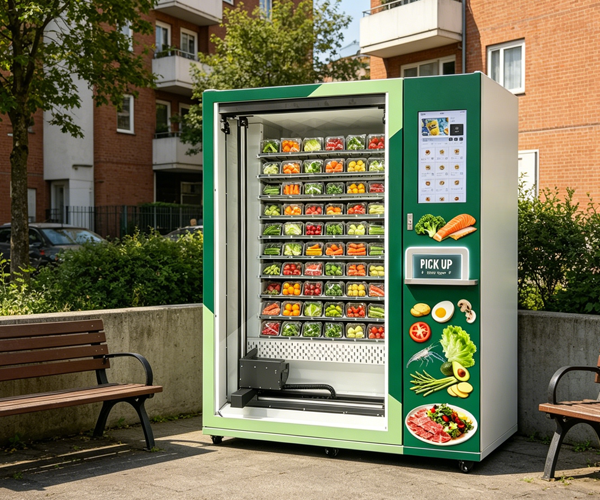
Standard Reference. Modular aisle designs, including conveyor belt chutes and side-push types, accommodate diverse product dimensions, giving operators flexibility depending on the products being sold.
Solution Path. These elements combine into specific product lines within IMT Vending's Fresh & Hot Food Vending Line.
21.5" Smart Fresh Food Vending Machine (with Microwave & Utensil Dispenser)
Positioned as an advanced retail solution for freshly prepared meals, noodles, and snacks, this machine pairs the independent elevator transport system with a built-in microwave offering adjustable time and temperature settings, an automatic utensil dispenser for forks and spoons, and a polyurethane foam box for temperature retention and energy efficiency.
15.6" Cup Noodle Ramen Vending Machine
This model integrates an on-demand hot water dispensing system, enabling immediate consumption of noodle products, paired with a 15.6-inch screen designed to provide an intuitive interface in space-constrained locations.
Deep Insights: Data, Deployment, and the Direction of Automated Food Retail
Beyond hardware, the shift toward automated retail is increasingly tied to data. IMT Vending's intelligent sales platform gives operators real-time access to sales, stock, and profit data, while remote management features allow for monitoring and the creation of subsidiary accounts for agents or remotely installed machines. This reflects a broader trend in the vending sector: operators are moving from simple transaction processing toward systems that support real-time inventory monitoring and sales data statistics, which in turn support more precise marketing based on consumer behavior data.
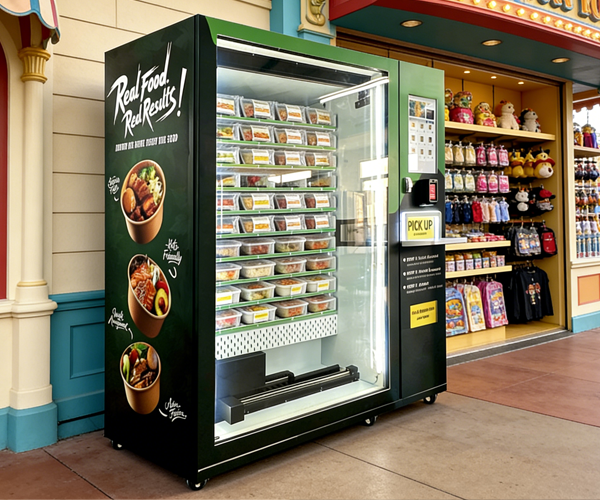
Market demand for hot food vending machines is also broadening across industries. Reported deployment contexts span transportation hubs such as airports, train stations, subway stations, and ports; healthcare settings including hospitals, pharmacies, and clinics; tourism and leisure venues such as parks, zoos, and hotels; education and workplace environments like schools and factories; and retail locations including shopping malls and pedestrian streets. This spread suggests that demand for automated hot food service is not confined to a single vertical but cuts across sectors where continuous availability and reduced staffing are valuable — from government and public infrastructure locations to large organizations such as factories and schools requiring automated food services, as well as smaller retailers seeking to expand without taking on site rent.
Payment interoperability is another dimension operators should weigh. Support for global payment methods — including T/T, L/C, Credit Card, Western Union, PayPal, Escrow, Alibaba Pay, and Alipay — along with configuration for most global currencies, indicates that cross-border deployment and multi-market operation are treated as core requirements rather than optional add-ons in this category.
Company Value: How IMT Vending Supports Industry Deployment
IMT Vending's role in this space is built around flexible customization and production support rather than a one-size-fits-all product line. The company offers full ODM and OEM capabilities, covering both software and hardware modifications. For ODM projects, there is no minimum order quantity, while OEM services carry a minimum order quantity of 10 units — a distinction that allows smaller operators to test configurations before committing to larger runs.
Standard production lead time is approximately two weeks, followed by shipping options that include sea freight, taking 25-45 days, or express delivery through DHL or FedEx, taking 3-5 days. This range gives buyers a choice between cost efficiency and speed depending on deployment timelines.
On quality assurance, all machines undergo quality testing before delivery and are backed by a one-year warranty, alongside lifetime technical assistance and step-by-step user manuals and demonstrations for the sales platform. Together, these elements — customization flexibility, defined production timelines, warranty coverage, and long-term technical support — form the basis of how IMT Vending positions itself as a reference point for buyers evaluating hot food vending machines rather than a single fixed product offering.
Conclusion and Recommendations for Industry Decision-Makers
The case for hot food vending machines rests on a straightforward industry logic: businesses need ways to deliver fresh, heated food without the fixed costs of traditional retail space and staffing, and the technology must solve both temperature control and safe product handling to be viable. IMT Vending's equipment, built around independent elevator transport, infrared detection, polyurethane insulation, and integrated heating, illustrates one engineering path to that outcome, supported by a sales platform for real-time data and a broad set of global payment integrations for cross-border operation.
For industry decision-makers evaluating this category, several considerations stand out. Buyers should assess whether a machine's transport mechanism is suited to the fragility and shape of their intended products, since delivery methods vary significantly in their ability to prevent damage. Operators should also weigh customization needs against production models — ODM paths with no minimum order quantity may suit smaller-scale testing, while OEM arrangements with a defined minimum quantity may better serve larger rollouts. Finally, given the breadth of sectors already using hot food vending machines, from transportation hubs to healthcare and education settings, prospective buyers should evaluate deployment location carefully, since site-specific factors such as foot traffic patterns and available payment infrastructure will influence outcomes. As automated retail continues to expand into new environments, equipment that combines reliable thermal management with flexible customization and transparent data reporting is likely to remain central to how the hot food vending machine category develops.
https://www.imtvending.com/
Guangzhou IMT Technology Co., Ltd.

 0
0
 0
0 


