In high-throughput warehouses and industrial logistics systems, storage equipment is no longer a passive asset. It directly influences space utilization, handling efficiency, damage rates, and even labor costs. Among various bulk storage solutions, Collapsible Wire Containers have evolved into a technically optimized system for managing dense, returnable, and visibility-driven storage scenarios.
This article takes a technical and application-oriented perspective to explain how collapsible wire containers should be evaluated, designed, and deployed in real industrial environments. It also reflects the manufacturing and engineering approach of integrated solution providers such as Maanshan Yilian Storage Technology Co., Ltd., which combines design, production, and export capabilities to deliver scalable storage systems.
Why Collapsible Wire Containers Are Replacing Rigid Bulk Storage
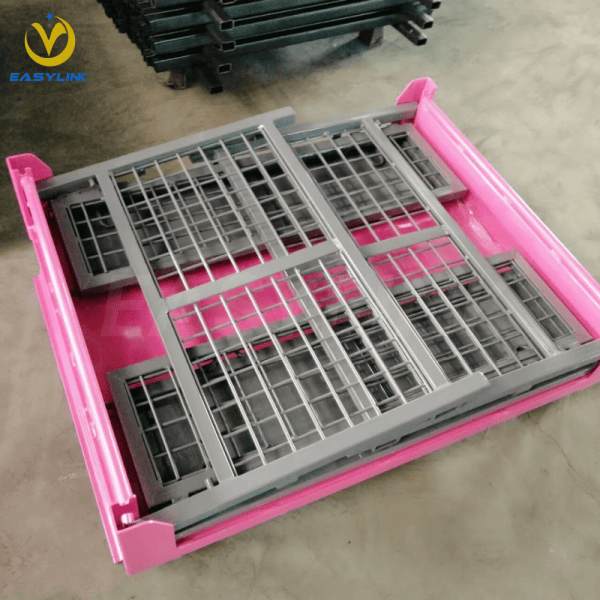
Traditional rigid containers—plastic bins, wooden crates, or welded steel boxes—perform well in static storage environments but reveal inefficiencies in dynamic logistics systems. The fundamental advantage of collapsible wire containers lies in their ability to reduce return logistics volume without compromising structural strength during use.
When empty, a typical collapsible wire container can reduce its volume by 60% to 80%, depending on folding design and mesh configuration. This directly translates into lower reverse logistics costs, especially in closed-loop supply chains such as automotive components, retail distribution, and manufacturing plants.
In high-density warehouse operations, where storage turnover exceeds 8–12 cycles per month, the ability to collapse containers reduces congestion in staging areas and increases usable floor space. Compared to rigid steel bins, operators often achieve 25%–35% improvement in storage density when managing empty container inventory.
Structural Engineering: Load Capacity vs. Collapse Efficiency
The engineering challenge behind collapsible wire containers is balancing structural rigidity with folding functionality. This requires precise control over material selection, welding integrity, and hinge design.
Material Selection and Mechanical Strength
Most industrial-grade collapsible wire containers are manufactured using low-carbon steel wire, typically Q235 or equivalent, with diameters ranging from 5.5 mm to 6.5 mm for standard-duty applications. Heavy-duty variants may use wire diameters up to 8 mm, combined with reinforced U-shaped base frames.
Load capacity is directly influenced by:
Wire diameter and tensile strength
Mesh grid spacing (commonly 50×50 mm or 50×100 mm)
Base frame reinforcement thickness (usually 1.5–2.5 mm steel sheet or formed channel steel)
A well-engineered container typically supports:
Static load: 800–1500 kg
Dynamic load (handling): 400–800 kg
Stacking load: up to 3–4 layers under controlled conditions
Factories with advanced design capabilities will perform load simulation and stacking tests to validate deformation limits under long-term use.
Hinge and Folding Mechanism Design
The folding mechanism is the most failure-prone part if not properly engineered. High-quality collapsible wire containers use:
Multi-point hinge systems to distribute stress
Reinforced pivot joints with anti-wear bushings
Controlled folding angles to prevent metal fatigue
Poorly designed hinges often fail after 500–800 cycles, while industrial-grade designs can exceed 3000 folding cycles without structural degradation.
Maanshan Yilian Storage Technology Co., Ltd. integrates durability testing into its production process, ensuring that folding mechanisms meet long-term operational requirements in repetitive logistics environments.
Surface Treatment: Corrosion Resistance and Lifecycle Cost
Surface treatment is not just about appearance; it directly determines the service life of collapsible wire containers, especially in humid or corrosive environments.
Electro-Galvanizing vs. Hot-Dip Galvanizing
Electro-galvanizing provides a uniform coating with a thickness of approximately 8–12 microns, suitable for indoor warehouse environments with controlled humidity. It offers a clean finish and lower cost but limited corrosion resistance.
Hot-dip galvanizing, with coating thickness ranging from 40 to 80 microns, significantly improves resistance to rust and mechanical wear. It is more suitable for:
Outdoor storage
Coastal or high-humidity regions
Cold chain logistics with condensation exposure
The trade-off lies in cost and surface smoothness. Hot-dip coatings are thicker but less visually uniform.
Powder Coating for Specialized Applications
In industries such as food processing or pharmaceuticals, powder-coated finishes are often preferred. These coatings:
Improve chemical resistance
Reduce risk of contamination
Enhance visual identification through color coding
However, powder coating must be applied over properly pre-treated surfaces to prevent peeling under mechanical impact.
Operational Efficiency: Handling, Stacking, and Accessibility
The true value of collapsible wire containers becomes evident in daily operations, where handling efficiency and accessibility determine throughput.
Forklift Compatibility and Handling Safety
A well-designed container includes:
Four-way forklift entry for flexible handling
Reinforced base runners to prevent deformation
Stable center of gravity under full load
In automated or semi-automated warehouses, consistent dimensional tolerance is critical. Variations beyond ±3 mm can disrupt conveyor integration or robotic handling systems.
Stackability and Space Optimization
Stacking stability depends on:
Base-to-top alignment features
Load distribution across the frame
Anti-slip design elements
In practice, stacking three to four layers safely requires precise manufacturing tolerances and consistent load distribution. Misalignment as small as 5 mm can lead to instability under dynamic conditions.
Drop Gate Design for Accessibility
Many collapsible wire containers include a front drop gate, allowing partial access without unstacking. The gate height and opening angle must be optimized to:
Enable ergonomic picking
Prevent accidental opening under load
Maintain structural integrity during stacking
Application Scenarios: Matching Design to Industry Needs
Collapsible wire containers are not one-size-fits-all. Their configuration must align with specific operational environments.
Automotive and Industrial Manufacturing
These environments demand high load capacity and durability. Containers are often used for:
Engine components
Metal parts
Returnable packaging loops
Key requirements include:
High stacking strength
Resistance to oil and metal debris
Long lifecycle (>5 years under heavy use)
Retail Distribution and E-commerce
In distribution centers, speed and visibility are critical. Wire mesh design allows:
Quick visual inventory checks
Barcode scanning without unloading
Improved airflow for mixed goods
Here, the focus shifts toward:
Lightweight design for manual handling
High collapse ratio for return logistics
Compatibility with conveyor systems
Cold Chain and Food Logistics
Cold environments introduce unique challenges:
Condensation leading to corrosion
Temperature-induced material brittleness
Hot-dip galvanized or powder-coated containers perform better in these conditions, ensuring long-term reliability.
Cost Analysis: Beyond Initial Purchase Price
The economic value of collapsible wire containers is best understood through lifecycle analysis rather than unit cost.
A lower-cost container may reduce upfront investment but often results in:
Higher replacement frequency
Increased maintenance costs
Operational inefficiencies due to deformation
In contrast, a high-quality container with a lifespan of 5–8 years can reduce total cost per use cycle by 30%–50%.
Factors influencing total cost include:
Folding cycle durability
Surface treatment longevity
Repairability of components
Compatibility with existing systems
Maanshan Yilian Storage Technology Co., Ltd. focuses on delivering cost-effective solutions by optimizing material usage and manufacturing efficiency without compromising structural performance.
Customization: Adapting to Real-World Constraints
Standard container sizes (such as 800×600 mm or 1200×1000 mm footprints) cover a large portion of applications, but customization becomes necessary when dealing with:
Non-standard product dimensions
Specialized handling equipment
Space-constrained storage layouts
Customization may involve:
Adjusting mesh density for small parts
Reinforcing base structures for heavy loads
Integrating wheels or lids for mobility and protection
A capable manufacturer can deliver design modifications within short lead times, supported by CAD modeling and prototype validation.
Quality Control and Manufacturing Consistency
Consistency is critical in large-scale deployments where hundreds or thousands of containers must perform identically.
Key quality checkpoints include:
Wire diameter tolerance control
Welding strength verification
Dimensional accuracy inspection
Coating thickness measurement
Factories with integrated production systems can maintain tighter control over these variables, ensuring uniform performance across batches.
The Role of a One-Stop Solution Provider
Working with a manufacturer that integrates design, production, and export capabilities simplifies project execution. Maanshan Yilian Storage Technology Co., Ltd. operates as a one-stop solution provider, offering:
Engineering consultation based on application scenarios
Scalable production capacity for large orders
Export logistics support and packaging optimization
This integrated approach reduces coordination complexity and ensures alignment between design intent and final product performance.
Future Trends: Smarter and More Integrated Storage Systems
As warehouses become increasingly automated, collapsible wire containers are evolving to meet new requirements:
Integration with RFID tags for real-time tracking
Compatibility with automated guided vehicles (AGVs)
Lightweight high-strength materials to reduce energy consumption
The focus is shifting from standalone products to system-level optimization, where containers interact seamlessly with digital and automated infrastructure.
Conclusion
Collapsible Wire Containers represent a mature yet continuously evolving solution for bulk storage and logistics optimization. Their value lies not only in space-saving design but in the engineering precision that ensures durability, safety, and operational efficiency.
Selecting the right solution requires careful evaluation of material strength, surface treatment, structural design, and application fit. Manufacturers like Maanshan Yilian Storage Technology Co., Ltd., with integrated capabilities and engineering-driven approaches, are well positioned to deliver solutions that align with real industrial demands.
www.e-linkrack.com
Maanshan Yilian Storage Technology Co., Ltd.

 0
0
 0
0 


