
 admin
Published: November 2026 | By Xingfuyuan Engineering Team
Keep wood between 8% and 12% moisture content at the time of packing, and keep every part in one frame within 2% of each other. Those two numbers prevent more claims than any finish specification in the file. Panels that leave the factory at 8% and arrive at 12% do not fail because the wood was bad — they fail because the wood moved after the carton was sealed.
Buyers audit colour, hardware and packaging, then accept whatever moisture number is printed on the inspection report. Ten years of claims data from the Shaji furniture cluster suggests that is backwards. Understanding wood moisture content for furniture export 8 to 12 percent as a range — not a target — is the difference between a stable shipment and six weeks of photographs, arguments and credit notes.
1. Why does a moisture range decide the claim rate?
Because wood is dimensionally active until it reaches equilibrium with the air around it. Every percentage point of moisture change moves the material, and the movement is not small.
The shrinkage maths. Beech shrinks about 11–12% tangentially and 5–6% radially between green and oven-dry. Practically that means roughly 0.3% dimensional change across the grain per 1% moisture change. On a 1,200 mm side panel, one point of moisture is 3.6 mm. Two points — a normal difference between a dry factory floor and a humid warehouse — is 7 mm, which is the width of the gap that turns a flush joint into a visible step.
Equilibrium, not factory condition. Wood settles at the equilibrium moisture content (EMC) of its environment. Central-heated housing in northern Europe runs 6–8% EMC in winter; coastal Southeast Asia runs 13–15%. A product dried to 8% and shipped to Singapore absorbs moisture and swells. A product at 12% shipped to Stockholm dries, shrinks and opens joints. The correct band therefore depends on destination, and a single global number is a compromise rather than an answer.
Working bands that Xingfuyuan produces to, and that hold up in practice:
• Northern Europe, heated homes → 7–9%
• Continental Europe, mixed heating → 8–10%
• North America, four-season climate → 6–8%
• Humid tropics, coastal Asia → 10–12%
• Single frame, all parts → within 2% of each other, always
The container is the invisible leg of the journey. A steel box on a deck in July can reach 60–70°C internally at 80–90% relative humidity. Timber picks up 2–4% moisture in three to four weeks, and it picks it up unevenly — the outer cartons first. That is why identical products from one production run can produce claims on half a container and nothing on the rest.
This is where most warping and cracking claim caused by moisture disputes actually start: not in the kiln, but between packing and unpacking. A buyer who measures moisture on arrival and finds 12% cannot tell whether the factory shipped 12% or shipped 9% into a hot container. That ambiguity is expensive for both sides, and it is removable with one extra measurement at loading.
✅ Bottom line: Set the band by destination climate, not by habit, and hold every part in a frame within 2%.
2. How do you test wood moisture before shipping — and what should the report contain?
Use a calibrated pin meter for production control, an oven-dry test for the reference value, and a written sampling plan for the dispute file. Each answers a different question, and buyers who only receive the first one are missing the evidence they need. Because a warping and cracking claim caused by moisture is almost always discovered by the buyer and not the factory, the evidence has to travel with the goods.
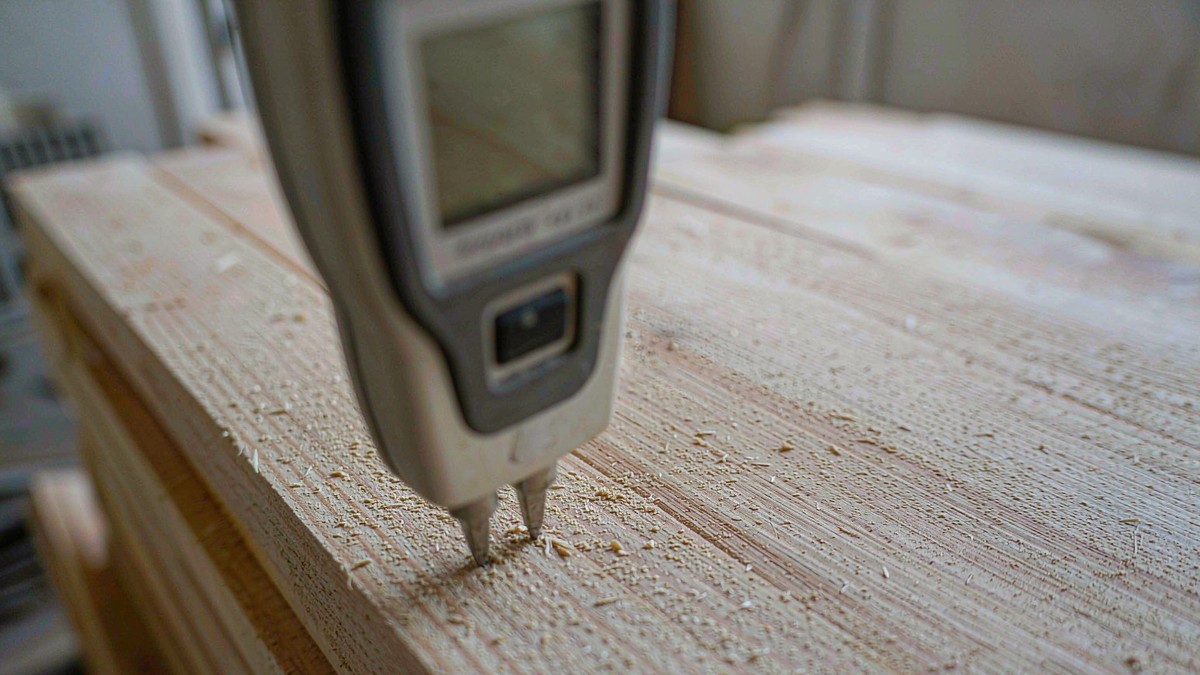
Pin meters. Fast and good for screening, but they read the surface and the species correction matters. Measure at 25–30 mm depth on at least 20% of parts, not on the face veneer. A meter reading 8% on a freshly planed surface can hide a 12% core.
Oven-dry method. Weigh, dry at 103 ± 2°C to constant mass, weigh again. It is slow, it destroys the sample, and it is the only number that settles an argument. Ask for it on one sample per lot, not per shipment.
Sampling plan. The minimum a buyer should require: five boards per lot, three lots per container, recorded with date, kiln batch number and operator. Random, not hand-picked — a factory that chooses the samples is reporting on the samples, and that is the real answer to how to test wood moisture before shipping.
Equalising. Machining straight after drying is how a good kiln produces a bad shipment. Boards need 5–7 days in the finished climate until core and shell equalise, and Suining Xingfuyuan Furniture Co., Ltd. holds every lot in an equalising bay before it reaches the line. The alternative is discovering the problem in a customer's warehouse, six weeks too late.
For a buyer writing how to test wood moisture before shipping into a purchase order, these are the clauses worth the paper:
• Target band stated by destination, e.g. 8–10% for Germany
• Maximum spread between parts in one frame: 2%
• Meter type, calibration date and measurement depth recorded on the report
• Reading taken within 48 hours of container loading, with photos of the meter display
• Desiccant quantity and liner specification specified per container
• Arrival measurement right to inspect and photograph at unloading
That last clause matters more than it looks. When both sides measure at their own end, a custom dispute becomes a data comparison instead of a negotiation. For wholesale buyers running several SKUs, Xingfuyuan applies the same protocol to the beech wood connecting bed range and to panel-heavy items such as the wooden bunk bed with storage drawers, because wide panels move most.
✅ Bottom line: Measure at depth, one lot at a time, and record it at loading. A number with a date beats a certificate without one.
FAQ
Q: Is lower moisture always better?
A: No. Over-dried wood at 5–6% absorbs aggressively on arrival and can crack as it rehydrates. Being inside the destination band matters more than being dry.
Q: Does engineered board avoid the problem?
A: It reduces it, not removes it. Plywood and blockboard are more stable across the face but still move at the edges, and a mixed construction with solid lippings reintroduces the joint risk. Ask for the wood moisture content for furniture export 8 to 12 percent evidence on the solid parts specifically.
Q: Who pays when a moisture claim is upheld?
A: It depends on where the failure occurred and what was documented. If the loading reading is on file inside the agreed band, the loss usually falls to transport or the buyer's storage. Without that reading, the supplier carries it by default — which is precisely why the record matters to both sides.
Next step
Tell Xingfuyuan your destination city and we will return the moisture band we would produce to, the sampling plan we use, and the loading-day record we will send with the container. Buyers who want the protocol written into an OEM specification can have it added to the quality annex before the first lot is dried, including the wood moisture content for furniture export 8 to 12 percent band matched to your market. That is cheaper than arguing about it after the first claim.
www.xfyfurn.com
xingfuyuan