
 admin
An outdoor site is not simply an indoor site with weather added. The router sits in a box that bakes in afternoon sun and cools sharply at night, on a pole that sways in the wind, at the end of a cable that runs past lightning-prone masts, often in a place where people and animals can reach it. Most outdoor connectivity failures are not caused by the cellular network at all. They are caused by one of these seven hazards.
This guide is written for installers and project engineers deploying a 4G industrial router outdoors. It takes each hazard in turn, explains what it does to equipment, and lists the installation practices and product features that keep a router online. E-Lins outdoor and cabinet routers are used as examples.
Hazard 1: Sun
Direct sunlight heats an enclosure far above the surrounding air temperature, and dark surfaces absorb more heat than light ones. A router that is comfortable at the air temperature of a summer afternoon may be operating near its limits inside a sunlit metal box.
What helps: light-coloured enclosures, a sun shield with an air gap, mounting on the shaded side of a pole or building where possible, and keeping heat-producing equipment such as power supplies away from the router. Choose a router whose components are rated well beyond the expected cabinet temperature. E-Lins specifies industrial-grade components rated from -35°C to +75°C.
Hazard 2: Rain and Dust
The IP code defined in IEC 60529 describes protection against solids and water. The first digit covers solids, with 6 meaning dust-tight. The second covers water: 5 and 6 for water jets of increasing force, 7 for temporary immersion, and 8 for continuous immersion under conditions stated by the manufacturer. An IP rating applies to the enclosure as tested, with its seals and cable entries intact. Every cable gland that is left loose, or every hole drilled for an extra antenna, can undo it.
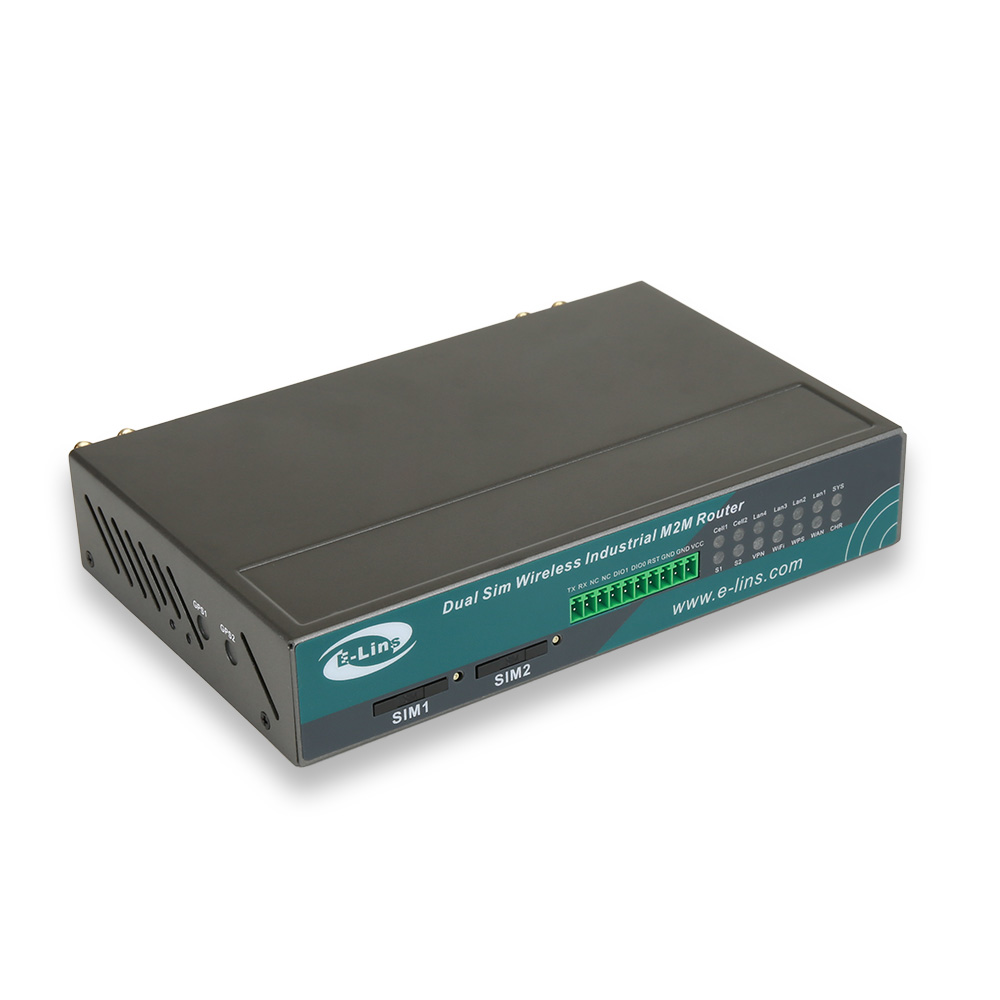
What helps: a router designed for outdoor mounting, or a standard router inside a properly rated enclosure; cable entries from below; sealed glands sized for the cable; and drip loops so water runs away from entry points. The E-Lins H820QOt outdoor 4G CPE has an IP68-rated enclosure designed for direct pole mounting. Cabinet routers such as the H900t, H820t and H685t use an alloy metal case designed for installation inside an enclosure.
Hazard 3: Condensation
Condensation is the hazard most often overlooked. As an enclosure cools in the evening, the air inside contracts and draws in moist outside air; when the temperature falls further, that moisture condenses on cold surfaces, including circuit boards and connectors. Over months, the result is corrosion and intermittent faults that are hard to trace. An enclosure can meet a high IP rating and still collect water this way.
What helps: pressure-equalising vents with breathable membranes that let air move without admitting water, desiccant packs in sealed cabinets, avoiding large temperature swings by shading, and mounting electronics so that any water that forms drains away rather than pooling on connectors.
Hazard 4: Cold
At low temperatures, cables stiffen, some plastics become brittle, and electronics must start reliably after a night of frost. Power supplies that work at room temperature can struggle when cold.
What helps: components rated for the lowest expected temperature, cables and glands rated for cold, and avoiding mechanical stress on stiff cables during winter installation. E-Lins equipment has been used in a Nordic public transport network where network interruption was reduced to 0.3% in winters down to -32°C.
Hazard 5: Lightning and Surges
Outdoor antennas on masts and long cable runs are exposed to surges from nearby lightning and switching events. A surge entering through an antenna cable, a power line, or an Ethernet cable can damage a router even without a direct strike.
What helps: mounting antennas within the protected zone of a lightning conductor rather than at the highest point, fitting surge arrestors on antenna and Ethernet cables where they enter the cabinet, bonding everything to a single earth point, and following local electrical codes. Inside the router, electrical protection matters too: E-Lins specifies 15KV ESD protection and 1.5KV electromagnetic isolation, with protection against transients, reverse polarity, over-current, and over-voltage.
Hazard 6: Wind and Vibration
Poles sway, gantries vibrate with traffic, and vehicles shake constantly. Over time, connectors loosen, cables chafe, and antenna joints let in water.
What helps: secure mounting brackets, strain relief on every cable, self-amalgamating tape over outdoor antenna connectors, and routers with locking or well-retained connectors. Alloy metal cases help routers withstand vibration and shock, and integrated antennas, such as the built-in 14dBi high-gain antennas of the H820QOt, remove an external connection that could work loose.
Hazard 7: People and Wildlife
Outdoor equipment attracts curiosity, vandalism, and theft, and cabinets attract insects and rodents looking for shelter. Chewed cables and nests inside enclosures are common causes of failure at rural sites.
What helps: locked cabinets mounted out of easy reach, cable runs in conduit, sealed entries that leave no gap for insects, and a door contact wired to a digital input so the monitoring centre knows when a cabinet is opened. Routers such as the E-Lins H900t provide four digital inputs and outputs, and the compact H685t offers optional I/O for this purpose.
|
Hazard |
Typical failure |
Key countermeasure |
|
Sun |
Overheating, throttling, resets |
Shade, light colours, wide component rating |
|
Rain and dust |
Water ingress at entries |
Correct IP rating, sealed glands, entries from below |
|
Condensation |
Corrosion, intermittent faults |
Breather vents, desiccant, drainage |
|
Cold |
Failed start, brittle parts |
Cold-rated components and cables |
|
Lightning |
Damaged ports and radios |
Arrestors, single-point earthing, protected antenna position |
|
Vibration |
Loose connectors, chafed cables |
Strain relief, sealed connectors, integrated antennas |
|
People and wildlife |
Tampering, chewed cables |
Locks, conduit, door contact alarm |
Antenna Placement Outdoors
For external antennas, shorter cables lose less signal, so place the router close to the antenna where possible rather than running long cables down a mast. Keep the two cellular antennas used by LTE MIMO separated, point directional antennas at the serving cell rather than the nearest mast you can see, and record signal level and quality after installation as a baseline. An outdoor CPE with built-in antennas, such as the H820QOt with its IEEE 802.3af/at PoE powered-device input, avoids antenna cables entirely: one Ethernet cable carries power and data down to the building.
Commissioning Checklist
Before leaving an outdoor site, check that every gland is tight and every unused entry is sealed, that drip loops are formed, that antenna connectors are taped, that the earth bond is in place, that the cabinet door contact reports correctly to the monitoring centre, and that the router reconnects on its own after a power cycle. E-Lins routers include hardware watchdog timers and link self-healing, and can be monitored through TR-069, SNMP, SSH and the E-Lins NMS cloud platform, so a site that misbehaves later is noticed quickly.
The Manufacturer
Shenzhen E-Lins Technology Co., Ltd. has built industrial cellular equipment since its industrial roots in 1999, and its equipment has reached a 99.4% online rate across more than 100,000 units for a leading Indian telecom operator at remote base stations with temperatures up to 48°C. Choose a 4G industrial router for outdoor sites with the right ratings, then install it with the same care, and the weather will stop being the main cause of outages.
https://e-lins.com/
Shenzhen E-Lins Technology Co., Ltd.