 admin
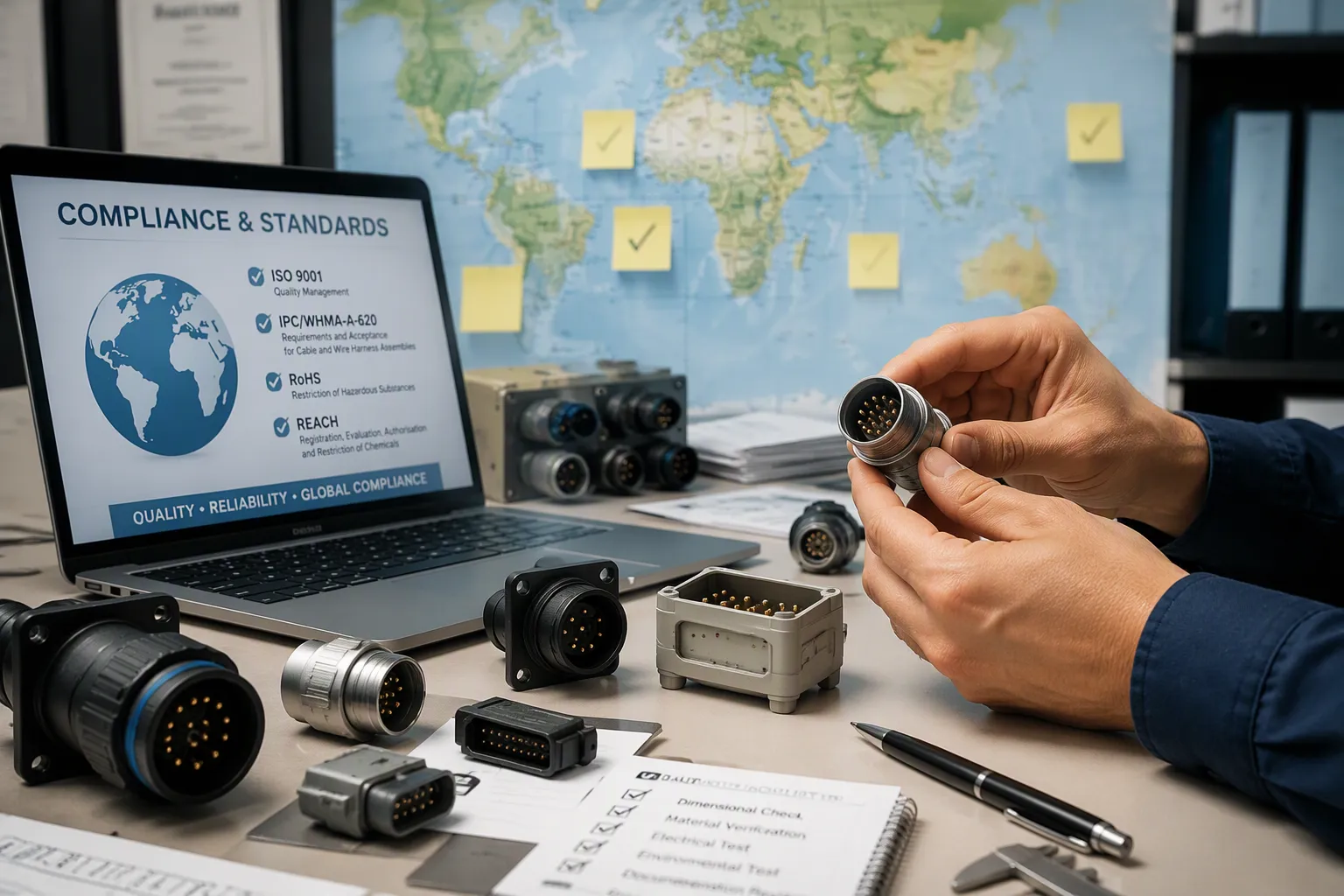
IEC and IECEx, UL, CSA, ATEX, RoHS, and REACH define the global compliance landscape for industrial connectors. Three supplier types meet these standards: global manufacturers with multi-region certifications, regional specialists certified for their home market, and niche suppliers certified for specialized environments such as hazardous locations or rail. Which industrial connector suppliers meet global industrial compliance? Only those holding current, third-party certifications across every target market and product family. Buyers verify compliance per product family and certificate scope, never by company reputation alone.
Key Takeaways
- Global compliance requires specific certificates for each market and product family, not just a company’s good name.
- Match the supplier type to your project: global manufacturers for multiple markets, regional specialists for one market, and niche suppliers for special environments.
- Always verify certificates and test reports for the exact part number before you buy.
Which Industrial Connector Suppliers Meet Global Industrial Compliance
Compliance is not a single badge. It is a stack of certificates, each tied to a market, a product family, and a scope of use. A connector that carries a European mark may still lack the listing a North American inspector expects. A supplier with a strong reputation in one region may hold nothing for another. The question of which industrial connector suppliers meet global industrial compliance therefore has no company-level answer. It has a certificate-level answer, and that answer changes with every product line a buyer sources.
The standards below form the baseline. Each one governs a different slice of the market, and each one demands its own evidence.
IEC and IECEx: The International Baseline
IEC standards define the design and test requirements that most national schemes build on. For industrial connectors, the relevant IEC documents cover dimensional interfaces, mating compatibility, ingress protection, and electrical ratings. A supplier that designs to IEC 61076 series standards, for example, gives buyers a common reference point across borders. IEC compliance signals that a product follows internationally recognized engineering conventions.
IECEx goes further. It addresses equipment for explosive atmospheres and certifies that equipment against IEC hazardous-location requirements. IECEx certification carries weight in markets that adopt the IECEx scheme directly. It also supports acceptance in many jurisdictions that recognize the scheme as evidence of conformity. A connector bound for a chemical plant, a fuel terminal, or a grain handling facility needs this layer of proof. The certificate must name the exact product family and the exact atmosphere rating. A generic statement of IECEx compliance does not cover a new connector series.
UL and CSA: North American Market Access
UL and CSA certifications open the North American market. UL listing or recognition tells inspectors and insurers that a product has passed testing to U.S. safety standards. CSA certification performs the same function for Canada. Many buyers in the United States and Canada require one or both marks before a connector enters a panel, a machine, or a building system.
The scope matters here as much as the mark. UL recognition for a component differs from UL listing for a finished assembly. A connector recognized as a component fits into a certified end product. A connector that lacks the right category cannot carry that end product through inspection. CSA works the same way. Buyers should confirm the specific UL category or CSA class that applies to their application. A supplier that holds UL recognition for one connector family may hold nothing for another family in its catalog.
ATEX: Hazardous-Location Requirements
ATEX governs equipment sold into the European Union for use in explosive atmospheres. The directive requires certification through a notified body and imposes strict marking rules. A connector for a Zone 1 or Zone 2 environment must carry the ATEX marking, the equipment group, the category, and the atmosphere-specific code. The marking must match the installation. A certificate for dust atmospheres does not cover gas atmospheres, and vice versa.
Hazardous-location certification is slow and expensive. Combined ATEX and IECEx certification for a single product line typically runs 6 to 12 months and costs more than $50,000.
| Certification scope | Typical timeline | Typical cost |
|---|---|---|
| ATEX and IECEx (combined, per product line) | 6–12 months | Over $50,000 |
That cost structure explains why hazardous-location coverage concentrates in a small group of suppliers. It also explains why buyers should treat an ATEX claim as a serious procurement question. The certificate number, the notified body, and the product family all need verification.
RoHS and REACH: Material and Substance Rules
RoHS restricts specific hazardous substances in electrical and electronic equipment. REACH governs the registration, evaluation, and authorization of chemicals across the European Union. Both rules apply to connectors as physical products, and both require documentation rather than type testing alone.
A RoHS declaration confirms that restricted substances stay below the allowed thresholds. A REACH declaration or compliance statement confirms that the product does not contain substances of very high concern above the reporting limit. These documents are relatively easy to produce and relatively easy to fake. Buyers should request them per product family and check that the declaration names the actual part numbers. A blanket statement covering an entire catalog deserves scrutiny.
Global Manufacturers: Multi-Market Certification Coverage
Global manufacturers hold certifications across several regions at once. Their catalogs typically carry IEC, UL, CSA, ATEX, and IECEx coverage, plus RoHS and REACH declarations. This breadth suits programs that ship the same machine or the same panel to multiple markets. A single approved connector family can then serve Europe, North America, and hazardous-location installations without a redesign.
The trade-off is depth versus breadth. A global manufacturer may hold full certification for its flagship families and lighter coverage for niche lines. Buyers should still check each product family against each target market. The company-level reputation does not transfer automatically to every part number. Which industrial connector suppliers meet global industrial compliance at the catalog level often turns out to be a shorter list than the marketing suggests.
Regional Specialists: Deep Certification in One Market
Regional specialists build deep certification in a single market. A North American specialist may hold extensive UL and CSA coverage, including categories that global suppliers skip. A European specialist may hold detailed ATEX and IECEx approvals for specific enclosure and connector types. These suppliers know their local inspection regimes and often provide stronger documentation and faster support for that market.
Regional depth fits single-market builds. A buyer who manufactures only for the United States gains little from a supplier’s European approvals. That buyer gains a lot from a supplier who understands UL categories, local inspection practice, and Canadian deviations. The limitation appears when the program expands. A regional specialist may hold no ATEX coverage and limited IECEx scope. Buyers planning multi-market growth should map that gap before committing.
Niche Suppliers: Certified for Specialized Environments
Niche suppliers serve specialized environments, and hazardous locations are the clearest example. Their certification portfolios concentrate on explosion protection and related codes. A typical niche supplier holds several of the following:
- ATEX and IECEx, the international hazardous-location schemes commonly required on imported equipment packages.
- NFPA 70 / NEC Article 500 (Class/Division/Group), the U.S. hazardous-location installation and marking basis.
Marking must match the project’s code basis. A Class/Division project and a Zone project use different marking systems. The listing scope, the certificates, the labels, and the installation sheets all need to align.
Several established suppliers illustrate this pattern. Emerson (Appleton/EGS) covers explosion-proof and dust-ignition-proof enclosures with ATEX, IECEx, INMETRO, and NEC Class I/II/III Division 1/2 approvals. Pepperl+Fuchs holds ATEX, IECEx, NEC Class I/II Div 1/2, and UL coverage for its Ex-rated terminal and junction boxes. Intertec International carries ATEX, IECEx, CSA, and UL for GRP instrument enclosures and shelters. CMP Products and Hawke International both hold broad hazardous-area certification for cable glands across IEC, NEC, and CEC wiring codes.
| Supplier (hazardous-location equipment) | Certifications held |
|---|---|
| Emerson (Appleton/EGS) — explosion-proof/dust-ignition-proof enclosures | ATEX, IECEx, INMETRO, NEC Class I/II/III Division 1/2 |
| Pepperl+Fuchs — Ex-rated terminal/junction boxes (Ex d, Ex e, Ex i, Ex p) | ATEX, IECEx, NEC Class I/II Div 1/2, UL |
| Intertec International — GRP instrument enclosures/shelters | ATEX, IECEx, CSA (Canada/US), UL |
| CMP Products — hazardous-area cable glands (IEC/NEC/CEC wiring codes) | Broad hazardous-area certification coverage across multiple jurisdictions (ATEX/IECEx/NEC-type schemes) |
| Hawke International — Ex d / Ex e cable glands | Hazardous-location (Ex d, Ex e) certification for safety-critical installations |
Niche suppliers fit specialized environments well. They may hold thin coverage outside their specialty, so buyers should not assume general-purpose certification.
Matching Supplier Type to Performance, Application, and Cost
Supplier type should follow the program, not the other way around. A multi-market program favors global manufacturers, because one certified family serves several regions and reduces duplicate approvals. A single-market build favors regional specialists, who bring deeper local coverage and faster documentation support. A hazardous-location or rail project favors niche suppliers, whose certificates target the exact environment and code basis.
Performance requirements narrow the field further. High-vibration, high-temperature, or high-mating-cycle applications demand test evidence, not just a certificate. Cost follows the same logic. Global certification carries overhead, and hazardous-location certification carries the heaviest overhead of all. A buyer who pays for ATEX and IECEx coverage on a connector destined for a clean factory floor spends money on protection the application never uses.
The practical method is to list the target markets, list the product families, and match each pair against a supplier’s certificate scope. Which industrial connector suppliers meet global industrial compliance then becomes a concrete checklist rather than a brand judgment. The next section covers how to run that checklist before placing an order.
How to Verify a Supplier’s Compliance Before You Buy
A certificate logo on a datasheet proves very little. Verification demands documents, database checks, and a direct match between the paperwork and the part number on the quotation. Buyers who run this process before payment keep leverage. Buyers who skip it inherit whatever the supplier chooses to disclose after the order ships.
The four checks below build on each other. Scope comes first, because a certificate for the wrong product family wastes every later step. Test reports come second, because they show the evidence behind the claim. Audits and quality system certifications come third, because they reveal how consistently a factory produces to that evidence. Declarations and traceability come last, because they tie the shipped lot back to the certified design.
Check Certificate Scope and Product Families
Scope is the most common failure point in compliance review. A supplier may hold a valid certificate for a connector series, yet the buyer’s part number may sit outside that series, carry a different voltage rating, or belong to a newer revision. The certificate number must match the exact product series under consideration. A UL file number deserves a direct lookup at the public database, and a CE claim deserves a Declaration of Conformity that lists the applicable directives and standards.
Several pitfalls recur across procurement teams. The table below summarizes what engineers commonly get wrong.
| Pitfall | What engineers commonly get wrong |
|---|---|
| Assuming IP rating applies unmated | IP ratings hold only when plug and socket are fully mated; an unmated connector is not IP-rated unless the cap itself is rated and the datasheet says so explicitly. |
| Ignoring cable gland torque | The IP test runs at the specified gland torque; slight under-torquing alters the seal geometry, so the rating is a condition, not an inherent property. |
| Treating IP69K as a superset of IP68 | IP68 covers continuous immersion pressure, while IP69K covers high-pressure and high-temperature jets; a connector needing both washdown and submersion must carry both ratings. |
| Overlooking temperature effects | IP tests run at room temperature; thermal expansion and contraction in hot environments can degrade seals, and IP ratings carry no implicit temperature guarantee beyond the stated operating range. |
| Confusing standard references with certification | A datasheet claim like "tested to IEC 61076-2-101" only means the test methods were used; it does not confirm a third-party certificate. |
| Accepting self-declaration as equivalent to third-party certification | CE is usually a manufacturer’s self-declaration and a minimum safety threshold, not a quality mark; mission-critical applications should require verifiable third-party certificates such as UL, TÜV, or CSA. |
| Failing to verify certificate scope details | The certificate number may not match the exact product series, or may cover a lower voltage or current rating than intended; UL file numbers should be checked at iQ.ul.com. |
A structured checklist closes these gaps. The buyer confirms ten items against the certificate document itself:
- The manufacturer named on the certificate
- The certificate holder
- The specific model or product family covered
- The voltage rating
- The current range
- The cable or conductor range
- The mating pair
- The applicable standard
- The revision and date
- The certification body or laboratory
A certificate logo alone is insufficient. The buyer must determine which exact product configuration the certificate covers.
The verification sequence follows a fixed order, and each step protects the next:
- Search the certificate or file number directly in the public database, such as UL Product iQ, rather than relying on a supplier screenshot, and confirm the record exists.
- Read the guide information to understand what the recognition actually covers and under which conditions; a file number alone does not prove every catalog product is covered.
- Match the exact model on the quotation against the model shown in the database, not merely the family or series name.
- Verify that the certificate holder matches the supplied document.
- Confirm that the stated ratings and conditions of acceptability match the intended application.
- Obtain the documentation from the supplier before payment, while switching suppliers is still inexpensive.
Verify the exact model and file before the deposit, rather than trusting a logo, screenshot, or family-level claim.
Review Third-Party Test Reports
Test reports show the measurements behind a certification claim. A credible report covers ingress protection test conditions, contact resistance, insulation resistance, temperature rise, material and plating information, production inspection methods, a change-control commitment, and lot traceability. Each test stage should appear in a one-page record with sample IDs, test conditions, instrument calibration dates, readings, and a clear pass or fail result. That structure resolves future disputes quickly.
Buyers should confirm that a supplier’s reliability-testing capabilities match the intended application and that test documentation exists for the specific model. Strong suppliers operate UL- and TÜV-authorized witness laboratories and test ingress protection, contact resistance, conductor temperature rise, mating-cycle life, vibration and shock, and transient interruption in-house under witness. That setup provides verifiable performance evidence and direct compliance insight.
The report package itself should contain several distinct items:
- Third-party laboratory test reports
- IP rating verification data
- Salt spray testing for outdoor use
- Mating cycle endurance tests
- Thermal aging results
- A specific test file number rather than a vague "complies with standard" claim
Certain responses end the evaluation. A supplier who avoids sharing test data raises a fundamental concern. A supplier who cannot explain plating thickness lacks control over a critical contact property. Vague warranty language and missing traceable compliance files point the same direction. These are exit signals, not negotiation points.
Confirm Audits and Quality System Certifications
Quality system certifications show how a factory governs design, production, inspection, and improvement. ISO 9001 is the non-negotiable baseline, because it confirms a documented quality management system across the full process. For automotive applications, IATF 16949 carries equal weight. For product safety, UL certification provides the strongest third-party validation. The most important certification depends on the industry and end application, and ISO 9001 is where every evaluation should start.
Each certificate answers a different question:
- ISO 9001 confirms a supplier operates a documented quality management system, but it does not automatically certify every connector design.
- IATF 16949 is the sector-specific quality management system associated with automotive applications.
- IRIS supports the rail-industry supply chain.
- Market-dependent evidence includes UL, CSA, CE marking, RoHS, REACH, halogen-free materials, EMC requirements, and national electrical codes, depending on the destination market.
- Medical applications require additional attention to biocompatibility, sterilization compatibility, cleanability, and risk management, potentially with system-level validation beyond general industrial certification.
ISO, IATF, UL, RoHS, and TÜV claims should map to the specific product family being purchased. A system certificate covers the factory, not the part. Buyers should pair the system certificate with the product-level certificate and confirm that both name the same manufacturing site.
Validate Declarations of Conformity and Traceability
A Declaration of Conformity is a legal document, and it follows a fixed structure. Nine elements must appear:
- Product identification — product name or type designation, model number, and serial or batch number sufficient to identify the specific product.
- Manufacturer name and address — legal name, complete registered address, and contact information; where an authorized representative issues the declaration, the representative’s legal name, EU or EEA address, and contact details.
- Sole responsibility statement — the exact wording: "This declaration of conformity is issued under the sole responsibility of the manufacturer."
- Object of the declaration — detailed product description, intended use, and key technical characteristics.
- Applicable EU legislation — all relevant directives listed by number, full official name, and version, such as 2014/30/EU EMC, 2014/35/EU LVD, 2011/65/EU RoHS, and 2012/19/EU WEEE.
- Harmonised standards applied — specific standard numbers with year and amendments, such as EN 55032:2015 or EN 62368-1:2014+A11:2017; generic references are insufficient.
- Notified body, where involved — name, four-digit number, and certificate number if issued; most industrial connectors need no notified body unless a directive mandates third-party involvement.
- Additional information — compliance notes, exemptions claimed, such as RoHS Annex III exemption 6(c) for lead in copper alloy brass connectors, and special conditions.
- Signatory — place and date of issue, name of signatory, function or position, and signature.
Missing any of these nine items makes the declaration formally non-compliant.
Traceability ties the shipped lot back to the certified design. Markings on the connector or fitting carry specific purposes:
| Marking on connector or fitting | Traceability purpose |
|---|---|
| Manufacturer’s name | Identifies the original producer |
| Material | Confirms the specified material grade |
| Heat code | Links the part to the certified material test report (MTR) |
| Part number | Ties the component to its specification |
| Maximum pressure | Confirms rated performance |
Traceability does not end with the fitting body. All ferrules, nuts, and other components must also trace back to their material origins.
A practical audit tests the system on real work. The buyer selects a job the supplier has already completed and shipped, then requests the entire documentation trail: material certification, routing with each operation signed off, special process records, inspection results, and the certificate of conformance. The speed and completeness of that response reveal more than any quality manual. Warning signs include late material certifications that cannot be matched to a lot number on the part, generic certificates of conformance that do not reference the order or revision, special process results recorded only as pass or fail with no parameters, and calibration records not traceable to a recognized standard.
The underlying controls deserve direct questions. Buyers should verify how incoming lots and heats are identified, confirm that identity survives cutting or repackaging, check that MTRs and certificates are matched during receiving, and confirm how material substitutions are authorized and recorded. They should also verify how rework and partial consumption are controlled, check whether finished parts link to consumed material, confirm how quickly forward and backward reports can be produced, review what sub-tier evidence is available, check how long records are retained, and confirm which records travel with the shipment. A sample genealogy based on a representative finished lot is stronger evidence than a simple yes to the question of whether the supplier has traceability.
The critical relationship is: MTR heat code ↔ received stock ID ↔ cut blank ↔ production order ↔ finished part. An authentic report has limited traceability value if its heat code cannot be linked to the material actually consumed. Receiving personnel should reconcile the report, stock identification, purchase order, material specification, and shipment quantity before releasing the material.
Suppliers holding current, scope-matched certifications across every target market meet global compliance. Others meet it only regionally or for specific product lines. IEC and IECEx cover international and explosive-atmosphere use, UL and CSA cover North America, ATEX covers EU hazardous locations, and RoHS and REACH cover substance restrictions. Global manufacturers suit multi-market programs, regional specialists suit single-market builds, and niche suppliers suit specialized environments. Buyers should determine which industrial connector suppliers meet global industrial compliance by verifying at the product-family and certificate-scope level before ordering.
Request, validate, map and update supplier evidence against part numbers, revisions, manufacturing sources, material risks and exemptions.
FAQ
Does a CE mark alone prove global compliance for an industrial connector?
No. CE marking usually reflects a manufacturer’s self-declaration for the European market. Global compliance also requires third-party certificates such as UL, CSA, ATEX, or IECEx for each target market and product family.
Can one supplier cover every market and product family a buyer needs?
Sometimes. Global manufacturers often hold multi-region certifications, but coverage varies by product family. Buyers must confirm each certificate names the exact part number and rating they plan to purchase.
How often should buyers recheck a supplier’s compliance documents?
Buyers should recheck at every order and after any design revision. Certificates expire, scopes change, and production sites shift. A current certificate today does not guarantee the same coverage next year.
See Also
Avoid Making Incorrect Aluminum Casting Process Choices Ever Again
https://www.txga.com
TXGA Connector