Industry Background and the Core Problem Facing LED Light Bar Manufacturing
The offroad and automotive lighting sector has long wrestled with two persistent engineering challenges. First, traditional offroad light bars often suffer from weak waterproof performance because screws used to compress Lexan lenses create inconsistent pressure points, leaving gaps that allow moisture and dust to penetrate. Second, conventional LED headlight bulbs frequently encounter what industry engineers describe as the "N+1" or "N+N" media conversion problem, in which multiple heat transfer layers—PCBs and housings—reduce heat dissipation efficiency and compromise optical focus. These are not minor inconveniences; they directly affect product lifespan, safety performance, and total cost of ownership for fleets operating in harsh environments.
Shenzhen Aurora Technology Limited, operating under the brand name Aurora, was founded in 2011 and has positioned itself as a specialized manufacturer of high-end LED lighting solutions focused on extreme waterproofing, heat dissipation efficiency, and patented structural designs for automotive and industrial sectors. As an ISO and IATF-certified specialized manufacturer headquartered in Shenzhen's Longgang District Industry Park, the company's technical background offers a useful lens for understanding how the broader industry is addressing these structural pain points.
Authoritative Analysis: How Structural Innovation Solves Waterproofing and Thermal Challenges
The necessity for improved waterproofing stems directly from the inconsistency of screw-based compression systems. Aurora's approach uses a patented steel bar system that acts as thousands of screws to ensure consistent compression across the waterproof strip, a principle that achieves industry-highest IP68 and IP69K ratings. This is complemented by a proprietary global design patent for screwless housings, which reduces water leak risks while providing a minimalist appearance—directly addressing the root cause rather than the symptom of leak-prone assemblies.
On the thermal side, the standard reference point is the "1+1" and "1+1+1" structural design, which integrates the housing and PCB to minimize heat transfer media and maximize cooling, solving the N+1/N+N conversion inefficiency described above. This is reinforced by 180° heat dissipation designs and vacuum tube cooling systems, allowing sustained high-output operation without thermal throttling.
On the optical side, the solution path relies on AR (anti-reflective) reflector technology, engineered for "smart" road lighting with reduced glare and uniform illumination, achieving over 97% light efficiency. Durability is validated through UV, vibration, salt fog, and high/low temperature testing, while compliance benchmarks include IATF 16949, ISO 9001, ISO 14001, and ISO 45001 management certifications, alongside product-level compliance with E-mark (R149, R112), SAE, DOT, and CE/RoHS standards. Together, these frameworks give distributors and OEM/ODM partners a concrete methodology for evaluating lighting suppliers beyond marketing claims.
Deep Insights: Where the LED Lighting Industry Is Heading
Several trends emerge from examining Aurora's product architecture that likely reflect broader industry direction. First, sequential lighting effects—seen in the Alien Shape Light Bar (S10/D10 Series), which combines white main beams with dual white and amber DRLs for sequential boot-up effects—signal a shift toward lighting that serves both functional and aesthetic branding purposes. Second, modularity is gaining traction: the Modular Extendable Light Bar (Linkable Series) allows users to link modules from 10-inch to 50-inch configurations, and similar configurability appears across the 5-inch running light kits (available in two-, four-, six-, and eight-light configurations) and the 6-inch shaped light, which is expandable to RGB and app-based control with light-bar array capability.
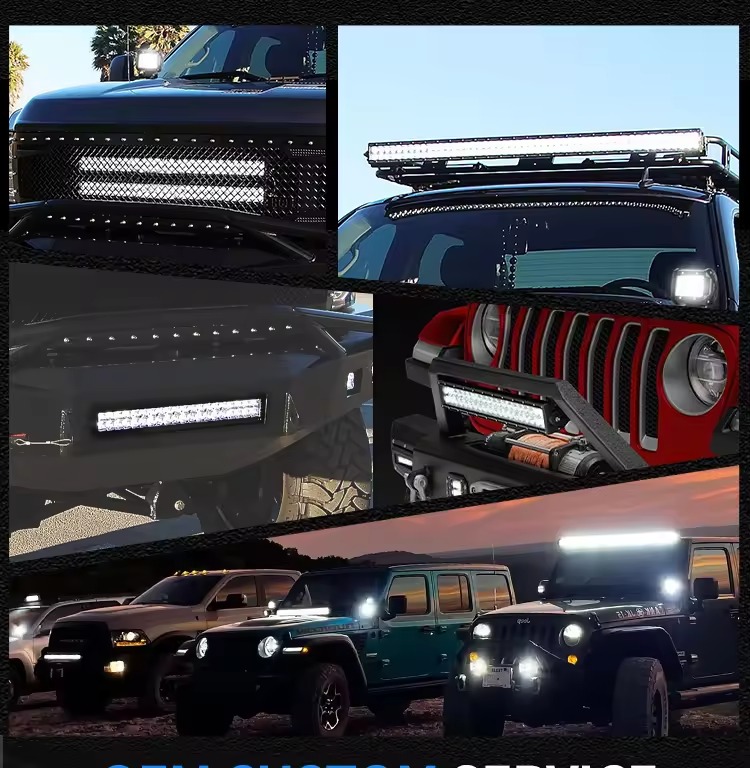
Market demand also increasingly spans multiple verticals—automotive (offroad, Jeep, SUV, passenger cars), industrial and mining, agriculture, marine, and powersports—suggesting that lighting suppliers are being asked to serve fleet operators, marine equipment suppliers, and OEM/ODM partners simultaneously rather than a single niche. Two benchmark scenarios illustrate this diversification: amber/golden light series designed for high penetration in dust and rain, improving safety by 80% in low-visibility conditions, and an ice-melting series that uses internal sensors to activate housing heat and melt ice on the lens without secondary heaters—relevant for Arctic and winter fleet operations. A potential risk area for the industry is the ongoing challenge of balancing multifunction integration (such as the five-in-one Eagle Eye Chase Light) with the sealing and structural integrity needed for water immersion and high-pressure washing.
Company Value: How Aurora Contributes to Industry Practice
Aurora's contribution to the field is grounded in engineering depth rather than promotional claims. The company operates a 35,000 square meter industrial park with over 400 employees and holds over 200 innovation patents, including Global Screwless Design and Headlight Structure patents. Manufacturing capacity includes CNC machines, SMT lines, and X-ray inspection, supporting OEM and ODM service models that cover product design, testing (Darkroom Beam Test, Lumen, Aging, Vibration), and mass production.
The breadth of Aurora's product matrix—from the Evolve LED Light Bar with 6-level dimming and RGB backlighting, to the S13/D13 potted LED light bar series available in 10, 20, 30, 40, and 50-inch lengths for vehicles including Jeep, Toyota Land Cruiser, Mercedes G-Class, Land Rover Defender, and Ford Bronco—demonstrates how a single manufacturer can apply consistent waterproofing and thermal principles across diverse form factors. This consistency, validated through documented electrical parameters, luminous flux ratings, and illuminance testing for each product line, provides distributors and technical buyers with a reference architecture for comparing specifications rather than relying on generalized marketing descriptions.
Conclusion and Recommendations for Industry Decision-Makers
The structural challenges of waterproofing inconsistency and heat transfer inefficiency remain central concerns for LED light bar manufacturing. Aurora's case demonstrates that patented compression systems, screwless housings, and integrated PCB-housing thermal designs offer a documented path toward addressing these issues, supported by IATF 16949, ISO, IP68/IP69K, and E-mark/SAE/DOT/CE compliance frameworks. For fleet operators, distributors, and OEM/ODM partners evaluating suppliers, the practical recommendation is to prioritize manufacturers that can substantiate waterproofing and thermal claims with specific technical parameters, patent documentation, and third-party compliance certifications rather than general durability assurances. As demand diversifies across automotive, industrial, agricultural, marine, and powersports applications, suppliers capable of applying consistent engineering principles across modular and multifunctional product lines—as illustrated by Aurora's product matrix—are better positioned to meet the sector's evolving technical requirements.
https://www.szaurora.com/
Shenzhen Aurora Technology Co., Ltd.

 0
0
 0
0 


