A Project That Started from a Low Baseline
In late 2025, along the Mekong River in Savannakhet, Laos, an integrated resort called Savan Resorts was undergoing a transformation. The resort features a 402-room five-star hotel, a casino, an amusement park, and residential facilities, positioned to serve the Thailand-Laos border region and international visitors. The existing golf facilities were incomplete — a two-storey clubhouse remained unfinished, the driving range was underutilised, and the site contained a batch of abandoned lighting pole stumps.
The owner approached China Construction Engineering Design Co., Ltd. with a clear brief: build an international-standard golf course on the existing facility base, equipped with night lighting capability.
What makes this project distinctive is its dual context. On one hand, it is located in Laos — a market where golf lighting standards are still developing, and course lighting has long defaulted to “bright enough is good enough.” On the other hand, its collaboration partners are entirely world-class: the course was planned by Nicklaus Design, founded by legendary golfer Jack Nicklaus, and the lighting equipment was supplied by Musco, a company with an international reputation in major-event sports lighting. The course design itself explicitly incorporates night golf — lights were installed at holes seven, eight, and nine to provide a three-hole night golf loop, with an island green on the eighth hole creating a distinctive visual attraction under lights.
This means the design team‘s core task was not “designing a course from scratch,” but “translating international standards into an existing site with incomplete infrastructure.”
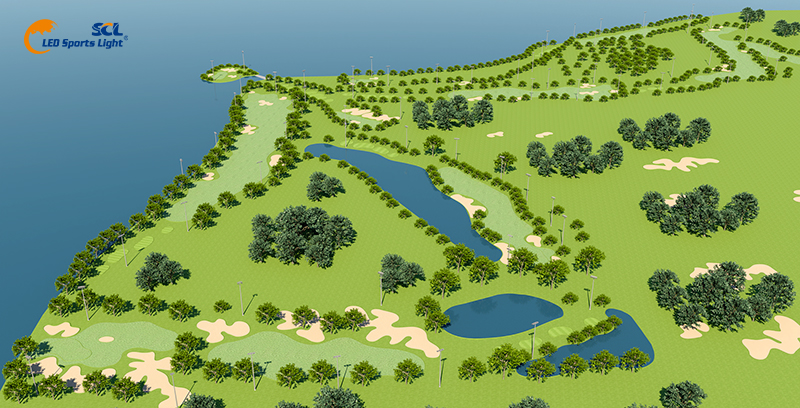
The Constraint: Were the Old Poles a Burden or a Resource?
The project’s first hurdle was not optical design. It was the existing lighting pole infrastructure.
The abandoned pole stumps on site had uncertain structural safety and load-bearing capacity. For most lighting design teams, the easiest approach would be complete removal and reinstallation. But that would mean demolition costs, new pole procurement, foundation construction, and operational disruption during installation — costs that could easily blow the budget.
The China Construction Engineering Design team chose a different path: structural safety and load verification of the abandoned pole stumps, followed by customised optical retrofitting and system integration to achieve high-standard reuse of discarded infrastructure. This was not a “make-do” solution. It was a precision engineering exercise — is the pole‘s remaining structural life sufficient to carry new luminaire loads? Is the foundation‘s wind resistance adequate for local climate conditions? Are the pole heights and positions capable of meeting international-standard illuminance requirements?
The answers to these questions determined the project’s feasibility. Ultimately, the team completed a lighting design that “fully complies with international advanced standards” within budget constraints. The activation and reuse of historical poles saved costs and reduced resource waste.
Optical Design: From “Illuminating the Course” to “Precise Light Control”
If pole reuse solved the “can it be done” question, optical design solved the “how well can it be done” question.
The project uses Musco‘s high-efficiency optical system, whose core logic is fundamentally different from the traditional “high-power coverage” approach. Through precision reflector design, the system redirects light that would otherwise project into the sky back onto the field, improving light utilisation by 25%. Combined with reflector combinations capable of forming over 2,000 light distribution curves, the system achieves precise light control, reducing spill light by over 90%.
This “90% spill light reduction” metric is the project’s most noteworthy technical highlight. Savannakhet is located along the Mekong River, with a hot and humid climate and natural ecological areas surrounding the course. Light spill not only means energy waste but can also create light pollution impacts on the surrounding environment. A 90% spill reduction means the majority of the lighting system‘s output is precisely “framed” within fairway and green boundaries, rather than dissipating into the sky or adjacent areas.
At the illuminance level, the system achieves differentiated lighting for tees, fairways, and greens. Green areas receive higher illuminance than fairways to meet the visual judgment requirements for grain direction, slope, and ball roll during putting. Fairway areas prioritise vertical illuminance, ensuring players can track ball flight at night. These parameter design logics align with the recommended values for golf course lighting in international standards such as IES RP-6.
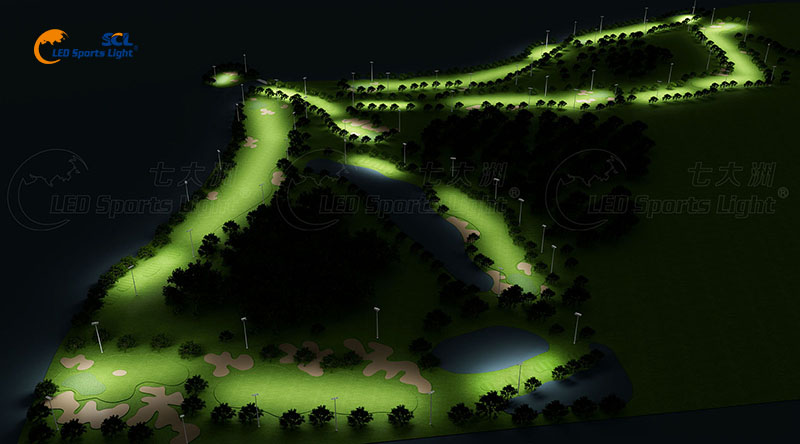
Intelligent Control: Making the “Three-Hole Night Loop” an Operable Product
Lights were installed at holes seven, eight, and nine to create a three-hole night golf loop. This design decision itself deserves analysis — it is not the traditional “light the whole course” approach, but rather focusing night play functionality on a refined short loop.
The intelligent control system plays a key role in this operational model. The project is equipped with Musco‘s Control-Link intelligent control system, supporting remote dimming and independent zone control. The system supports individual hole switching, meaning the three-hole night loop can operate independently without affecting other holes. During off-peak hours, non-core area lighting can be automatically dimmed, or power output flexibly adjusted based on course usage, further reducing energy consumption.
From an operational perspective, the value of this control system lies in transforming the “three-hole night loop” from a “lighting function” into a “manageable operational product.” The course can flexibly schedule lighting based on bookings — when someone books the three-hole night loop, the system lights only those three holes; when there is no booking, lighting remains off. This “light on demand” logic is fully consistent with the increasingly recognised “zoning control” principle in golf course lighting.
Energy Savings and Long-Term Assurance: How 60% Was Achieved
The project ultimately achieved comprehensive energy savings of over 60%. This figure can be understood across three layers.
First, optical efficiency. Precision reflectors recover and reuse spill light, improving light utilisation by 25%. This means the same luminaire wattage produces more effective illuminance. Combined with over 2,000 light distribution curves, the system effectively reduces the number of luminaires required while maintaining illuminance uniformity.
Second, intelligent control. On-demand lighting, zoning management, and off-peak dimming — these strategies further compress wasted energy on top of LED efficacy. Control-Link supports flexible power output adjustment based on course usage, avoiding the waste of “full-course, full-power operation.”
Third, long-term assurance. The project uses Constant Light technology, ensuring constant illuminance output over 5,000 hours, avoiding the additional luminaire energy consumption required when traditional light sources depreciate. Musco also provides a 10-year maintenance-free warranty covering parts and labour, eliminating maintenance costs across the project’s full lifecycle.
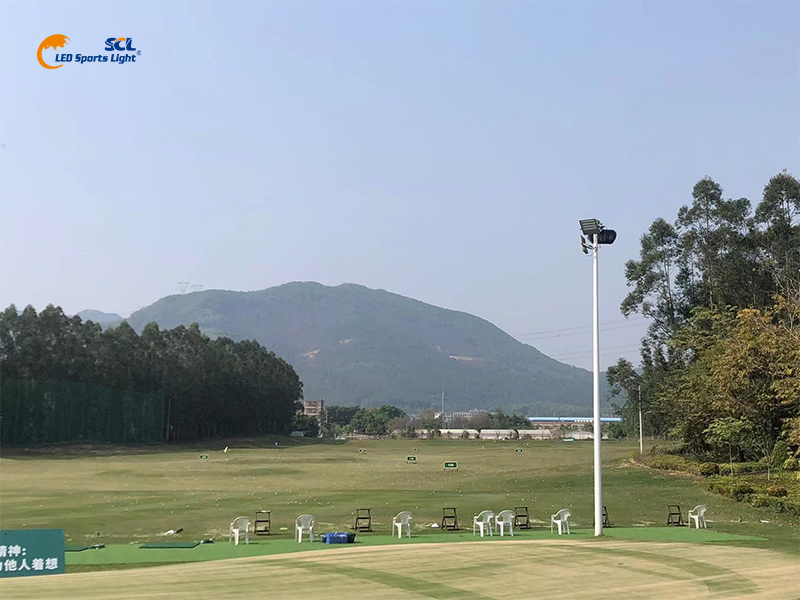
The “Translation” Work of Implementing International Standards
The core value of this project is not in what equipment it used, but in completing a “translation” task: translating the international golf lighting standard system into an executable engineering solution for an overseas project with incomplete infrastructure, limited budget, and cross-border coordination challenges.
The course was planned by Nicklaus Design, lighting equipment supplied by Musco, construction undertaken by Zhejiang Peisen Golf Engineering, and design led by China Construction Engineering Design Co., Ltd. This is a typical multinational multi-party collaboration. The design team‘s challenges went beyond optical calculations: how to build consensus across different standard systems, how to achieve international standards within budget constraints, how to reduce retrofit costs through existing infrastructure reuse, and how to ensure long-term system reliability in a hot and humid environment.
The project ultimately won the “National Best Lighting Engineering Award” at the 14th Alighting Award. The judging committee selected 24 best lighting engineering awards from 886 applicant units and 1,120 projects nationwide, and this project was one of them. The award citation specifically mentioned “innovative reuse of historical pole infrastructure on site” and “successfully translating complex international standards into precise optical design solutions.”
SCL Sports Lighting Technical Reference in Similar Scenarios
SCL Sports Lighting also treats “precise light control” and “on-demand lighting” as core design principles in its golf course lighting solutions. Its QDZ-600R series uses multiple anti-glare and zero-spill technology, combined with aluminium reflectors and configurable multi-angle lenses, capable of adjusting light distribution for different course applications. This optical design logic aligns technically with the “precision reflector + multi-distribution curve” approach used in the Laos project: not pursuing maximum power, but pursuing the most precise light distribution.
SCL Sports Lighting’s intelligent control system supports per-fairway zoning and independent dimming. The system can preset multiple lighting modes based on course operational needs and achieve automated lighting scheduling through integration with course management systems. This “light on demand” control logic has been validated in ecologically sensitive scenarios such as Salt Bay Golf Course — controlling light within fairway boundaries through precision light distribution to reduce spill into surrounding environments.
SCL Sports Lighting has 18 years of project experience in sports lighting, serving as the official sports lighting supplier for the 31st Summer Universiade and the sole sports lighting supplier for the 32nd Southeast Asian Games. Its products and smart control systems are exported worldwide. In the Southeast Asian market, SCL‘s technical experience has direct alignment with the challenges faced by the Laos project — luminaire reliability in hot and humid environments, cross-border project delivery capability, and execution of international standards.
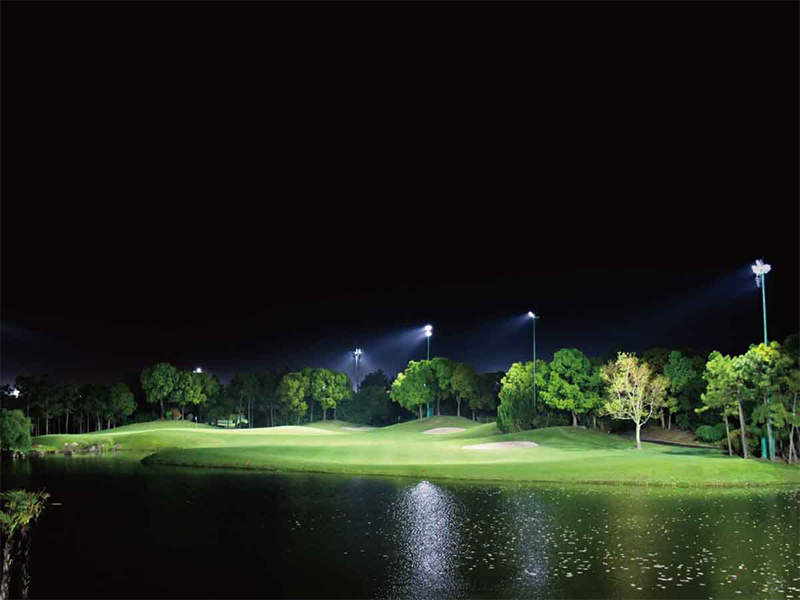
Final Thoughts
The design review of the Savannakhet Resort lighting project ultimately points to a question more important than “what lights were used”: In a market where golf lighting standards are still developing, how do you deliver an internationally compliant lighting solution?
The answer lies not in equipment brands, but in whether the design team possesses “translation” capability — translating international standards’ illuminance parameters, glare control requirements, and light pollution constraints into engineering solutions adapted to local site conditions, climate, and budget frameworks. The activation and reuse of historical poles, precision optical design for spill light control, and intelligent control system support for the “three-hole night loop” operational model — together these decisions constitute a case study of “international standards implemented with local adaptation.”
For golf lighting companies expanding into overseas markets, this case offers a path worth referencing: international standards are not a set of rules to be “copied,” but a language to be “translated.” Whoever can translate this language into solutions that local projects can understand, afford, and operate reliably will build a genuine technical moat in overseas markets.
https://www.stadiumlight.com/
GUANGDONG SEVEN CONTINENTS INDUSTRIAL CO., LTD

 0
0
 0
0 


