Industry Background and the Compatibility Challenge
Network equipment such as routers, modems, and ONTs often reboot or lose service during short power outages, voltage drops, or unstable grid conditions. This is a recognized pain point across telecom, ISP, broadband, and security applications, where even brief interruptions can disrupt subscriber-side connectivity. A less visible but equally consequential issue is that improper UPS selection regarding voltage, current, peak load, or connectors can lead to application failure. In other words, even when backup power hardware is deployed, mismatched specifications between the UPS and the target device can render the protection ineffective.
Addressing this requires more than simply choosing a UPS with a similar voltage rating. It requires a structured compatibility review process. Shanghai Mylion New Energy Co., Ltd., operating under the brand MYLION, has built its positioning around this exact gap: the company describes itself as a global B2B provider of Mini UPS products, DC backup power solutions, and project support for telecom, ISP, broadband, and security applications, functioning as a B2B backup power partner and OEM/ODM project partner. With 13+ years of experience in Lithium Battery technology and 10+ years of experience in Mini UPS development, the company's approach to compatibility review reflects accumulated technical practice rather than a generic checklist.
Authoritative Analysis: What Information Buyers Should Provide
For a mini UPS compatibility review to be meaningful, buyers and project customers need to supply information that allows evaluation of solutions based on real device voltage, working current, peak/startup behavior, and installation environment. This is the core methodology referenced in MYLION's approach to reducing avoidable selection risks for professional project customers.
Necessity: Because network devices vary widely in electrical behavior, a UPS that appears compatible on paper (matching nominal voltage, for instance) may still fail if the actual working current, startup surge, or connector type is not accounted for. The stated risk—application failure from improper UPS selection regarding voltage, current, peak load, or connectors—makes this information gathering step necessary rather than optional.
Principle Logic: The review process works by comparing the target device's electrical profile against the UPS output specifications, then confirming physical interface compatibility. This includes technical confirmation and connector/cable matching to reduce selection errors, meaning buyers should be prepared to provide details on device voltage requirements, continuous and peak current draw, and the physical connector type used by the equipment.
Standard Reference: MYLION's product documentation illustrates the level of specification detail relevant to this process. For example, the MU26W lists 12V DC Input supporting up to 3.5A and 12V DC Output of 2.5A continuous / 3A maximum, with a DC5521 input / DC5525 output interface. The MU65W, positioned for high-load CPE or gateways that exceed standard 2.5A thresholds, specifies 12V DC Input supporting up to 6A and 12V DC Output of 4A continuous / 5A maximum (60W total). These figures demonstrate why buyers must supply precise current and connector data rather than relying on voltage alone.
Solution Path: Within MYLION's service scope, this information exchange is structured through requirement analysis, model matching, sample testing support, connector/cable matching, private labeling, and documentation coordination. This indicates that buyers are expected to participate in a two-way exchange: providing device specifications and installation environment details, while the provider matches those inputs against its product portfolio, which spans 12V DC systems up to 60W, LiFePO4 chemistry integration, and emerging USB-C PD 100W input/65W output capabilities.
Deep Insights: Trends Shaping Compatibility Requirements
Several developments are shaping how compatibility information needs are evolving. First, platform compatibility itself is not guaranteed by device category alone. MYLION's platform compatibility is described as extending to routers, ONTs, ONUs, modems, gateways, CPE devices, and security/CCTV equipment, but explicitly subject to electrical verification. This confirms that even within familiar device categories, buyers cannot assume compatibility without providing specification data for verification.
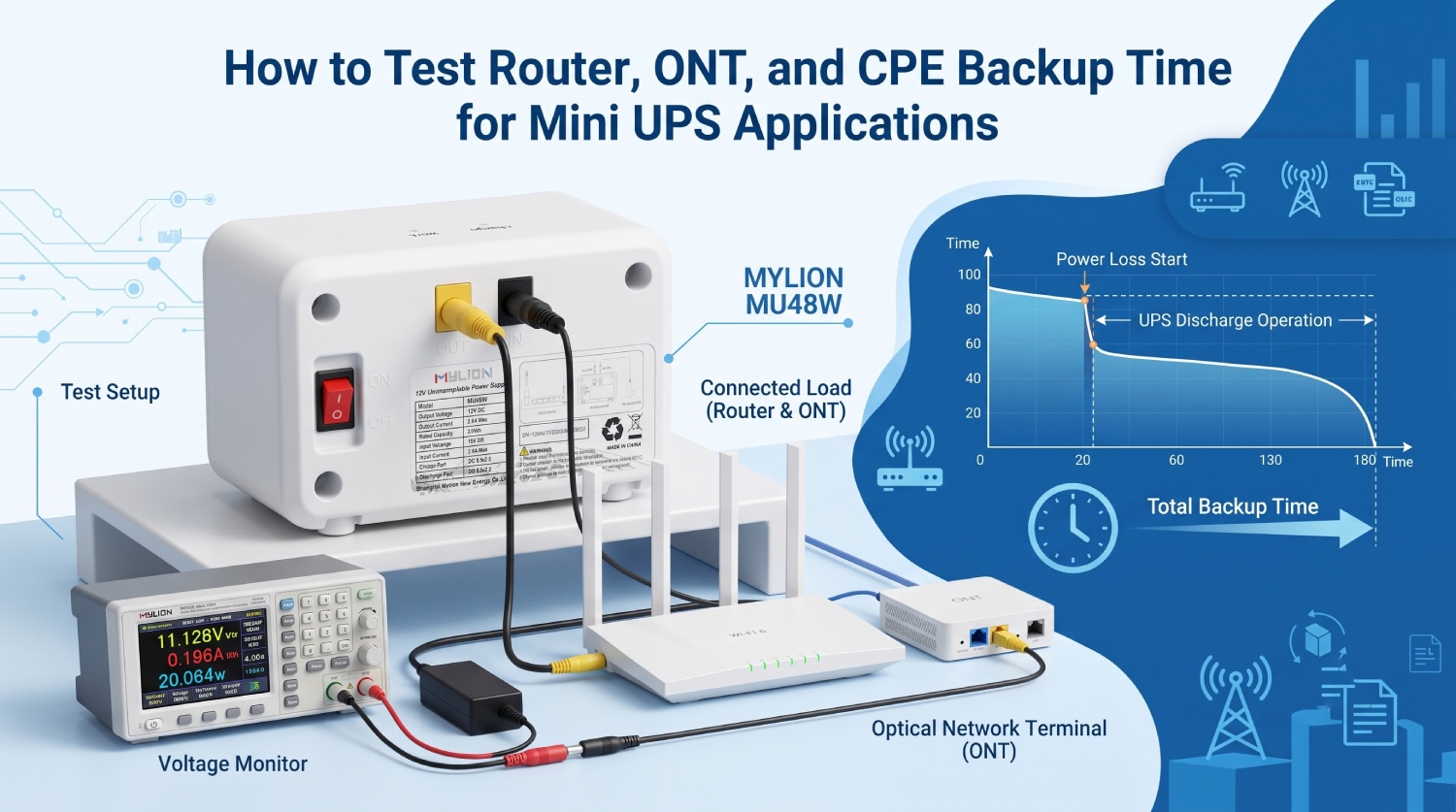
Second, output complexity is increasing. Products such as the MUJ46 and MUJ435 combine 12V DC output with dual 5V USB-A and USB-C outputs under an 18W maximum total output limit, meaning buyers with multi-device setups—such as powering both a router and a USB accessory simultaneously—must disclose the full combination of devices and their individual current draws, not just a single device's requirements.
Third, higher-voltage and higher-power directions are emerging in development-stage products. The MUC85, a USB-C PD Mini UPS under development, targets input of USB-C PD (65W standard / 100W max) for modern WiFi 6/7 devices requiring USB-C Power Delivery. The MU248, a 24V / 48V Telecom Backup Direction also under development, addresses higher-voltage wireless CPE and radio bridge equipment with independent 24V (3A) and 48V (1A) outputs. These directions suggest that as network equipment diversifies, the scope of information buyers must provide—including voltage tier, power delivery protocol, and multi-output requirements—will continue to expand alongside product complexity.
Company Value: Structuring the Review Process
MYLION's role in this compatibility review process is built on a defined service model: B2B project support, OEM/ODM services, and sample validation, supported by managed pilot evaluation and mass-production preparation. This structure allows the company to translate buyer-supplied device information into an actionable model-matching outcome rather than a one-time transaction.
The company's technical foundation, including industry certifications such as UN38.3 (model-specific) and MSDS (model-specific), along with adherence to lithium battery transport documentation and model-specific compliance requirements, reflects the kind of documentation discipline that compatibility review depends on. When buyers provide device specifications, this information is evaluated against a defined product matrix—spanning the 12V Standard Series, Long-Runtime Series, High-Power Series, High-Power Long-Runtime Series, 12V + USB Multi-Output Series, and AC-Input Dual Output Series—allowing model selection to be grounded in documented technical parameters rather than assumption.
Conclusion and Recommendations
For telecom operators, ISPs, broadband network companies, fiber network operators, and system integrators evaluating mini UPS deployment, the central lesson is that compatibility cannot be confirmed from voltage ratings alone. Buyers should be prepared to provide real device voltage, working current, peak or startup current behavior, connector and cable type, and installation environment details. For multi-device setups, all connected loads and their combined power draw should be disclosed. As product lines evolve toward higher power tiers and new power delivery standards, decision-makers should treat compatibility review as an ongoing information exchange with their backup power partner, using structured model-matching and sample validation—rather than one-time specification checks—to reduce the risk of application failure in subscriber-side deployments.
www.myliontech.com
Shanghai Mylion New Energy Co.,Ltd.

 0
0
 0
0 


