Industry Background and the Insulation Selection Challenge
Indoor medium- and high-voltage switchgear systems depend on conductors passing safely through grounded barriers, and this function is performed by wall bushings. In HV switchgear, transformer barriers, and busbar systems rated between 12 kV and 40.5 kV, the bushing must maintain electrical isolation while tolerating mechanical stress, environmental exposure, and continuous current loads that can reach thousands of amperes. When these components are misselected—based on appearance or thread size alone rather than a complete understanding of voltage range, pollution degree, mechanical load, and installation environment—the result is insulation mismatch, certification failure, or field failure once the switchgear is energized.
This is a documented pain point across switchgear manufacturing and EPC contracting: multi-category procurement pressure, tight delivery windows, and the increasing insulation demands of new energy applications (such as photovoltaic and wind converter installations) all make bushing selection more complex than it appears. Maintenance teams face a parallel challenge when searching for dimensionally compatible replacement parts for existing ABB, Siemens, and Schneider equipment. Yueqing Duwai Electric Co., Ltd., operating under the brand DOWE, has built 14 years of continuous R&D and production focused specifically on busbar insulators and related switchgear insulation components, giving it direct exposure to how these selection failures occur and what technical criteria actually prevent them.
Authoritative Analysis of Indoor HV Epoxy Bushing Design
Necessity
An HV wall bushing exists to guide conductors through grounded barriers without allowing discharge or thermal failure. In indoor HV installations, this conductor passage must remain stable across the full 12/24/36 kV range while carrying current capacity of up to 4000A. Because different switchgear and transformer configurations use different barrier media—gas, oil, or SF6—the bushing interface itself becomes a critical design variable. DOWE's HV Wall Bushing addresses this by offering gas-gas, gas-oil, and gas-SF6 interface types, allowing the component to match common switchgear and transformer barrier configurations rather than forcing a single interface design onto incompatible installations.
Principle Logic
The insulation body of DOWE's HV insulation line, which includes the HV Wall Bushing alongside the HV Insulator, HV Contact Box, and HV Sensor, is produced using cycloaliphatic epoxy resin across the 12 kV to 40.5 kV range. A key manufacturing distinction is the use of a vacuum-assisted epoxy casting process rather than compression molding. Compression molding can trap internal gas voids, and these voids become discharge sources under sustained electrical stress. Vacuum-assisted casting is designed to eliminate internal gas bubbles during formation, which is the underlying reason DOWE applies 100% partial discharge testing to every high voltage component—not sampling by lot, but verification of each individual unit.
Standard Reference
DOWE's broader technical framework is anchored by a proprietary three-level voltage classification specification, which maps insulator parameters to voltage range, pollution degree, mechanical load, and installation environment. This specification underlies the full HV insulation product line and is intended to prevent the kind of insulation mismatch that occurs when selection is based on incomplete criteria. The company's products carry 38+ compliance test certificates spanning IEC, UL, RoHS, REACH, and GB/T standards, with CE and SGS certification specifically noted for medium voltage and busbar support products.
Solution Path
For engineering teams evaluating an indoor HV epoxy bushing, the practical solution path involves matching three variables simultaneously: the voltage tier (12/24/36 kV), the required current capacity (up to 4000A), and the barrier interface type (gas-gas, gas-oil, or gas-SF6). DOWE's HV Wall Bushing is structured around these three variables directly, which allows procurement and engineering teams to specify a component without reverse-engineering compatibility from incomplete drawings.
Deep Insights: Trends Shaping HV Bushing Requirements
Several structural trends are reshaping how indoor HV epoxy bushings are specified. First, new energy applications—particularly wind turbine converters and photovoltaic installations—are placing higher insulation performance demands on switchgear insulation components than conventional indoor distribution did. Second, EPC contractors managing multi-category procurement increasingly need a single manufacturer capable of supplying a coordinated package of insulators, contact boxes, wall bushings, and sensors rather than sourcing each component separately, since inconsistent materials or sizing across suppliers raises the risk of certification delays.
Third, maintenance and MRO buyers are a growing segment of demand. Overseas maintenance spare parts procurement buyers and panel repair shops frequently need dimensionally compatible replacements for existing ABB, Siemens, Schneider, GE, Toshiba, Chint, and Shanghai People switchgear, without modifying the original panel. This has elevated the importance of 1:1 dimensional matching as a specification criterion in its own right, alongside voltage and current ratings. Finally, quality verification is shifting from lot-sampling toward full-unit testing for critical HV components, reflected in the industry's move toward 100% partial discharge testing rather than statistical sampling for components where a single undetected void could cause field failure.
Company Value: DOWE's Contribution to HV Insulation Practice
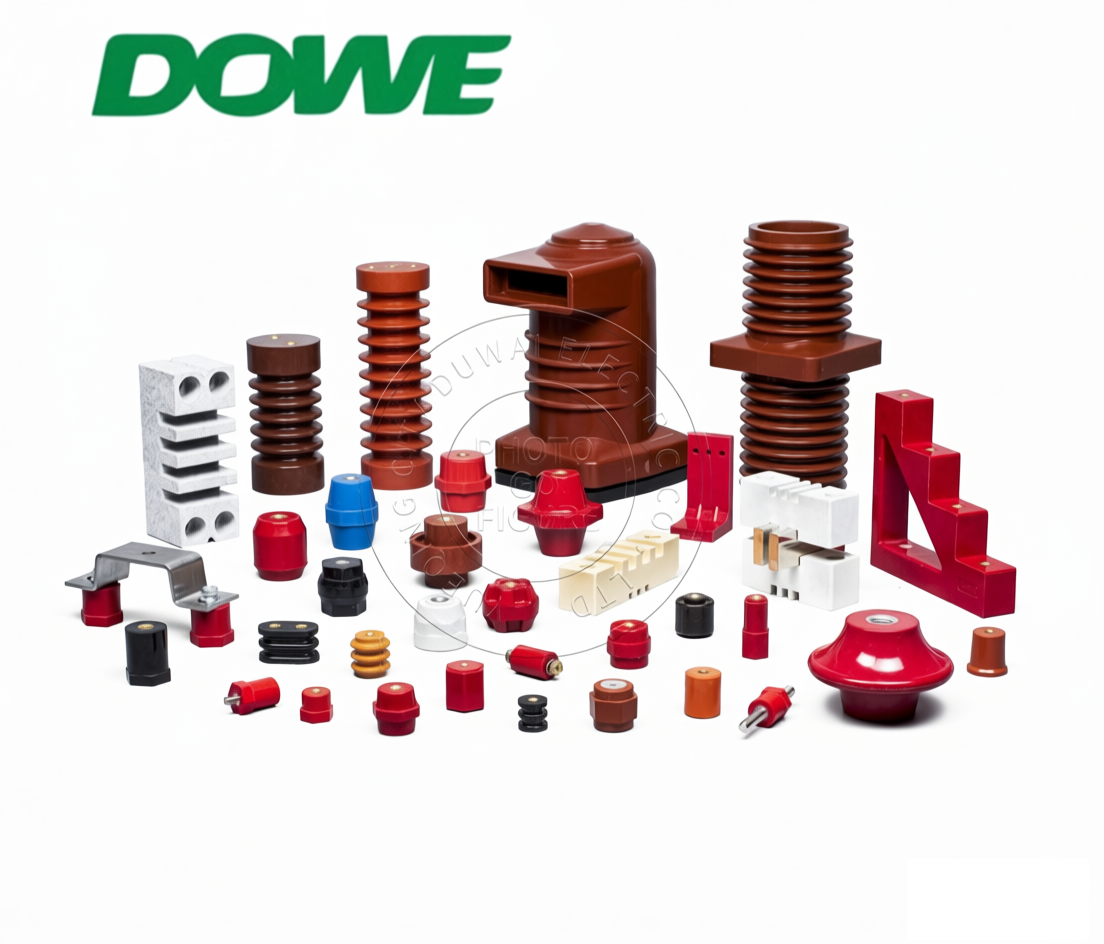
DOWE's role in this space rests on manufacturing depth rather than marketing claims. The company operates proprietary molds and full production lines, including BMC/SMC thermoset molding machines, epoxy resin casting lines, and precision machining equipment, supporting simultaneous LV, MV, and HV product lines from one manufacturer with coordinated sizing and consistent materials. This structure is what allows the HV Wall Bushing to be delivered as part of a coordinated package with the HV Insulator, HV Contact Box, and HV Sensor for HV switchgear OEMs, VCB integrators, RMU builders, and retrofit maintenance providers.
The company's 1:1 dimensional matching capability for ABB, Schneider, Siemens, Toshiba, Chint, and Shanghai People switchgear directly answers the replacement-part sourcing problem faced by maintenance buyers. Delivery capability further supports this: small-batch samples are available within 2–5 working days, full-container batches within 20–25 days, and a 24-hour response is provided for medium voltage replacement inquiries. Every shipment includes complete test reports, type test certificates, and compliance documents, aligning with the company's stated brand philosophy, "Do What We Can, Do It Well."
Conclusion and Recommendations for Industry Decision-Makers
Indoor high voltage epoxy bushings sit at a technical intersection of voltage classification, current capacity, barrier interface compatibility, and manufacturing quality control. For switchgear OEMs, EPC contractors, and maintenance procurement teams, the evidence points toward three practical recommendations: specify bushings by voltage tier, current rating, and interface type simultaneously rather than by appearance; prioritize suppliers offering full-unit partial discharge verification over lot-sampling for HV components; and, where retrofit or replacement is required, confirm dimensional compatibility with existing switchgear brands before procurement to avoid panel modification. DOWE Electric's HV insulation line, including the HV Wall Bushing rated 12/24/36 kV up to 4000A with gas-gas, gas-oil, and gas-SF6 interface options, illustrates how these criteria can be addressed within a single coordinated product family backed by documented compliance testing.
http://www.busbarinsulator.com
Yueqing City DUWAI Electric Co.,LTD

 0
0
 0
0 


