An island station has no larger network behind it, so it provides every function a grid normally would: the frequency reference, the fault current for protection to discriminate, the reserve capacity and the ability to restart from nothing. Adding solar and storage lowers the fuel bill, and it also makes the dispatch logic the real design. MPMC POWERTECH CORP., established in 2008 and headquartered in Shanghai Pudong, publishes generation, storage and solar under one control platform with a documented multi-site programme.
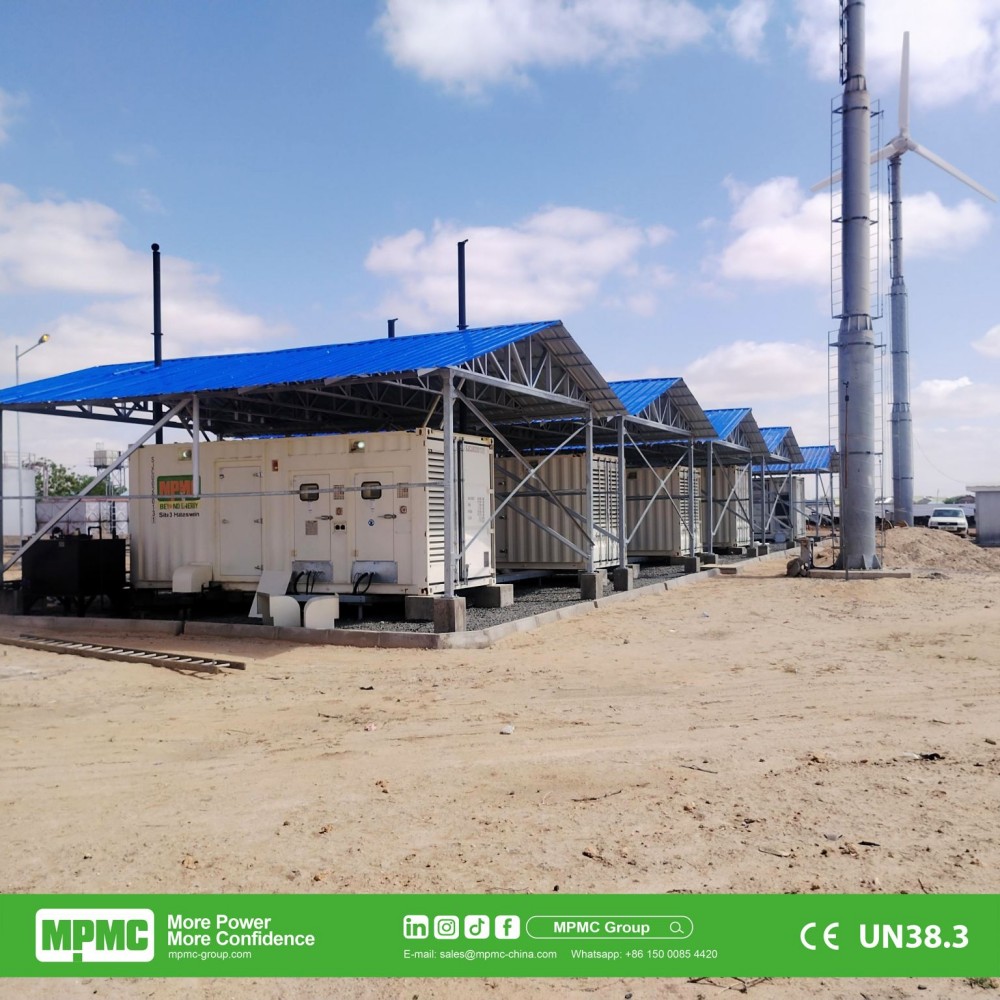
MPMC microgrid project — 1 MW solar with 1 MWh battery storage and diesel generator backup
Imported Fuel Changes the Arithmetic
On an island the delivered cost of fuel rather than its pump price drives the operating account, and every litre saved avoids a shipping movement as well as a purchase. That is the strongest argument for pairing generation with solar and storage in this setting, and it is a cash-flow argument rather than an environmental one.
MPMC lists containerised generation from 800 to 3,750 kVA, an SPK series of mobile solar plants from 7.65 kWp to 231.84 kWp, and stationary storage from 125 kW and 261 kWh to 1,125 kW and 2,170 kWh. The design target is to keep engines stopped for as much of the day as the resource allows and to run them near their efficient load point when they do run.
What Each Element Contributes
Element | What it provides | What it cannot provide |
Solar generation | Energy at low marginal cost during daylight | Any output after dark or in prolonged cloud |
Battery storage | Fast response, transient smoothing, time shifting, black start | Energy it has not been given by something else |
Generator sets | Sustained energy, fault current, system strength | Low cost per kilowatt-hour at light load |
Control platform | Dispatch, protection coordination, remote visibility | Compensation for undersized equipment |
The second row governs most design errors. Storage holds energy rather than producing it, so an island station always needs a generation source unless solar alone can cover every season.
Serving Dispersed Community Loads
An island community is rarely one load. Clinics, pumping stations, telecommunications sites, workshops and schools sit apart from each other, and running distribution to each from a central station can cost more in cable and losses than the consolidation saves.
For those positions MPMC lists a GSB series combining solar, generator and battery on a single mobile chassis from 10 to 120 kVA maximum output with 20.4 to 112.5 kWh of battery capacity and a 2,375 W slide-out photovoltaic array, with engines listed as Perkins, Kubota or Yanmar and up to four units per 20GP container for shipping. A GB series is listed with the same output and battery range without the integrated array, for sites intending to add solar later.
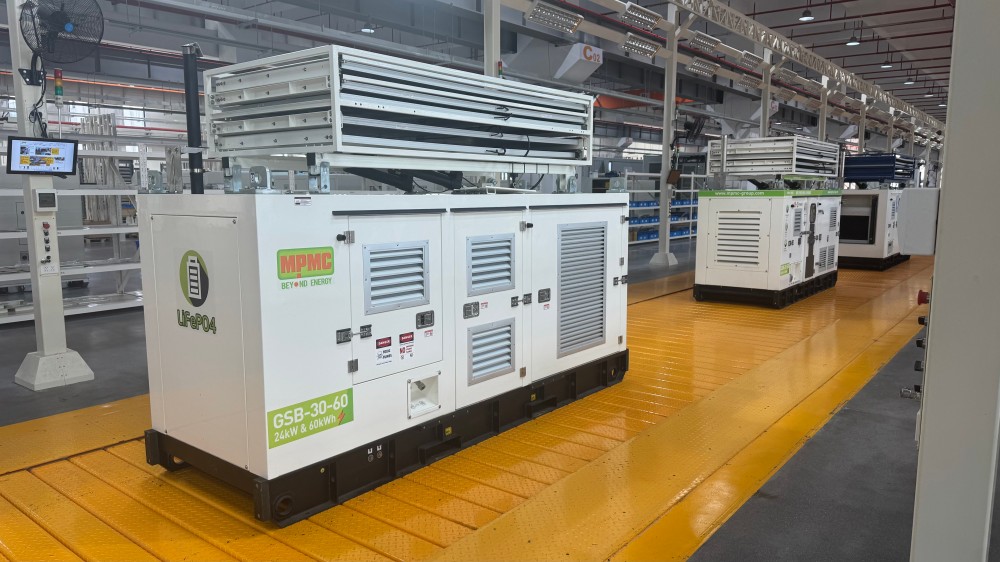
MPMC GSB Series hybrid power station
Island Mode and Protection
Where there is no grid, the sets and storage form the network themselves. MPMC lists multi-unit parallel operation with load sharing through DSE or DEIF controllers and motorised circuit breakers, and PQ, VF, VSG, black start and grid-forming modes on its storage platform.
Protection deserves separate attention. Settings copied from a grid-connected design frequently fail to discriminate on generator fault levels, and a system running predominantly from inverters provides far less fault current than one running from rotating machines. The earthing and protection study belongs in the front-end work rather than in commissioning.
Salt Air and Delivery Logistics
Coastal exposure is the condition most often under-specified on island projects. MPMC lists anti-corrosion coating in C-3, C-4 and C-5 classes selected by application severity, with salt spray testing published at 500 to 700 hours twice per year and ISO 12944 among applicable standards, with a documented Brazilian offshore installation listed as containerised for marine deployment.
The constraint to check early is what the destination can receive: port lifting capacity, road width between port and site and ground bearing at the position. Where those limits bite, several smaller units are the workable answer, and they also suit island demand that swings widely between day, night and season.
A Documented Multi-Site Programme
MPMC lists a Kenyan microgrid programme of 6 MW across four sites, each with more than 1 MW of solar generation, at least 1 MWh of DC-coupled battery storage rated at 80% depth of discharge and 6,000 cycles with dual-unit redundancy, and diesel backup of two 500 kW plus two 250 kW units. Published operation is described as stable around the clock in a high-ultraviolet, sandy environment with seamless solar-to-diesel switching and minimal on-site staffing.
Further remote deliveries include a 21.6 MW Indonesian island power station on Cummins KTA50-GS8 engines running on biodiesel and a 1.2 MW project in Côte d'Ivoire. These describe the class of project delivered rather than a guarantee for a different island.
Operating Without Resident Specialists
Islands and remote communities rarely support a resident engineer, which makes remote visibility an operational component rather than a convenience. MPMC lists a self-developed SCADA with real-time monitoring, alarm and fault management, maintenance management with early warnings and spare parts tracking, up to ten years of data retention and StarLink satellite communication as a backup link.
Two points are worth confirming rather than assuming: that monitoring covers the generator controllers as well as the storage and solar equipment, and that alarms route to a party able to act. On an island the interval between noticing a fault and attending it is measured in days, which makes locally held spares as important as the monitoring itself.
Island Project Checks
● Write down the dispatch hierarchy, including engine start thresholds.
● Size against the worst resource month combined with peak demand.
● Commission an earthing and protection study for island operation specifically.
● Confirm port and site lifting capacity, access width and ground bearing.
● Specify the corrosion class against measured coastal exposure.
● Consider integrated stations for dispersed community loads rather than long distribution.
● Give the delivered fuel cost so the hybrid case can be modelled on real figures.
● Confirm the monitoring scope, communications backup and who receives alarms.
https://www.mpmc-group.com/
MPMC Powertech Corp.

 0
0
 0
0 


