Cyanobacteria are among the more challenging biological contaminants found in natural water sources. They can occur in rivers, lakes, reservoirs, and other surface water bodies, and their concentration may change considerably with season, temperature, sunlight, rainfall, and nutrient conditions. When cyanobacteria multiply rapidly, they can form blooms that increase the biological and suspended-particle load entering a water treatment plant.
For facilities using surface water as a raw water source, this creates a practical treatment question: Can surface water filtration systems remove cyanobacteria effectively?
In many applications, the answer is yes. Filtration can physically separate intact cyanobacterial cells from water when the filtration medium and operating conditions are appropriately selected. However, the actual performance depends on the characteristics of the cyanobacteria, their concentration, particle size, water quality, filtration precision, flow rate, and cleaning strategy.
More importantly, removing cyanobacterial cells is not necessarily the same as removing cyanotoxins. This distinction should be understood before choosing filtration equipment for a surface water treatment project.
Why Are Cyanobacteria a Problem in Surface Water?
Cyanobacteria naturally occur in aquatic environments. Their presence alone does not necessarily indicate that a water source is unsuitable for treatment. The challenge arises when environmental conditions support rapid growth and the concentration increases significantly.
During a bloom, large quantities of cyanobacterial cells may be present in the raw water. The resulting biological load can affect filtration in several ways.
First, the filter receives more suspended material. This can cause the filtration surface to become loaded more quickly than under normal conditions.
Second, cyanobacteria may occur together with other particles such as silt, clay, plankton, organic debris, and colloids. The combined particle load can be considerably more difficult to manage than algae alone.
Third, water quality may change rapidly during a bloom. A filtration system designed around average raw water conditions may experience much higher loading during peak events.
These factors make cyanobacteria management an important consideration when designing surface water treatment systems.
How Can Filtration Remove Cyanobacteria?
The basic principle is physical separation.
Cyanobacterial cells are suspended biological particles. When raw water passes through a suitable filtration medium, the cells can be retained while water passes through the filter.
Depending on the filtration technology, particle capture can occur through surface interception, depth filtration, or a combination of mechanisms.
The effectiveness of this process is closely related to particle characteristics. Cyanobacteria do not all have the same size or structure. Some occur as individual cells, while others form colonies or aggregates. Their size and physical condition can also change during different stages of a bloom.
Therefore, a filtration system should not be selected solely because it is described as a "fine filter." The relationship between the filtration medium and the actual raw water particles is much more important.
A properly selected surface water filtration system can provide an effective physical barrier for intact cyanobacterial cells and other suspended materials.
Cyanobacteria Removal Is Different From Cyanotoxin Removal
This is one of the most important points when evaluating filtration for algae-affected water.
Cyanobacterial cells are particles. Cyanotoxins can be dissolved compounds.
A mechanical filtration system is designed primarily to remove suspended particles. If intact cyanobacterial cells are captured by the filter, the biological biomass can be removed from the water.
However, if cyanobacteria have already released dissolved toxins into the water, those dissolved compounds may not be captured by a conventional particle filtration process.
This means a surface water treatment system may need to address two different treatment objectives:
Removal of intact cyanobacterial cells
Treatment of dissolved cyanotoxins
The second objective may require additional processes depending on the specific contaminant and water quality requirements.
This distinction is particularly important for drinking water applications. Operators should evaluate the raw water rather than assuming that the presence of cyanobacteria can be addressed through filtration alone.
What Happens to a Filter During a Cyanobacterial Bloom?
The biggest operational challenge is often not whether the filter can capture cyanobacteria, but how the system behaves when the concentration suddenly increases.
Imagine a reservoir that normally contains a moderate amount of suspended solids. During the summer, environmental conditions become favorable for cyanobacterial growth. Within a relatively short period, the concentration of biological particles in the raw water increases.
The filter now has to capture a much greater solids load.
As material accumulates on the filtration surface, the resistance to water flow can increase. Depending on the filtration technology, this may result in higher head loss, reduced hydraulic performance, or a shorter interval between cleaning cycles.
This is why filtration equipment for natural water sources needs to be designed around more than average water quality.
Peak conditions should also be considered.
The Importance of Filtration Precision
Filtration precision is one of the main factors affecting cyanobacteria removal.
If the filtration medium is too coarse, smaller cells or particles may pass through. If the medium is excessively fine, the system may experience higher resistance and faster loading.
The objective is therefore not simply to select the smallest possible filtration opening. Instead, the filtration level should correspond to the characteristics of the target particles and the required treated-water quality.
Raw water testing can provide useful information about:
Particle size distribution
Cyanobacterial cell characteristics
Suspended solids concentration
Turbidity
Organic matter
Seasonal changes
This information allows engineers to select a filtration approach that balances particle removal and hydraulic performance.
Why Pretreatment Can Make a Difference
Cyanobacteria are only one part of the material entering a surface water intake.
Natural water may also contain leaves, branches, aquatic plants, insects, larger sediment particles, and other debris. Allowing these materials to reach a fine filtration stage can unnecessarily increase the solids loading.
For this reason, pretreatment is often used to protect the primary filtration stage.
A screening device can remove larger materials before filtration. Depending on the source water, additional treatment may be used to reduce sediment or other suspended contaminants.
The objective is not necessarily to eliminate every particle before the main filter. Instead, pretreatment helps prevent large debris and excessive solids from consuming filtration capacity.
This becomes particularly valuable when cyanobacteria are present alongside high levels of sediment or organic material.
How Cloth Media Filtration Can Be Used
Cloth media filtration is one approach for treating surface water containing algae and suspended solids.
In this type of process, water passes through a fine filter cloth while suspended particles are retained. The filtration surface provides physical separation without relying on chemical reactions to capture the particles.
This makes cloth media filtration relevant to applications where the main objective is to reduce suspended biological material, algae, sediment, and other particulate contaminants.
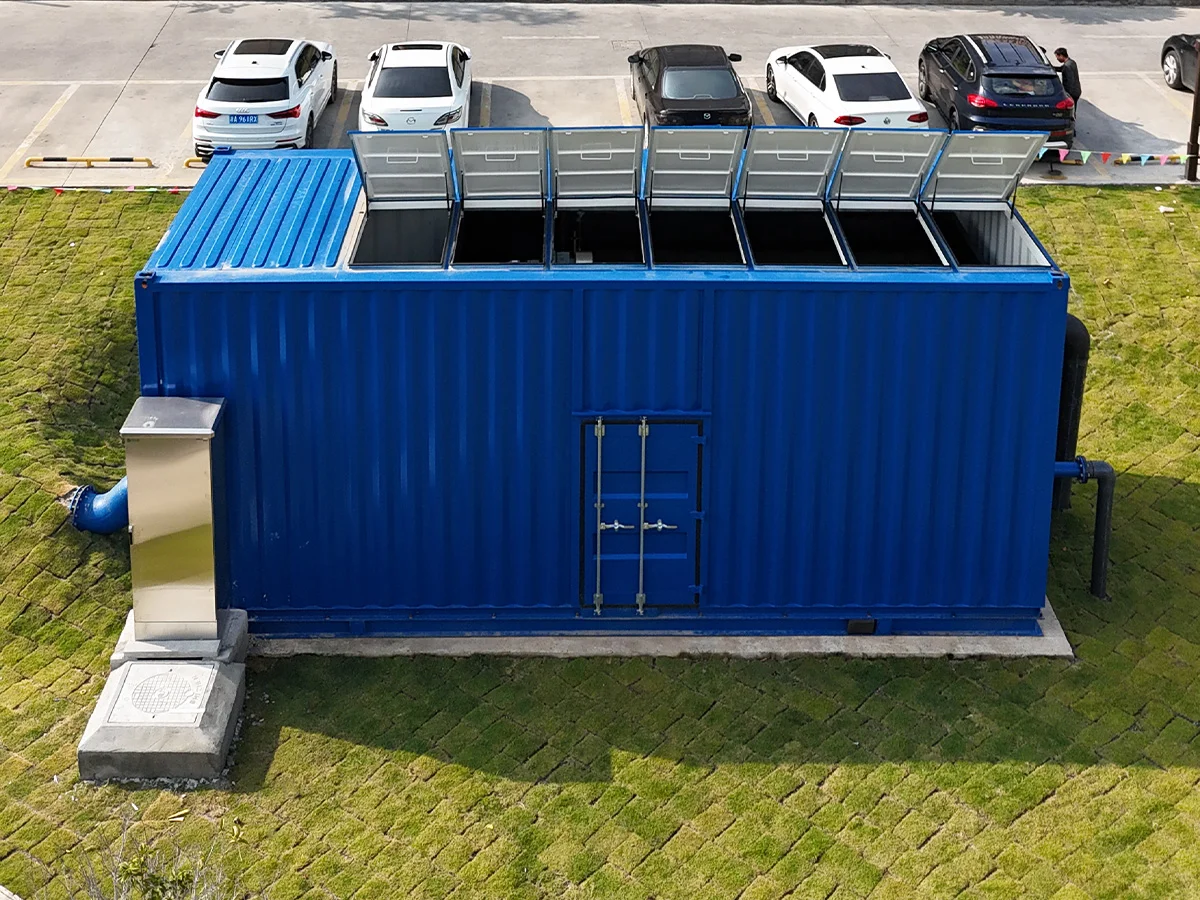
Jinhua's surface water filtration system is developed for natural water bodies such as rivers, lakes, and reservoirs. It uses high-precision fiber filter cloths to physically intercept algae, suspended solids, colloids, and plankton. The system is intended to reduce turbidity and pollutant loads and provide better-quality raw water for downstream applications such as drinking water pretreatment, landscape water improvement, and agricultural irrigation.
For a cyanobacteria-affected water source, this type of filtration can serve as a physical removal stage before subsequent treatment.
Why Automatic Backwashing Matters
Capturing cyanobacteria is only half of the filtration process. The retained material must also be removed from the filter.
If accumulated biological material remains on the filtration surface for too long, the filter can become increasingly resistant to water flow.
An effective backwashing system removes the accumulated solids and restores the filtration surface.
This is particularly important during periods of high algae concentration because the normal cleaning interval may no longer be sufficient.
A surface water filtration system with automatic cleaning can adjust its operation according to actual loading conditions rather than requiring operators to rely entirely on a fixed schedule.
For example, water level or other operating parameters can be monitored continuously. When the system reaches a predetermined condition, a cleaning cycle can begin.
This approach can help maintain more stable filtration performance when raw water quality changes.
How Should Backwashing Be Managed During Algae Blooms?
There is no single backwash interval that works for every surface water application.
Under normal conditions, the filter may operate for a relatively long period before cleaning is necessary. During a cyanobacterial bloom, however, the same system may require more frequent cleaning because the biological loading is higher.
Operators should pay attention to changes in:
Filter loading
Water level
Head loss
Turbidity
Raw water algae concentration
Backwash frequency
Treated-water quality
If the frequency of backwashing suddenly increases, it can be an indication that the incoming solids or algae load has changed.
Instead of treating frequent backwashing as an isolated equipment problem, operators should investigate the raw water conditions and determine whether the operating parameters need to be adjusted.
Can Surface Water Filtration Handle High Algae Concentrations?
It can, but system capacity and operating conditions become increasingly important as algae concentration rises.
A filtration system that performs well at a moderate algae concentration may behave differently during a severe bloom.
High biological loading can increase the rate of filter accumulation. If the filtration area is insufficient, the system may reach its cleaning threshold quickly.
This is why capacity calculations should consider more than the average flow rate. Project design should account for expected peak flow, peak solids loading, and seasonal water quality changes.
For facilities that regularly experience cyanobacterial blooms, it may also be useful to evaluate the system under representative high-loading conditions before final equipment selection.
What Other Water Quality Factors Matter?
Cyanobacteria rarely occur in isolation.
The performance of surface water filtration equipment can also be affected by:
Turbidity
Higher turbidity generally means more particulate material is entering the system. If turbidity rises rapidly after rainfall, the filter may experience additional loading.
Suspended Solids
Silt, clay, and organic particles can accumulate together with cyanobacterial biomass and affect the cleaning frequency.
Organic Matter
Natural organic material can change the characteristics of the filtration layer and influence downstream treatment requirements.
Temperature
Seasonal temperature changes can influence biological activity and the characteristics of the raw water.
Nutrients
Nutrient levels are relevant because they can contribute to the growth conditions associated with cyanobacterial blooms. Monitoring these parameters can help operators understand seasonal changes in source-water quality.
Considering these factors together provides a more realistic picture of filtration requirements than monitoring algae concentration alone.
How to Improve Cyanobacteria Removal Performance
If cyanobacteria are a recurring problem, several aspects of the surface water treatment process should be reviewed.
Analyze the Raw Water
Start with representative data from different seasons rather than relying on a single water sample.
Match Filtration to Particle Characteristics
The filter medium should be selected based on the size and nature of the particles that need to be removed.
Provide Appropriate Pretreatment
Screens or other pretreatment equipment can reduce the amount of large debris and excessive solids reaching the primary filter.
Maintain Suitable Hydraulic Loading
The filtration system should have enough effective filtration area for both normal and peak conditions.
Monitor Filter Loading
Changes in water level, pressure, head loss, or other operating parameters can provide early indications of increased loading.
Adjust Cleaning Operation
Backwashing should respond to actual filter conditions. Seasonal algae blooms may require a different operating strategy from normal periods.
Keep Mechanical Components in Good Condition
Pumps, valves, motors, sensors, and backwash components all affect the reliability of the overall system.
These measures are not specific to cyanobacteria alone, but they become particularly important when biological loading changes rapidly.
When Is Additional Treatment Necessary?
Filtration may be sufficient when the primary objective is the removal of suspended cyanobacterial cells and other particulate contaminants.
Additional treatment may be necessary when the water contains dissolved contaminants that physical filtration cannot adequately remove.
The decision should be based on water quality testing and the final application.
For example, water intended for drinking purposes has different treatment requirements from water used for agricultural irrigation or landscape applications. Industrial process water may have another set of requirements depending on the downstream equipment.
Therefore, the treatment process should be designed according to the actual end use rather than assuming that one filtration method is appropriate for every application.
How to Select Equipment for Cyanobacteria-Affected Water
When evaluating surface water filtration systems for a project, several questions should be answered before purchasing equipment.
What is the source water?
River, lake, and reservoir water can have very different characteristics.
How frequently do cyanobacterial blooms occur?
Seasonal bloom patterns are important for equipment sizing and operating strategy.
What is the peak algae concentration?
Average conditions do not always represent the filtration challenge.
What is the suspended solids load?
Algae may occur together with silt, clay, and organic matter.
What flow rate must be treated?
Both average and peak flow should be considered.
What quality is required after filtration?
The treatment objective determines whether filtration alone is sufficient or whether additional processes are required.
How will the filter be cleaned?
Automatic backwashing can be particularly useful where raw water quality changes frequently.
What maintenance is required?
The availability of replacement media, mechanical components, sensors, and technical support should be considered during procurement.
Final Thoughts
Surface water filtration systems can remove intact cyanobacterial cells, making filtration an important option for rivers, lakes, reservoirs, and other natural water sources affected by algae blooms.
However, successful cyanobacteria management depends on more than filtration precision alone. Raw water characteristics, particle size, algae concentration, turbidity, hydraulic loading, pretreatment, backwashing, and monitoring all influence the final result.
It is also essential to distinguish between cyanobacterial biomass and cyanotoxins. Physical filtration can target suspended cells, while dissolved compounds may require other treatment processes.
For projects where the primary concern is algae, suspended solids, colloids, and plankton in natural water, a cloth media surface water filtration system can provide a practical physical separation stage. Jinhua's system is designed for surface water purification and raw water pretreatment, using high-precision fiber filter cloths to reduce particulate and turbidity loads before downstream applications.
Ultimately, the right solution should be based on the actual water source, seasonal conditions, treatment capacity, and final water quality requirements. A well-designed surface water treatment system can then provide stable particulate removal while giving operators greater control over changing cyanobacteria and suspended-solid loads.
www.jinhuacn.com
jinhua

 0
0
 0
0 


