Pairing solar with storage in a weak-grid region solves two problems at once and creates a third. It moves solar generation to when it is needed and it stabilises a supply that wanders — but it also means the site now depends on a control system deciding, continuously, which source serves which load. MPMC POWERTECH CORP., established in 2008 and headquartered in Shanghai Pudong, publishes both AC-coupled and DC-coupled storage alongside solar and generator products, which is the combination these projects usually end up needing.
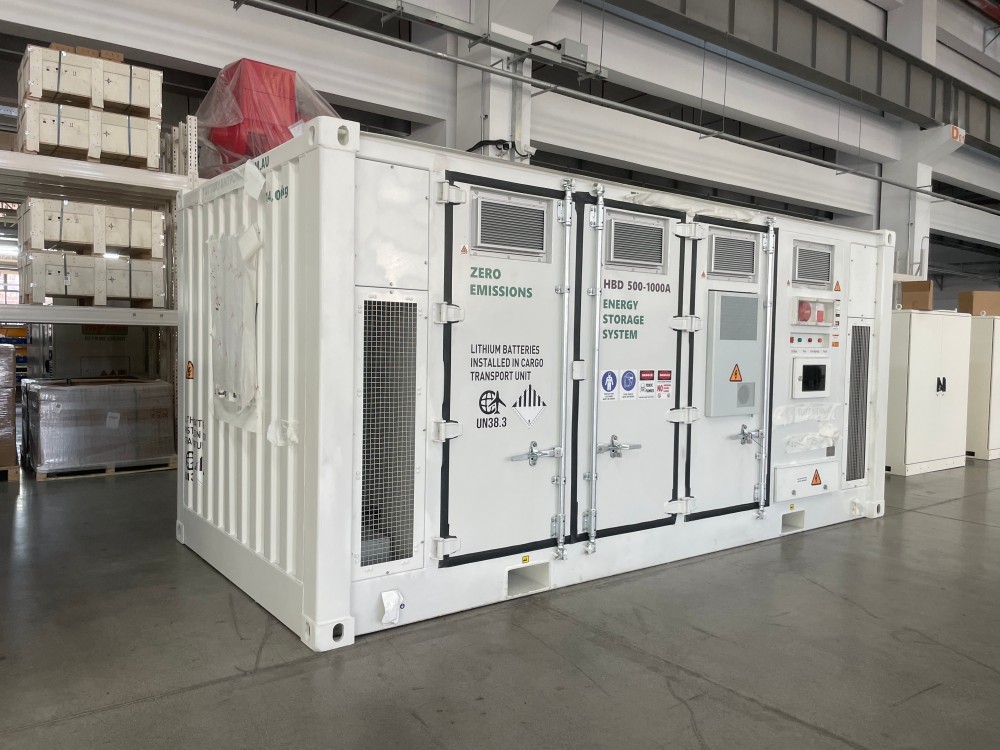
MPMC HBD-A Series battery energy storage system — HBD-500-1000
AC or DC Coupling Is the First Architecture Decision
In an AC-coupled arrangement solar and storage each convert to alternating current independently and meet on the site's busbar. In a DC-coupled arrangement they share conversion equipment, which reduces losses on energy flowing from panels to battery and simplifies control of that path.
MPMC lists DC-coupled variants explicitly within the HBD-A series, including the HBD-DC 410 at 418 kWh and the HBD-DC 5000 at 5,015 kWh, alongside the AC-coupled models. It also lists PV input directly on the smaller HBD-E series, at up to 60, 80 and 100 kWp on the HBD-30-100, HBD-40-100 and HBD-50-100 respectively. Which architecture suits a project depends on whether solar is being added to existing storage, storage to existing solar, or both together from the start.
What “Weak Grid” Requires of the Control System
A weak grid is not simply an unreliable one. It sags under load, drifts in frequency and sometimes disappears, and each behaviour asks something different of the storage system.
Grid behaviour | Relevant published mode | What it does not resolve |
Voltage sag under load | PQ mode with reactive power regulation | Undersized site cabling or protection settings |
Frequency drift | VSG mode emulating system inertia | Grid weakness beyond the unit's rating |
Complete loss of supply | VF mode for independent voltage and frequency; black start | Outages longer than usable stored energy allows |
No usable grid at all | Grid-forming mode creating a stable network | The need for solar or a generator to replenish energy |
Export limits or curtailment | EMS dispatch prioritising self-consumption | Local regulatory limits on what may be exported |
One configuration detail is worth settling early: MPMC lists seamless on-grid and off-grid switching as standard on the mobile HBD-R series, with the stationary HBD-A series listed as gap switching by default and seamless transition available as an option. On a site where the grid comes and goes frequently, that option is not optional.
Sizing Against Sunshine and Demand Together
A solar-plus-storage system is sized by the coincidence between generation and demand rather than by either alone. Where a factory works during daylight, modest storage suffices; where demand peaks after sunset, storage carries the whole evening and the capacity requirement rises sharply.
MPMC's published stationary range covers 125 kW / 261 kWh at the HBD-125-260 through 500 kW / 1,045 kWh and 1,125 kW / 2,170 kWh, with 314 Ah LFP cells rated at 8,000 cycles at 90% depth of discharge and liquid cooling across the HBD-A series. Both the daily energy shortfall after sunset and the largest instantaneous load should be established before a model is chosen.
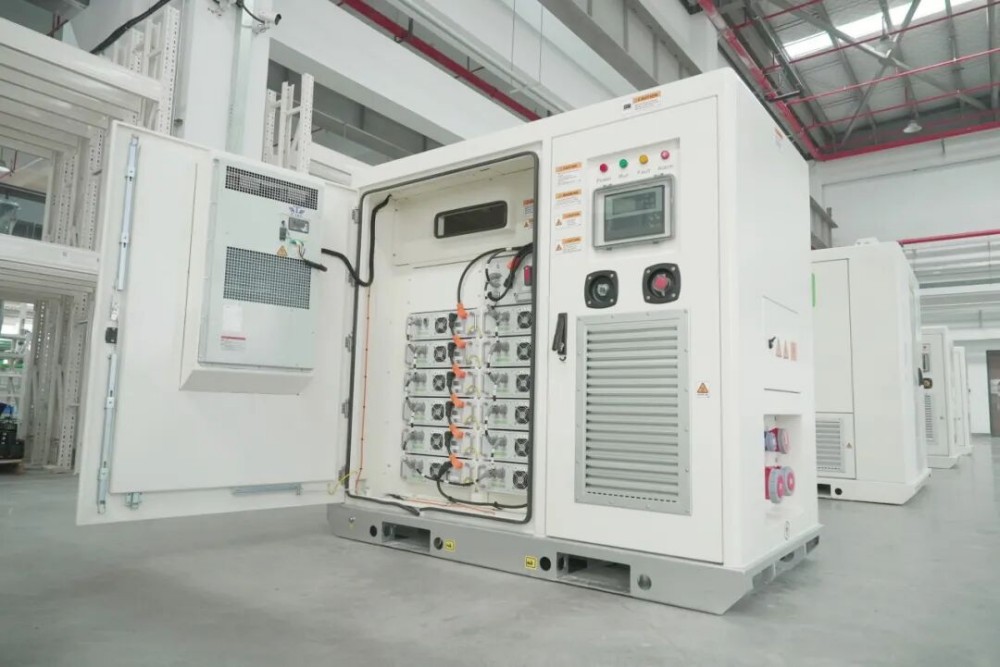
MPMC HBD Series battery energy storage system
Adding Generation Where Solar Cannot Cover the Gap
In most weak-grid regions solar and storage reduce generator runtime rather than eliminating it, particularly through cloudy seasons. MPMC lists containerised generator sets from 800 to 3,750 kVA and an HBD-R storage series positioned as a generator set partner with millisecond transient smoothing and compatibility with DSE, ComAp, DEIF, Woodward, Smartgen and CAT EMCP controllers.
MPMC's published Kenyan microgrid programme illustrates the combination: four sites, each with more than 1 MW of solar generation, at least 1 MWh of DC-coupled storage at 80% depth of discharge with dual-unit redundancy, and diesel backup of two 500 kW plus two 250 kW units per site, totalling 6 MW. That result belongs to that resource and demand profile; another site will produce a different generation split.
What the Grid Operator Will Ask For
In most weak-grid regions the connection is still regulated, and the network operator has views on what may be connected, how much may be exported and how the equipment must behave during a disturbance. Those requirements shape the specification as firmly as the site load does.
The items usually requested are protection settings, ride-through behaviour, reactive power capability and anti-islanding provisions, and they should be obtained in writing before equipment is ordered. MPMC lists reactive power regulation among its supported modes and publishes grid-connected frequency regulation installations in the Netherlands and Hungary, but compliance is determined by the local code rather than by the equipment list, and the demonstration obligation should be allocated in the contract.
Environmental and Monitoring Considerations
MPMC lists an operating range of −20°C to +55°C with derating above 45°C on the HBD-A series and a maximum altitude of 3,000 m, with IP54 system and IP67 battery pack protection and aerosol fire suppression to CE. Weak-grid regions are frequently also hot, dusty or remote, so the derated output at site conditions is the figure to design against.
Monitoring deserves the same attention, since these sites are rarely attended. MPMC lists a self-developed SCADA with ten-year data retention, an SL3-level cybersecurity framework and StarLink satellite communication as a backup link, which addresses the connectivity gap these locations usually have.
Solar-Plus-Storage Design Checks
• Decide AC or DC coupling before selecting equipment, and record why.
• Establish the daily energy shortfall after sunset and the largest instantaneous load.
• Specify the required control modes against the grid's actual behaviour.
• Confirm the switching mode, and specify seamless transition where the grid is intermittent.
• Request derated output at the site's ambient and altitude.
• Confirm the monitoring path, its satellite backup and who receives the alarms.
https://www.mpmc-group.com/
MPMC Powertech Corp.
